Aix Marseille Univ, INSERM, IRD, SESSTIM, Sciences Economiques and Sociales de la Santé and Traitement de l'Information Médicale, Aix Marseille Institute of Public Health ISSPAM, Marseille, France.
ANRS-MIE, University of Health Sciences, Phnom Penh, Cambodia.
Front Public Health. 2024 Mar 27;12:1359363. doi: 10.3389/fpubh.2024.1359363. eCollection 2024.
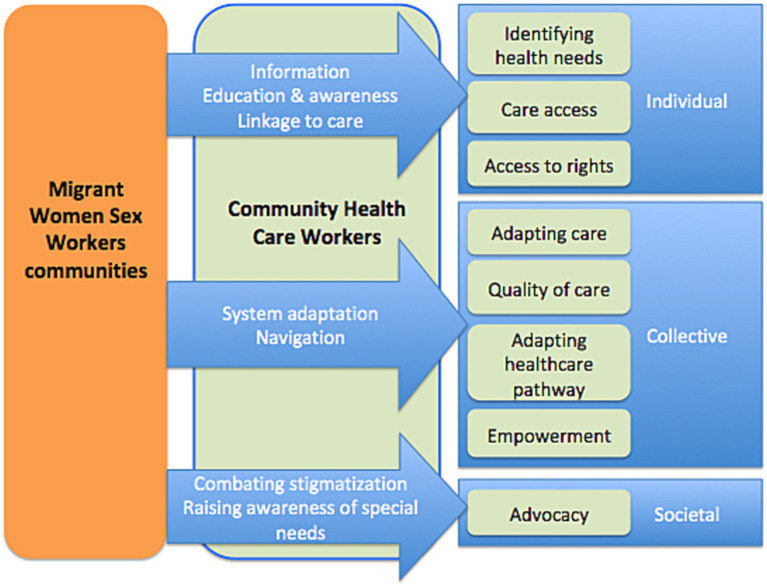
Given the high infection rate of sexually transmitted infections (STI) among migrant women sex workers (WSWs), it is necessary to understand how to improve prevention, information and care for this vulnerable population. Community health workers (CHWs), by linking community to health services, are positioned to improve health outcomes in migrant communities. This article aims to describe a pilot innovative intervention performed by CHWs to improve sexual health in migrant WSWs.
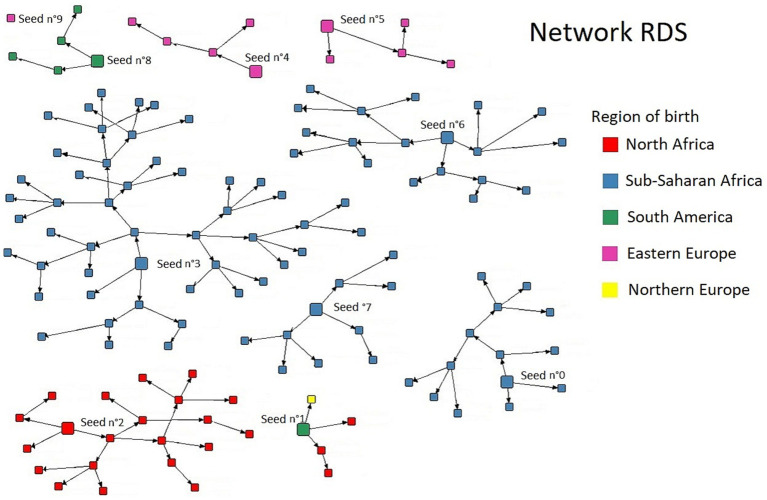
This one-year intervention study used a respondent-driven sampling (RDS) to recruit a representative cohort of migrant WSWs in Marseille, France. Four CHWs were recruited from different communities and participated in all stages of the research. They performed individual and group interventions of prevention, support in care and empowerment. Data on participant characteristics, type of intervention and adherence to the intervention were reported via questionnaires given to participants. Simultaneously, semi-structured interviews and informal interviews of migrant WSW, CHWs and care providers were carried out.
A total of 132 migrant WSWs were included in the cohort. Very few of them knew about PrEP (12%) or already used HIV post-exposure treatment (9%). Migrant WSWs were often victims of rape or racism, 15 and 21%, respectively. In two-thirds of cases the level of health literacy was low. Participants suffered from a combination of vulnerability factors: difficulties with access to social rights, food or housing. Only 13% reported having benefited from medical follow-up or assistance by an NGO in the 3 months prior to the program. By 3 months, more than one third of the participants had been tested for HIV (35%) and 63% knew about PrEP. A total retention rate of 70% was reported in the cohort after 6 months.
CHWs enabled to improve care access for migrant WSWs by improving the collaboration between care and social actors at a local level. Through these "bring-back-to" interventions for this hard-to-reach population, CHWs enabled an optimization of the care pathway. Our results also highlight the importance of a population-based approach for individual and group support of empowerment interventions in order to strengthen their capacity for action.
鉴于性传播感染(STI)在移民性工作者(WSW)中的高感染率,有必要了解如何改善这一弱势群体的预防、信息和护理工作。社区卫生工作者(CHWs)通过将社区与卫生服务联系起来,能够改善移民社区的健康状况。本文旨在描述 CHWs 为改善移民 WSW 的性健康而进行的一项试点创新干预措施。
这项为期一年的干预研究使用响应驱动抽样(RDS)招募了法国马赛的代表性移民 WSW 队列。从不同社区招募了 4 名 CHWs 并参与了研究的所有阶段。他们对预防、护理支持和赋权进行了个人和团体干预。通过向参与者发放问卷,报告参与者特征、干预类型和对干预的依从性数据。同时,对移民 WSW、CHWs 和护理提供者进行了半结构化访谈和非正式访谈。
共有 132 名移民 WSW 纳入了队列。其中很少有人了解 PrEP(12%)或已经使用过 HIV 暴露后治疗(9%)。移民 WSW 经常遭受强奸或种族主义的侵害,分别占 15%和 21%。三分之二的人健康素养水平较低。参与者遭受多种脆弱因素的困扰:难以获得社会权利、食物或住房。在方案启动前的 3 个月内,只有 13%的人报告曾接受过医疗随访或 NGO 的援助。3 个月后,超过三分之一的参与者接受了 HIV 检测(35%),63%的人了解 PrEP。在 6 个月后,队列的总体保留率为 70%。
CHWs 通过改善当地护理和社会行为者之间的合作,使移民 WSW 更容易获得护理。通过这些针对难以接触人群的“带回”干预措施,CHWs 优化了护理途径。我们的研究结果还强调了基于人群的方法的重要性,这种方法可以为个人和团体提供赋权支持干预,以增强他们的行动能力。