Centre for Public Health, Queen's University Belfast, Belfast BT12 6BA, UK.
Department of Cancer Control and Population Health, National Cancer Center Graduate School of Cancer Science and Policy, Goyang 10408, Korea.
J Public Health (Oxf). 2023 Nov 29;45(4):e702-e713. doi: 10.1093/pubmed/fdad143.
The aim of this scoping review was to identify key research gaps and priorities in order to advance policy and practice for people living with cancer in the UK.
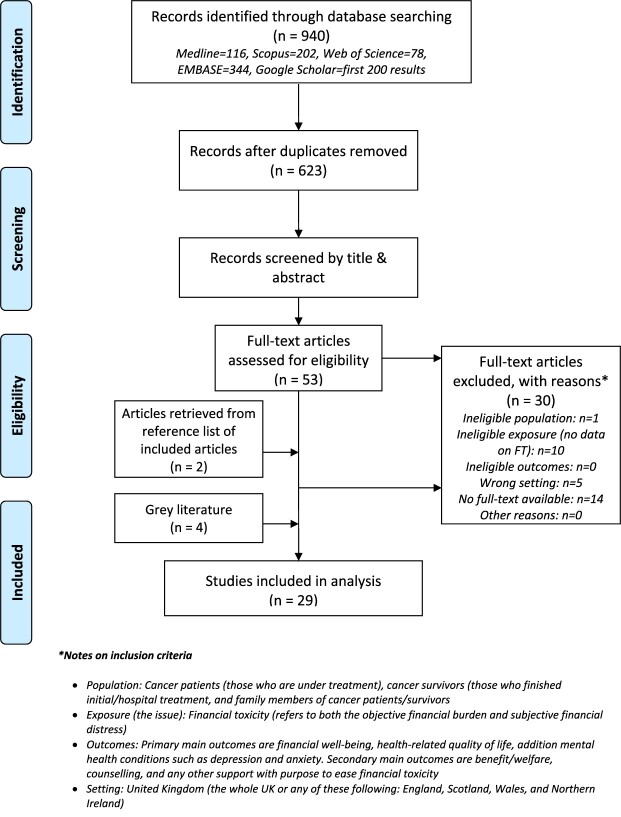
The review adhered to PRISMA guidelines for scoping review. We searched MEDLINE, EMBASE, Scopus, Web of Science and Google Scholar on 16 July 2022. There were no restrictions in terms of study design and publication time; gray literature was included. The key words, 'financial' or 'economic', were combined with each of the following words 'hardship/stress/burden/distress/strain/toxicity/catastrophe/consequence/impact.'
29/629 studies/reports published during 1982-2022 were eligible to be included in the review. No study conducted a comprehensive inquiry and reported all aspects of financial toxicity (FT) or used a validated measure of FT. The most three commonly reported outcomes related to financial hardship were financial well-being (24/29), benefit/welfare (17/29) and mental health status (16/29).
It is evident that FT is experienced by UK cancer patients/survivors and that the issue is under-researched. There is an urgent need for further research including rigorous studies which contribute to a comprehensive understanding about the nature and extent of FT, disparities in experience, the impacts of FT on outcomes and potential solutions to alleviate FT and related problems.
本范围综述旨在确定关键的研究差距和优先事项,以推动英国癌症患者的政策和实践。
本综述遵循 PRISMA 指南进行范围综述。我们于 2022 年 7 月 16 日在 MEDLINE、EMBASE、Scopus、Web of Science 和 Google Scholar 上进行了检索。研究设计和出版时间没有限制;包括灰色文献。关键词“财务”或“经济”与以下每个词“困难/压力/负担/痛苦/紧张/毒性/灾难/后果/影响”相结合。
1982-2022 年期间发表的 29/629 项研究/报告符合纳入本综述的条件。没有研究进行全面调查并报告财务毒性(FT)的所有方面,也没有使用经过验证的 FT 衡量标准。最常报告的与财务困难相关的三个结果是财务幸福感(24/29)、福利/福利(17/29)和心理健康状况(16/29)。
显然,英国癌症患者/幸存者经历了财务毒性,而且这个问题的研究还不够充分。需要进一步研究,包括有助于全面了解财务毒性的性质和程度、体验差异、财务毒性对结果的影响以及缓解财务毒性和相关问题的潜在解决方案的严格研究。