Centre for Motivation and Health Behaviour Change, Department for Health, University of Bath, Bath, BA2 7AY, UK.
Research Institute for Care of Older People, The RICE Centre, Royal United Hospital, Combe Park, Bath, BA1 3NG, UK.
BMC Geriatr. 2023 Aug 4;23(1):471. doi: 10.1186/s12877-023-04169-6.
Finding innovative yet feasible ways of preventing physical and cognitive decline in those at risk is a critical global challenge, with exercise being championed as a key precursor to robust health in later life. Exercise snacking, here defined as short bouts of sporadic [muscle-strengthening] exercise, is one such strategy designed to overcome typical participation barriers observed in older adults. This study examined the acceptability of exercise snacking amongst pre-frail older adults and explored the efficacy of this approach in improving physical function.
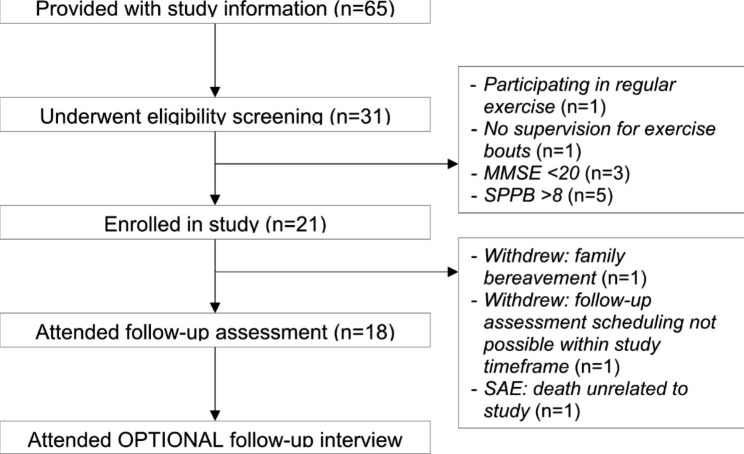
In this single group design, 21 pre-frail outpatients with mild-cognitive impairment were recruited from a UK memory clinic. To be eligible, participants were aged ≥ 65-years who scored 3-8 (inclusive) on the short physical performance battery (SPPB) and were not regularly engaging in sport or exercise. Participants completed a 28-day, twice daily, exercise snacking intervention, consisting of five muscle-strengthening exercises, with the aim being to complete as many repetitions as possible of each exercise in a minute. Acceptability of the intervention was measured quantitatively and qualitatively using a survey and topic guide informed by the Theoretical Framework of Acceptability. Pre- and post-intervention physical function was measured using the SPPB, timed up-and-go (TUG), and 60s standing balance and sit-to-stand tests.
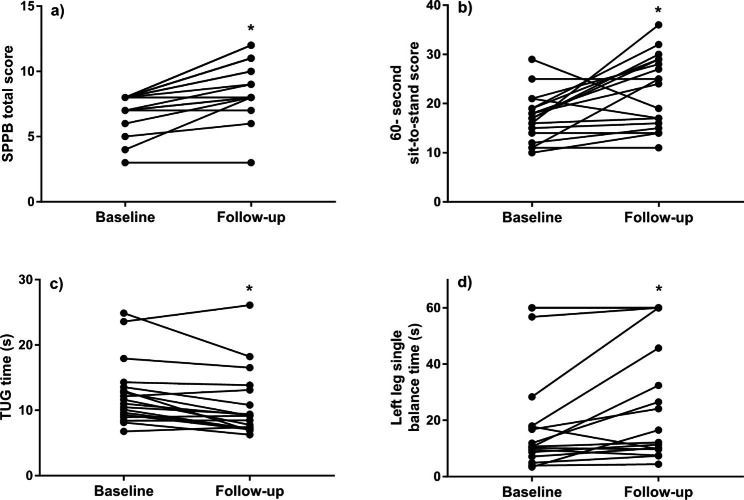
Eighteen participants provided follow-up data and showed 85% adherence to the exercise snacking intervention, measured as the proportion of all sessions completed out of a possible 56. Participants rated the intervention as highly acceptable (4.6/5) suggesting it supported their self-efficacy (4.3/5) was enjoyable (4.1/5) and had a low burden (2.1/5). Qualitative findings suggested the ease of use, flexibility of the programme, and perceived effectiveness was important, and particularly useful for non-exercisers. Changes in SPPB score (8(1) vs. 9(3), p < 0.01), TUG (11.32(4.02) vs. 9.18(5.25) seconds, p < 0.01) and in the 60-second sit-to-stand test (17 ± 5 vs. 23 ± 7 repetitions, p < 0.01) were seen between baseline and follow-up.
Exercise snacking is an acceptable and potentially efficacious format of exercise for pre-frail memory clinic attendees who are at heightened risk of falling and frailty. Large scale randomised controlled trials are required to confirm whether exercise snacking is effective in the short and long term.
NCT05439252 (30/06/2022).
寻找创新且可行的方法来预防有风险的人群的身体和认知能力下降是一个全球性的挑战,运动被认为是晚年健康的关键前提。运动零食,这里定义为短时间的零星[肌肉强化]运动,是一种旨在克服老年人中常见的典型参与障碍的策略。本研究调查了运动零食在虚弱前期老年人中的可接受性,并探讨了这种方法在改善身体功能方面的效果。
在这项单组设计中,从英国记忆诊所招募了 21 名患有轻度认知障碍的虚弱前期门诊患者。参与者必须年满 65 岁,短体适能测试电池 (SPPB) 得分 3-8(含),且不经常参加运动或锻炼。参与者完成了为期 28 天、每天两次的运动零食干预,包括五项肌肉强化运动,目标是在一分钟内尽可能多地完成每个运动的重复次数。干预的可接受性使用调查和基于可接受性理论框架的主题指南进行定量和定性评估。在干预前后使用 SPPB、计时起身行走测试 (TUG)、60 秒站立平衡和坐立站起测试测量身体功能。
18 名参与者提供了随访数据,表明他们对运动零食干预的依从性为 85%,这是根据可能的 56 次会话中完成的会话比例来衡量的。参与者对干预的评价非常高(4.6/5),表明它支持他们的自我效能感(4.3/5)、趣味性(4.1/5)和低负担(2.1/5)。定性研究结果表明,该方案的易用性、灵活性和感知效果非常重要,对于非运动者尤其有用。与基线相比,SPPB 评分(8(1) vs. 9(3),p<0.01)、TUG(11.32(4.02) vs. 9.18(5.25) 秒,p<0.01)和 60 秒坐立站起测试(17±5 vs. 23±7 次,p<0.01)均有所改善。
运动零食对于有跌倒和虚弱高风险的虚弱前期记忆诊所就诊者来说是一种可接受且可能有效的运动形式。需要进行大规模随机对照试验来确认运动零食在短期和长期内是否有效。
NCT05439252(2022 年 6 月 30 日)。