Department of Neurology, Medical University of Warsaw, ERN EURO-NMD, ul. Banacha 1a, Warsaw, 02-097, Poland.
Department of Neurology and Stroke, Ludwik Rydygier Specialist Hospital, Osiedle Złotej Jesieni 1, Kraków, 31-826, Poland.
Orphanet J Rare Dis. 2023 Aug 4;18(1):230. doi: 10.1186/s13023-023-02769-4.
Spinal muscular atrophy (SMA) is an autosomal recessive disorder caused by a biallelic mutation in the SMN1 gene, resulting in progressive muscle weakness and atrophy. Nusinersen is the first disease-modifying drug for all SMA types. We report on effectiveness and safety data from 120 adults and older children with SMA types 1c-3 treated with nusinersen.
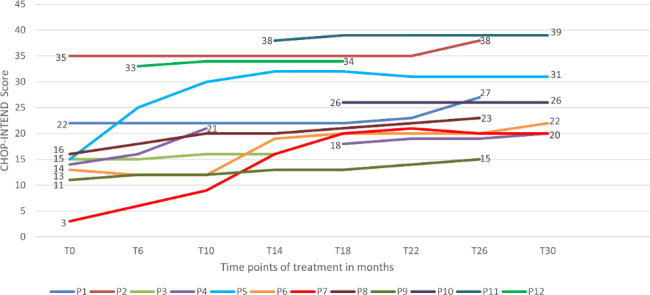
Patients were evaluated with the Hammersmith Functional Motor Scale Expanded (HFMSE; n = 73) or the Children's Hospital of Philadelphia Infant Test of Neuromuscular Disorders (CHOP-INTEND; n = 47). Additionally, the Revised Upper Limb Module (RULM) and 6-minute walk test (6MWT) were used in a subset of patients. Patients were followed for up to 30 months of nusinersen treatment (mean, SD; 23, 14 months). Subjective treatment outcomes were evaluated with the Patients Global Impression-Improvement (PGI-I) scale used in all patients or caregivers at each follow-up visit.
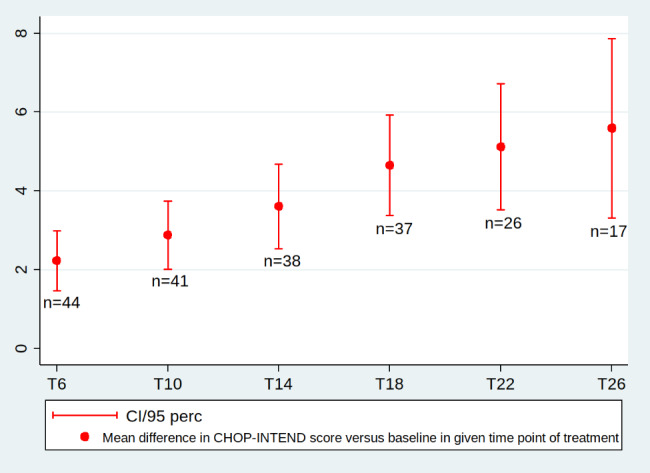
An increase in the mean HFMSE score was noted at month 14 (T14) (3.9 points, p < 0.001) and month 30 (T30) (5.1 points, p < 0.001). The mean RULM score increased by 0.79 points at T14 (p = 0.001) and 1.96 points (p < 0.001) at month 30 (T30). The mean CHOP-INTEND increased by 3.6 points at T14 (p < 0.001) and 5.6 points at month 26 (p < 0.001). The mean 6MWT improved by 16.6 m at T14 and 27 m at T30 vs. baseline. A clinically meaningful improvement in HFMSE (≥ 3 points) was seen in 62% of patients at T14, and in 71% at T30; in CHOP INTEND (≥ 4 points), in 58% of patients at T14 and in 80% at T30; in RULM (≥ 2 points), in 26.6% of patients at T14 and in 43.5% at T30; and in 6MWT (≥ 30-meter increase), in 26% of patients at T14 and in 50% at T30. Improved PGI-I scores were reported for 75% of patients at T14 and 85% at T30; none of the patients reporting worsening at T30. Adverse events were mild and related to lumbar puncture.
In our study, nusinersen led to continuous functional improvement over 30-month follow-up and was well tolerated by adults and older children with a wide spectrum of SMA severity.
脊髓性肌萎缩症(SMA)是一种常染色体隐性疾病,由 SMN1 基因的双等位基因突变引起,导致进行性肌肉无力和萎缩。诺西那生钠是所有 SMA 类型的首个疾病修正药物。我们报告了 120 名 SMA 1c-3 型成人和大龄儿童接受诺西那生钠治疗的有效性和安全性数据。
患者接受了 Hammersmith 功能性运动量表扩展版(HFMSE;n=73)或费城儿童医院婴儿神经肌肉疾病测试(CHOP-INTEND;n=47)的评估。此外,修订后的上肢模块(RULM)和 6 分钟步行测试(6MWT)也在部分患者中使用。患者接受诺西那生钠治疗的时间最长为 30 个月(平均,标准差;23,14 个月)。所有患者或每位患者的照顾者在每次随访时均使用患者总体印象改善量表(PGI-I)评估主观治疗结局。
在第 14 个月(T14)(3.9 分,p<0.001)和第 30 个月(T30)(5.1 分,p<0.001)时,HFMSE 评分均值增加。在第 14 个月(T14)时,RULM 评分均值增加了 0.79 分(p=0.001),在第 30 个月(T30)时增加了 1.96 分(p<0.001)。在第 14 个月(T14)时,CHOP-INTEND 评分均值增加了 3.6 分(p<0.001),在第 26 个月(T26)时增加了 5.6 分(p<0.001)。在第 14 个月(T14)时,6MWT 平均提高了 16.6 米,在第 30 个月(T30)时提高了 27 米,与基线相比。在第 14 个月(T14)时,62%的患者 HFMSE 改善≥3 分,71%的患者在第 30 个月(T30)时 HFMSE 改善≥3 分;在第 14 个月(T14)时,58%的患者 CHOP INTEND 改善≥4 分,80%的患者在第 30 个月(T30)时 CHOP INTEND 改善≥4 分;在第 14 个月(T14)时,26.6%的患者 RULM 改善≥2 分,43.5%的患者在第 30 个月(T30)时 RULM 改善≥2 分;在第 14 个月(T14)时,26%的患者 6MWT 增加≥30 米,在第 30 个月(T30)时,50%的患者 6MWT 增加≥30 米。在第 14 个月(T14)时,75%的患者报告 PGI-I 评分改善,85%的患者在第 30 个月(T30)时报告 PGI-I 评分改善;没有患者报告在第 30 个月(T30)时恶化。不良事件轻微,与腰椎穿刺有关。
在我们的研究中,诺西那生钠在 30 个月的随访中持续改善了功能,且被广泛的 SMA 严重程度的成人和大龄儿童耐受良好。