Socon - Social and Health Consultants Ltd, Tampere, Finland.
Faculty of Social Sciences, Tampere University, Tampere, Finland.
BMC Complement Med Ther. 2023 Aug 4;23(1):279. doi: 10.1186/s12906-023-04088-4.
Population based studies have shown large differences in the estimated prevalence of complementary and integrative health (CIH) usage between studies. This is in part due to there being no golden standard definition for CIH. In Finland, an updated and internationally comparable study on the prevalence of CIH usage is needed. In the present study, a modified Finnish version of the International Questionnaire to Measure Use of Complementary and Alternative Medicine (I-CAM-QFI) was utilised to examine prevalence of use of different CIH modalities and their experienced helpfulness in the general Finnish population.
Respondents aged 16 and above were invited to take part in this descriptive cross-sectional study through an online panel in December 2022. The usage of CIH and the experienced helpfulness were calculated with SPSS (v28) as the proportion of users per each modality. The data were weighted based on gender, age and place of residence.
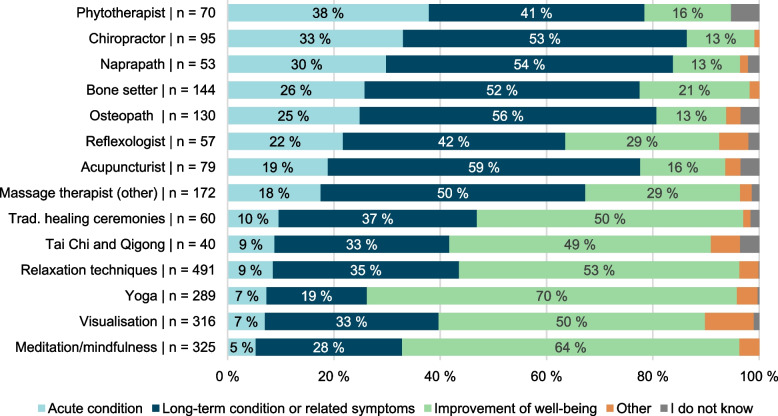
A total of 3244 respondents completed the survey. CIH was used by 51.1% (95%CI: 49.4-52.8) of the respondents in the 12 months prior to the survey. Self-help practices were the most used category of CIH (28.8%; 95%CI: 27.3-30.4). The prevalence of usage of CIH natural remedies excluding vitamins and minerals was 27.0% (95%CI: 25.5-28.6). CIH providers were visited by 20.4% of the respondents (95%CI: 19.0-21.8). Getting help for a long-term illness or improvement of well-being were often mentioned as the most important reason for the use of different CIH modalities. CIH was generally used more by women compared to men. The large majority found the modalities they used helpful.
The results increase current understanding on CIH usage in Finland. As the majority of users experience CIH as helpful, there is a need to study CIH in the context of public health policies. The estimates of CIH usage are highly dependent on what is considered as CIH, and this should be paid attention to in future studies.
基于人群的研究表明,不同研究之间互补和综合健康(CIH)使用的估计患病率存在很大差异。这在一定程度上是由于 CIH 没有黄金标准定义。在芬兰,需要进行一项更新的、具有国际可比性的 CIH 使用患病率研究。在本研究中,使用了经过修订的芬兰版国际补充和替代医学使用情况问卷(I-CAM-QFI)来调查普通芬兰人群中不同 CIH 方式的使用情况及其经验疗效。
通过 2022 年 12 月的在线小组邀请年龄在 16 岁及以上的受访者参加这项描述性横断面研究。CIH 的使用情况和经验疗效用 SPSS(v28)计算,每种方式的使用者比例。数据根据性别、年龄和居住地进行加权。
共有 3244 名受访者完成了调查。在调查前 12 个月,有 51.1%(95%CI:49.4-52.8)的受访者使用过 CIH。自助实践是最常用的 CIH 类别(28.8%;95%CI:27.3-30.4)。使用 CIH 天然疗法(不包括维生素和矿物质)的患病率为 27.0%(95%CI:25.5-28.6)。20.4%的受访者(95%CI:19.0-21.8)曾访问过 CIH 提供者。受访者常提到使用不同 CIH 方式的最重要原因是治疗长期疾病或改善健康状况。与男性相比,女性更常使用 CIH。绝大多数人认为他们使用的方式是有帮助的。
这些结果增加了对芬兰 CIH 使用情况的了解。由于大多数使用者认为 CIH 是有帮助的,因此需要在公共卫生政策的背景下研究 CIH。CIH 使用情况的估计高度依赖于被认为是 CIH 的内容,这在未来的研究中应该引起注意。