Orthopedics (Orthopedic Trauma Group), The Affiliated Traditional Chinese Medicine Hospital of Southwest Medical University, Luzhou, Sichuan Province, China.
Department of Orthopedics, The Affiliated Hospital of Southwest Medical University, Luzhou, Sichuan Province, China.
Medicine (Baltimore). 2023 Aug 4;102(31):e34464. doi: 10.1097/MD.0000000000034464.
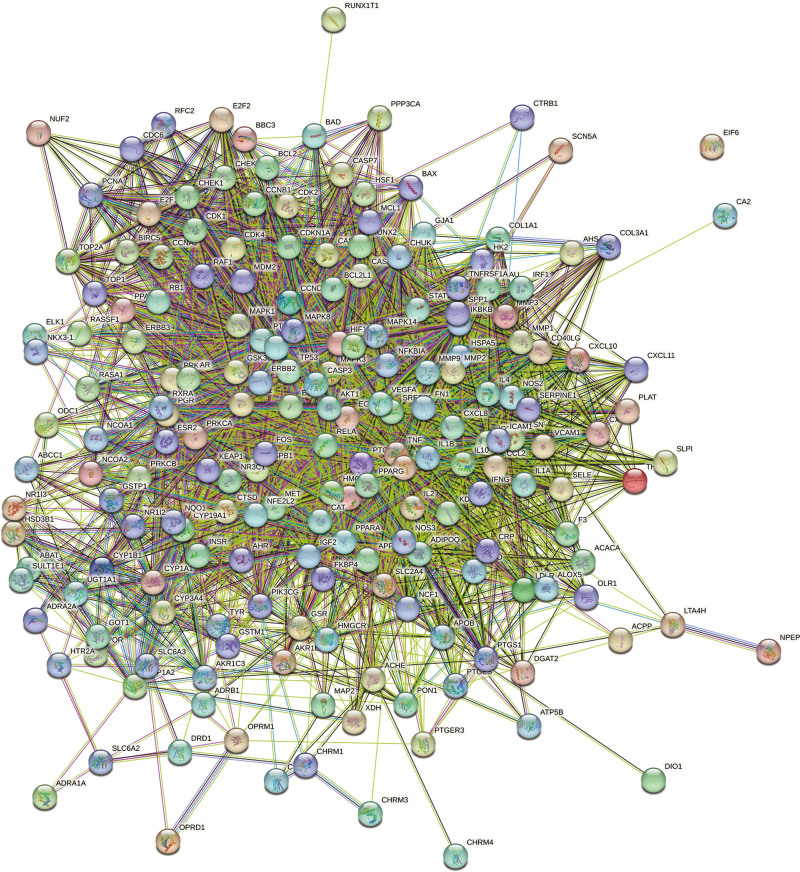
Based on network pharmacology methods, we explored the mechanism of the classic Chinese medicine formula Coix seed decoction (CSD) in treating knee osteoarthritis (KOA). We searched each single drug in the CSD in the traditional Chinese medicine systematic pharmacology database in turn to obtain information on the active ingredients and target proteins of the CSD, and obtain the name of the genes corresponding to the target proteins through the UniProt database. We collected KOA-related genes from DisGeNET, GeneCards, comparative toxicogenomics database, and MalaCards database. The Venny online tool identified potential therapeutic targets by intersecting CSD and KOA target genes, while gene ontology and Kyoto encyclopedia of genes and genomes analysis was performed using the Oebiotech Cloud Platform. A protein-protein interaction network was established using the String database; a "CSD-active ingredient-target gene-KOA" network plot was constructed using Cytoscape 3.9.1 software and screened for key targets and hub targets. Finally, molecular docking was performed for hub genes with high Degree values. A total of 227 effective target genes for CSD and 8816 KOA-related target genes were obtained, as well as 191 cross-target genes for CSD and KOA. We screened 37 key gene targets and identified the top 10 hub target genes in descending order of Degree value using protein-protein interaction and Cytoscape 3.9.1 software (TNF, IL-6, MMP-9, IL-1β, AKT-1, VEGFα, STAT-3, PTGS-2, IL-4, TP53). Gene ontology analysis showed that the biological process of CSD treatment of KOA mainly involves cytokine-mediated signaling pathway, negative regulation of apoptotic process, cellular response to hypoxia, cellular response to cadmium ion, response to estradiol, and extrinsic apoptotic signaling pathway in absence of ligand. Kyoto encyclopedia of genes and genomes analysis revealed major signaling pathways including Cellular senescence, TNF signaling pathway, and PI3K-Akt signaling pathway. The molecular docking results show that the core components bind well to the core targets. In conclusion, CSD may exert therapeutic effects on KOA by inhibiting pathological processes such as inflammatory response, apoptosis, cellular senescence, and oxidative stress.
基于网络药理学方法,我们探讨了经典中药方剂薏苡仁汤(CSD)治疗膝骨关节炎(KOA)的作用机制。我们依次在中药系统药理学数据库中搜索 CSD 中的每一味单药,获取 CSD 的活性成分和靶蛋白信息,并通过 UniProt 数据库获得靶蛋白对应的基因名称。我们从 DisGeNET、GeneCards、比较毒理学基因组学数据库和 MalaCards 数据库中收集 KOA 相关基因。Venny 在线工具通过 CSD 与 KOA 靶基因的交集鉴定潜在的治疗靶点,而基因本体和京都基因与基因组百科全书分析则使用 Oebiotech Cloud Platform 进行。通过 String 数据库建立蛋白质-蛋白质相互作用网络;使用 Cytoscape 3.9.1 软件构建 CSD-活性成分-靶基因-KOA 网络图,并筛选关键靶标和枢纽靶标。最后,对 Degree 值较高的枢纽基因进行分子对接。共获得 227 个 CSD 有效靶基因和 8816 个 KOA 相关靶基因,以及 CSD 和 KOA 的 191 个交叉靶基因。我们筛选了 37 个关键基因靶标,并使用蛋白质-蛋白质相互作用和 Cytoscape 3.9.1 软件,按 Degree 值降序排列,确定前 10 个枢纽靶基因(TNF、IL-6、MMP-9、IL-1β、AKT-1、VEGFα、STAT-3、PTGS-2、IL-4、TP53)。基因本体论分析表明,CSD 治疗 KOA 的生物学过程主要涉及细胞因子介导的信号通路、细胞凋亡过程的负调控、细胞对缺氧的反应、细胞对镉离子的反应、对雌二醇的反应和无配体情况下的外在凋亡信号通路。京都基因与基因组百科全书分析揭示了主要信号通路,包括细胞衰老、TNF 信号通路和 PI3K-Akt 信号通路。分子对接结果表明,核心成分与核心靶标结合良好。综上所述,CSD 可能通过抑制炎症反应、细胞凋亡、细胞衰老和氧化应激等病理过程对 KOA 发挥治疗作用。