Dantuma M, Gasteau D B, Manohar S
Multi-Modality Medical Imaging Group (M3I), TechMed Centre, University of Twente, Enschede, The Netherlands.
Photoacoustics. 2023 Jul 25;32:100534. doi: 10.1016/j.pacs.2023.100534. eCollection 2023 Aug.
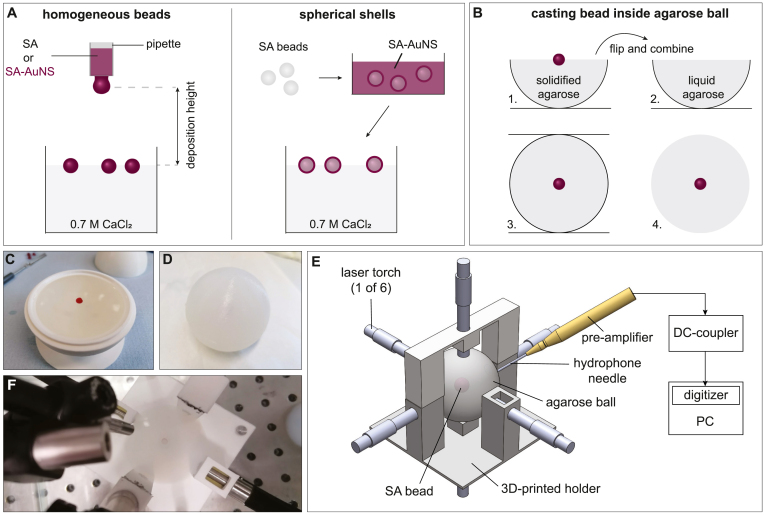
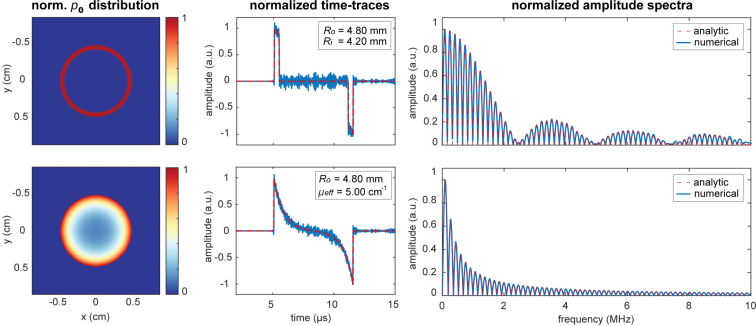
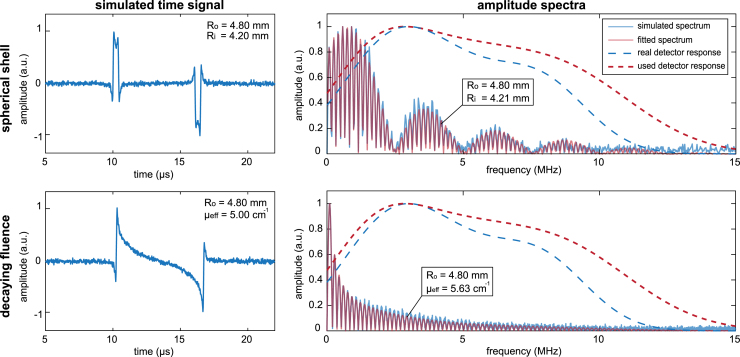
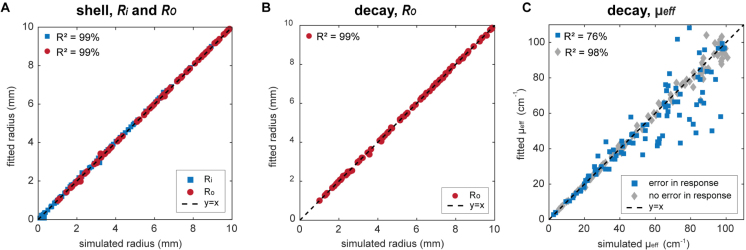
The photoacoustic signal generated by an optically absorbing target is determined by the spatial profile of absorbed optical energy within the target. The analysis of the time profile and frequency content of the signal enables the recovery of the geometry of the object, as well as information about the optical properties. The photoacoustic response of spheres with a homogeneous absorbed optical energy profile is well described, and it is known that the width of the photoacoustic pulse is determined by the diameter of the sphere and its sound speed. In practice, the optical attenuation coefficients within the sphere will result in an inwardly decaying fluence profile leading to a similarly decaying absorbed optical energy profile. Further, the optical attenuation coefficients may be inhomogeneously distributed in the sphere. The implication for both cases is that the existing model for spheres does not fully apply. In this work, we developed analytical expressions for the photoacoustic time traces and amplitude spectra generated by a sphere with absorbed optical energy only in a spherical shell, and by a sphere with an inwardly decaying optical energy profile. Numerical simulations and experiments were conducted on these two imperfect sphere types. Fitting our model to the simulated or measured spectra allowed us to test our model's ability to extract the sphere size and optical properties. We found that the radii can be recovered with high accuracy, even when the frequency response of the detector recording the photoacoustic pulse is not precisely known. The model was found to be less sensitive in recovering the optical attenuation coefficient, but it is feasible when the detector's frequency response is well known.
由光吸收目标产生的光声信号取决于目标内部吸收光能量的空间分布。对该信号的时间分布和频率成分进行分析,能够恢复物体的几何形状以及有关光学特性的信息。具有均匀吸收光能量分布的球体的光声响应已得到很好的描述,并且已知光声脉冲的宽度由球体的直径及其声速决定。实际上,球体内的光学衰减系数会导致通量分布向内衰减,从而导致吸收光能量分布也类似地衰减。此外,光学衰减系数在球体内可能分布不均匀。这两种情况的影响是,现有的球体模型并不完全适用。在这项工作中,我们针对仅在球壳内具有吸收光能量的球体以及光能量分布向内衰减的球体,推导了光声时间轨迹和幅度谱的解析表达式。对这两种不完美球体类型进行了数值模拟和实验。将我们的模型拟合到模拟或测量的光谱上,使我们能够测试模型提取球体大小和光学特性的能力。我们发现,即使记录光声脉冲的探测器的频率响应不完全清楚,也能高精度地恢复半径。发现该模型在恢复光学衰减系数方面不太敏感,但当探测器的频率响应已知时是可行的。