Zhao Bingying, Mertz Jerome
Department of Electrical and Computer Engineering, Boston University, MA 02215.
Department of Biomedical Engineering, Boston University, MA 02215.
bioRxiv. 2023 Sep 16:2023.07.24.550382. doi: 10.1101/2023.07.24.550382.
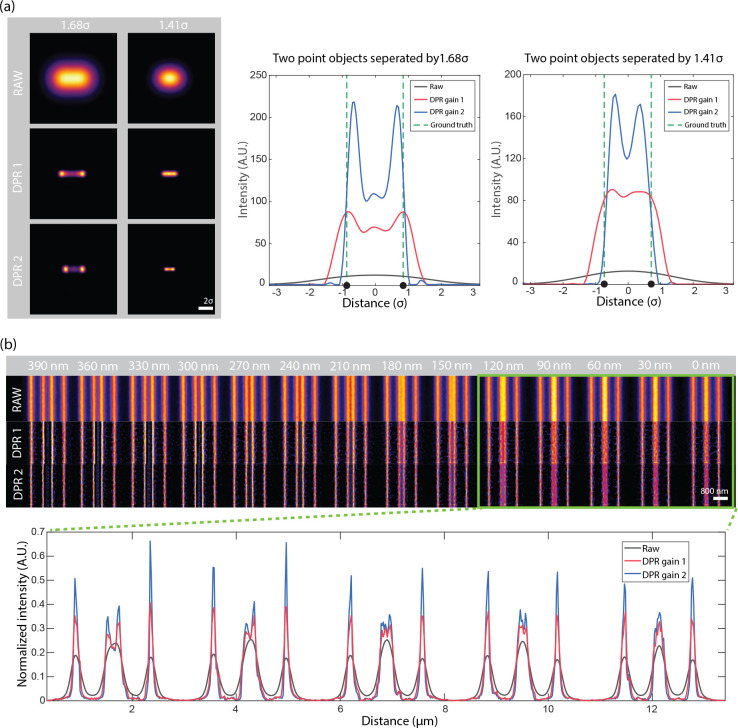
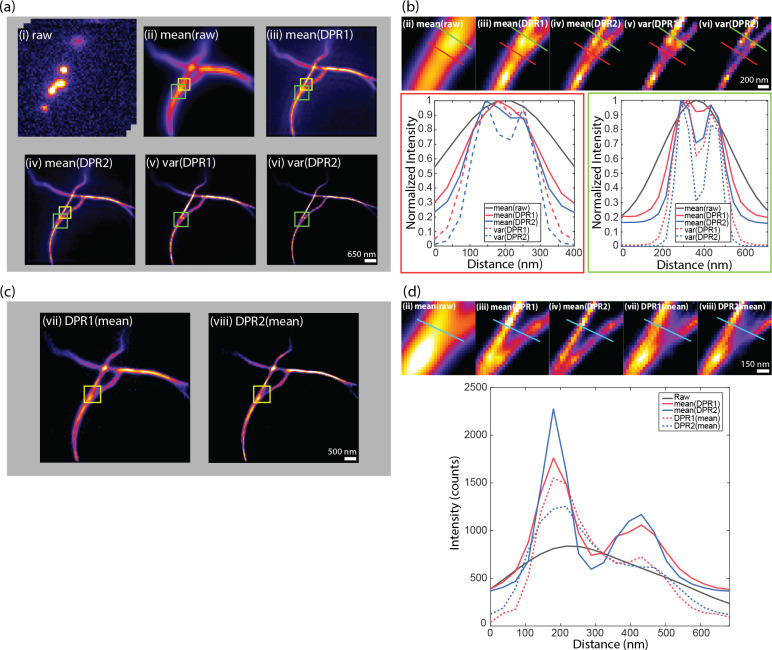
Improving the spatial resolution of a fluorescence microscope has been an ongoing challenge in the imaging community. To address this challenge, a variety of approaches have been taken, ranging from instrumentation development to image post-processing. An example of the latter is deconvolution, where images are numerically deblurred based on a knowledge of the microscope point spread function. However, deconvolution can easily lead to noise-amplification artifacts. Deblurring by post-processing can also lead to negativities or fail to conserve local linearity between sample and image. We describe here a simple image deblurring algorithm based on pixel reassignment that inherently avoids such artifacts and can be applied to general microscope modalities and fluorophore types. Our algorithm helps distinguish nearby fluorophores even when these are separated by distances smaller than the conventional resolution limit, helping facilitate, for example, the application of single-molecule localization microscopy in dense samples. We demonstrate the versatility and performance of our algorithm under a variety of imaging conditions.
提高荧光显微镜的空间分辨率一直是成像领域的一项持续性挑战。为应对这一挑战,人们采取了多种方法,从仪器开发到图像后处理。后者的一个例子是反卷积,即根据显微镜点扩散函数的知识对图像进行数字去模糊处理。然而,反卷积很容易导致噪声放大伪像。通过后处理进行去模糊处理也可能导致出现负值或无法保持样本与图像之间的局部线性关系。我们在此描述一种基于像素重新分配的简单图像去模糊算法,该算法本质上可避免此类伪像,并且可应用于一般的显微镜模式和荧光团类型。即使附近的荧光团之间的距离小于传统分辨率极限,我们的算法也有助于区分它们,例如,有助于在密集样本中应用单分子定位显微镜。我们在各种成像条件下展示了我们算法的通用性和性能。