Zhang Siwei, Strayer Nick, Vessels Tess, Choi Karmel, Wang Geoffrey W, Li Yajing, Bejan Cosmin A, Hsi Ryan S, Bick Alexander G, Velez Edwards Digna R, Savona Michael R, Philips Elizabeth J, Pulley Jill, Self Wesley H, Hopkins Wilkins Consuelo, Roden Dan M, Smoller Jordan W, Ruderfer Douglas M, Xu Yaomin
Department of Biostatistics, Vanderbilt University, Nashville, TN, USA.
Posit PBC, Boston, MA, USA.
medRxiv. 2023 Jul 30:2023.07.23.23293047. doi: 10.1101/2023.07.23.23293047.
Multimorbidity, characterized by the simultaneous occurrence of multiple diseases in an individual, is an increasing global health concern, posing substantial challenges to healthcare systems. Comprehensive understanding of disease-disease interactions and intrinsic mechanisms behind multimorbidity can offer opportunities for innovative prevention strategies, targeted interventions, and personalized treatments. Yet, there exist limited tools and datasets that characterize multimorbidity patterns across different populations. To bridge this gap, we used large-scale electronic health record (EHR) systems to develop the Phenome-wide Multi-Institutional Multimorbidity Explorer (PheMIME), which facilitates research in exploring and comparing multimorbidity patterns among multiple institutions, potentially leading to the discovery of novel and robust disease associations and patterns that are interoperable across different systems and organizations.
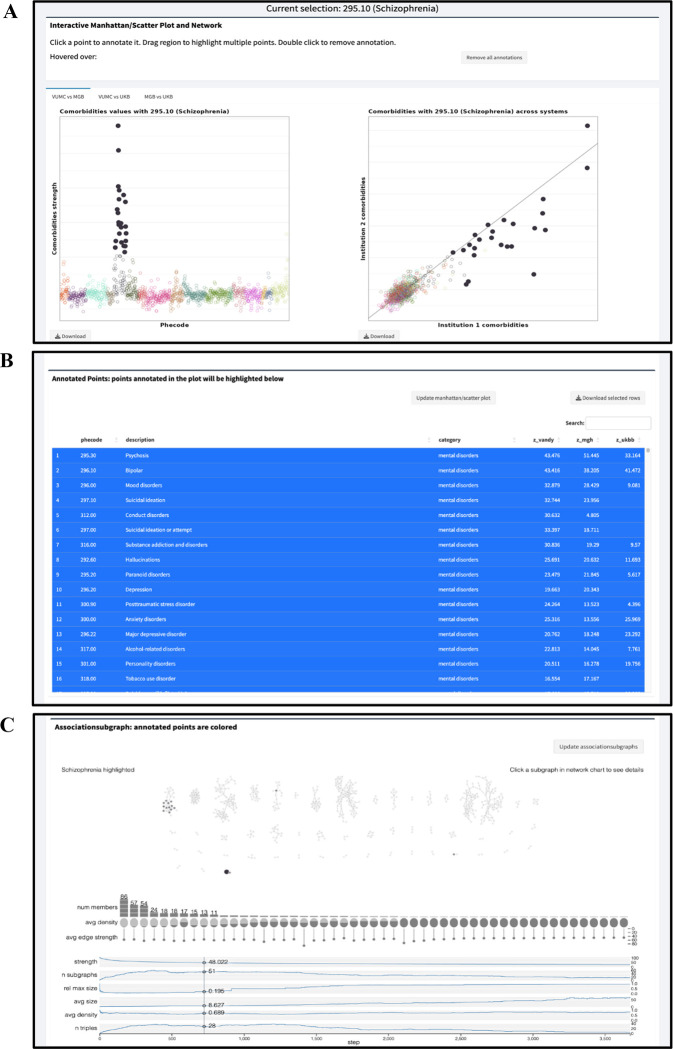
PheMIME integrates summary statistics from phenome-wide analyses of disease multimorbidities. These are currently derived from three major institutions: Vanderbilt University Medical Center, Mass General Brigham, and the UK Biobank. PheMIME offers interactive exploration of multimorbidity through multi-faceted visualization. Incorporating an enhanced version of associationSubgraphs, PheMIME enables dynamic analysis and inference of disease clusters, promoting the discovery of multimorbidity patterns. Once a disease of interest is selected, the tool generates interactive visualizations and tables that users can delve into multimorbidities or multimorbidity networks within a single system or compare across multiple systems. The utility of PheMIME is demonstrated through a case study on schizophrenia.
The PheMIME knowledge base and web application are accessible at https://prod.tbilab.org/PheMIME/. A comprehensive tutorial, including a use-case example, is available at https://prod.tbilab.org/PheMIME_supplementary_materials/. Furthermore, the source code for PheMIME can be freely downloaded from https://github.com/tbilab/PheMIME.
The data underlying this article are available in the article and in its online web application or supplementary material.
多重疾病,即个体同时患有多种疾病,是一个日益受到全球关注的健康问题,给医疗系统带来了巨大挑战。全面了解疾病之间的相互作用以及多重疾病背后的内在机制,可为创新的预防策略、靶向干预和个性化治疗提供机会。然而,目前用于描述不同人群多重疾病模式的工具和数据集有限。为了弥补这一差距,我们利用大规模电子健康记录(EHR)系统开发了全表型多机构多重疾病探索器(PheMIME),它有助于研究和比较多个机构之间的多重疾病模式,有可能发现新的、可靠的疾病关联和模式,这些关联和模式在不同系统和组织之间具有互操作性。
PheMIME整合了疾病多重疾病全表型分析的汇总统计数据。这些数据目前来自三个主要机构:范德比尔特大学医学中心、麻省总医院布莱根分院和英国生物银行。PheMIME通过多方面可视化提供对多重疾病的交互式探索。结合关联子图的增强版本,PheMIME能够对疾病集群进行动态分析和推理,促进多重疾病模式的发现。一旦选择了感兴趣的疾病,该工具就会生成交互式可视化和表格,用户可以深入研究单个系统内的多重疾病或多重疾病网络,或在多个系统之间进行比较。通过对精神分裂症的案例研究证明了PheMIME的实用性。
PheMIME知识库和网络应用程序可在https://prod.tbilab.org/PheMIME/上访问。https://prod.tbilab.org/PheMIME_supplementary_materials/上提供了包括用例示例在内的全面教程。此外,PheMIME的源代码可从https://github.com/tbilab/PheMIME免费下载。
本文所依据的数据可在文章及其在线网络应用程序或补充材料中获取。