Wang Yani, Cheng Jun, Yang Nannan, Li Ting, Dong Yanling, Xie Lixin
Medical College, Qingdao University, Qingdao, China.
Qingdao Eye Hospital of Shandong First Medical University, Qingdao, China.
Front Med (Lausanne). 2023 Jul 21;10:1190485. doi: 10.3389/fmed.2023.1190485. eCollection 2023.
To compare the surgical outcomes of combined penetrating keratoplasty (PK) and cataract surgery with those of sequential surgery (cataract surgery after PK) for herpes simplex keratitis (HSK).
The medical records of consecutive patients diagnosed with HSK who underwent combined or sequential PK and cataract surgery in active and stable stages between June 2015 and June 2022 were reviewed retrospectively. Complications, graft survival, endothelial cell density (ECD), and final BCVA were compared and analyzed between both surgical methods in each stage.
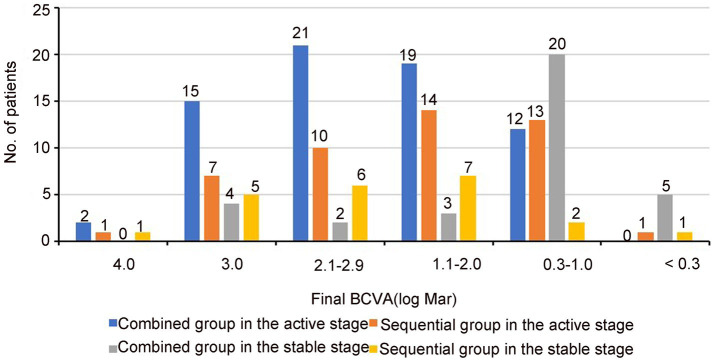
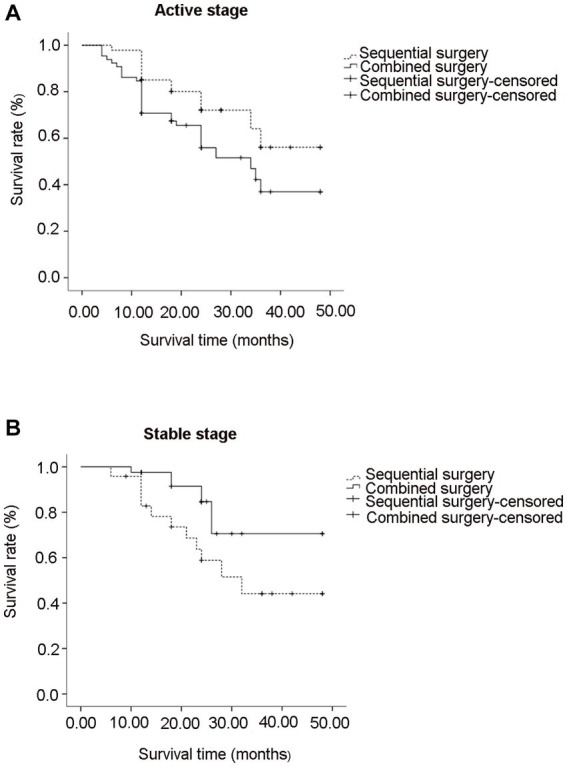
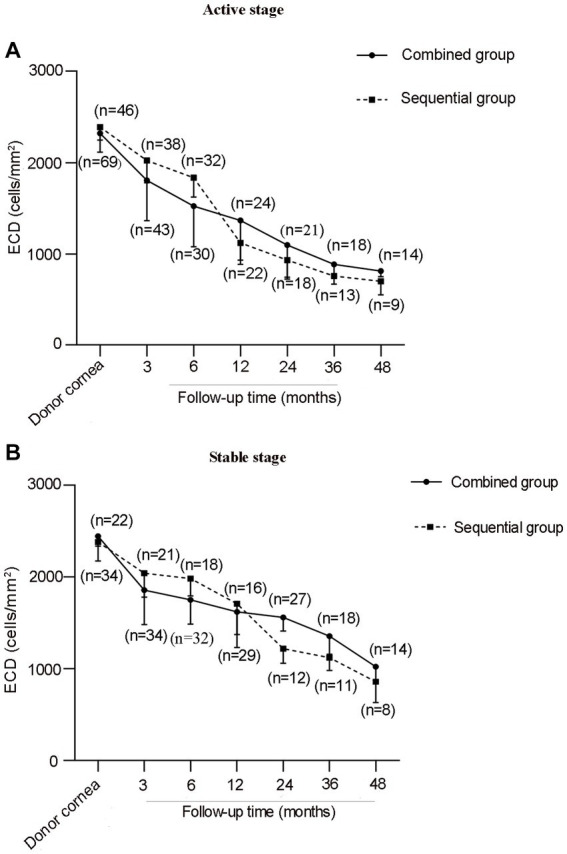
A total of 171 eyes of 171 patients were enrolled, including active stage (69 combined, 46 sequential) and stable stage (34 combined, 22 sequential). The average follow up was 24.2 ± 15.8 months (range, 3 months - 48 months). The final BCVA had obvious improvement and the postoperative ECD was not different in combined and sequential groups of each stage. In sequential group of active stage, 66.7% of persistent epithelial defects and 50% of HSK recurrence occurred within 3 months after cataract surgery; nevertheless, compared to that in sequential group, capsular rupture ( = 0.021), persistent epithelial defects ( = 0.027), and HSK recurrence ( = 0.035) occurred more frequently in combined group, leading to a lower graft survival rate ( = 0.045); at the last visit, 46.4 and 67.4% of grafts remained clear in combined and sequential groups, respectively. By contrary, 82.4 and 50.0% of grafts remained clear in stable stages of combined and sequential groups at the last visit, respectively, and a higher graft survival rate was observed in combined group ( = 0.030).
Although the postoperative ECD is not different between two surgical groups in each stage, sequential surgery in active stage of HSK seems to have advantages in less complications and higher graft survival rate, whereas combined surgery in stable stage has a better outcome than that in sequential surgery.
比较穿透性角膜移植术(PK)联合白内障手术与单纯穿透性角膜移植术序贯白内障手术(PK术后行白内障手术)治疗单纯疱疹病毒性角膜炎(HSK)的手术效果。
回顾性分析2015年6月至2022年6月期间连续诊断为HSK并在活动期和稳定期接受联合或序贯PK及白内障手术的患者的病历。比较并分析两个手术阶段中各手术方法的并发症、植片存活率、内皮细胞密度(ECD)和最终最佳矫正视力(BCVA)。
共纳入171例患者的171只眼,包括活动期(联合手术69只眼,序贯手术46只眼)和稳定期(联合手术34只眼,序贯手术22只眼)。平均随访时间为24.2±15.8个月(范围3个月至48个月)。各阶段联合手术组和序贯手术组的最终BCVA均有明显改善,术后ECD无差异。活动期序贯手术组中,66.7%的持续性上皮缺损和50%的HSK复发发生在白内障手术后3个月内;然而,与序贯手术组相比,联合手术组的晶状体囊膜破裂(P = 0.021)、持续性上皮缺损(P = 0.027)和HSK复发(P = 0.035)发生率更高,导致植片存活率更低(P = 0.045);末次随访时,联合手术组和序贯手术组分别有46.4%和67.4%的植片保持透明。相反,末次随访时稳定期联合手术组和序贯手术组分别有82.4%和50.0%的植片保持透明,联合手术组的植片存活率更高(P = 0.030)。
虽然两个手术组在各阶段术后ECD无差异,但HSK活动期行序贯手术在并发症较少和植片存活率较高方面似乎具有优势,而稳定期行联合手术的效果优于序贯手术。