Yusuf Hamied Department of Chemistry, University of Cambridge, Cambridge CB2 1EW, United Kingdom.
School of Chemical and Biomolecular Engineering, The University of Sydney, Sydney, NSW 2006, Australia.
Proc Natl Acad Sci U S A. 2023 Aug 15;120(33):e2301366120. doi: 10.1073/pnas.2301366120. Epub 2023 Aug 7.
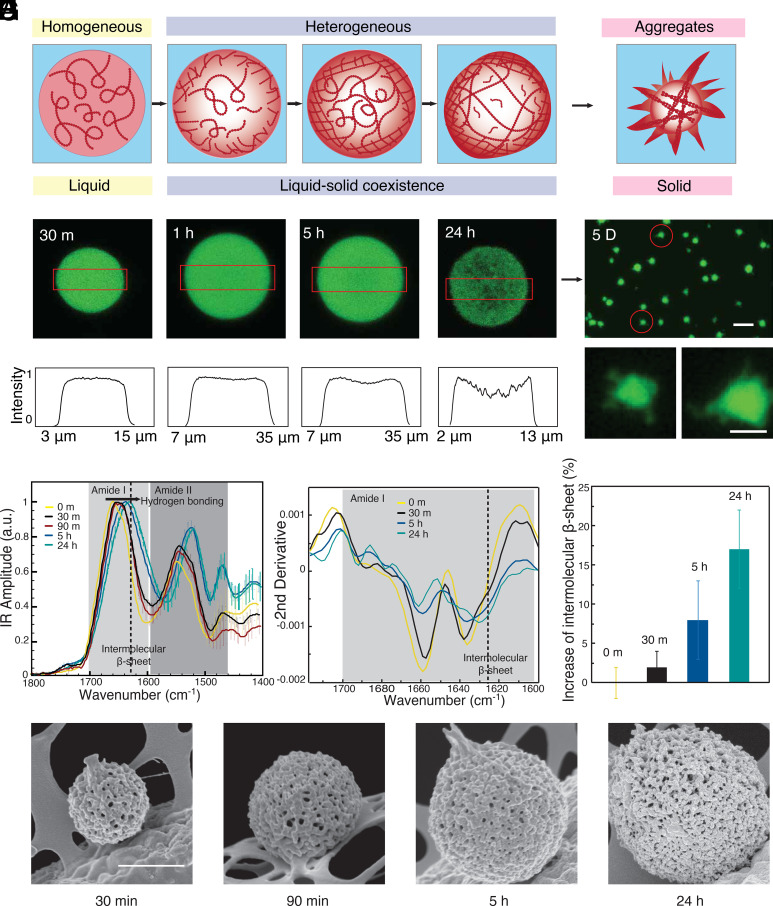
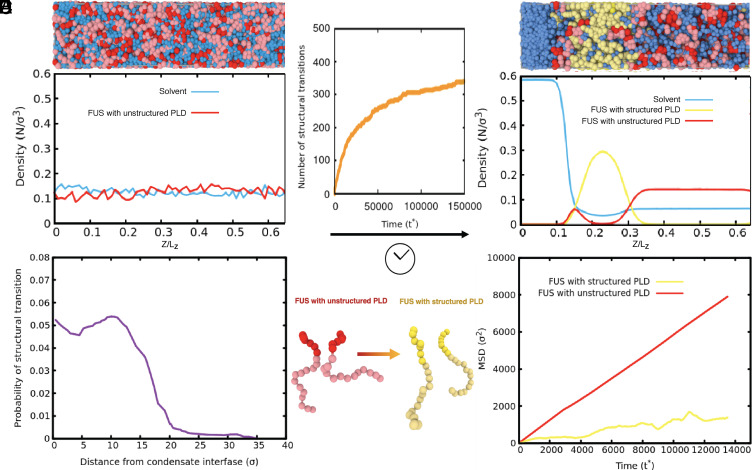
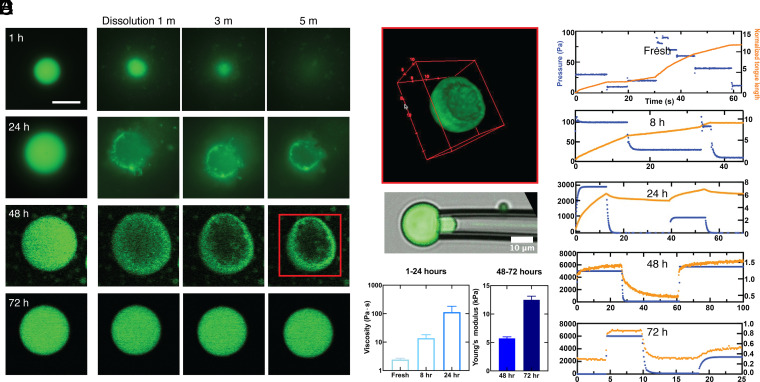
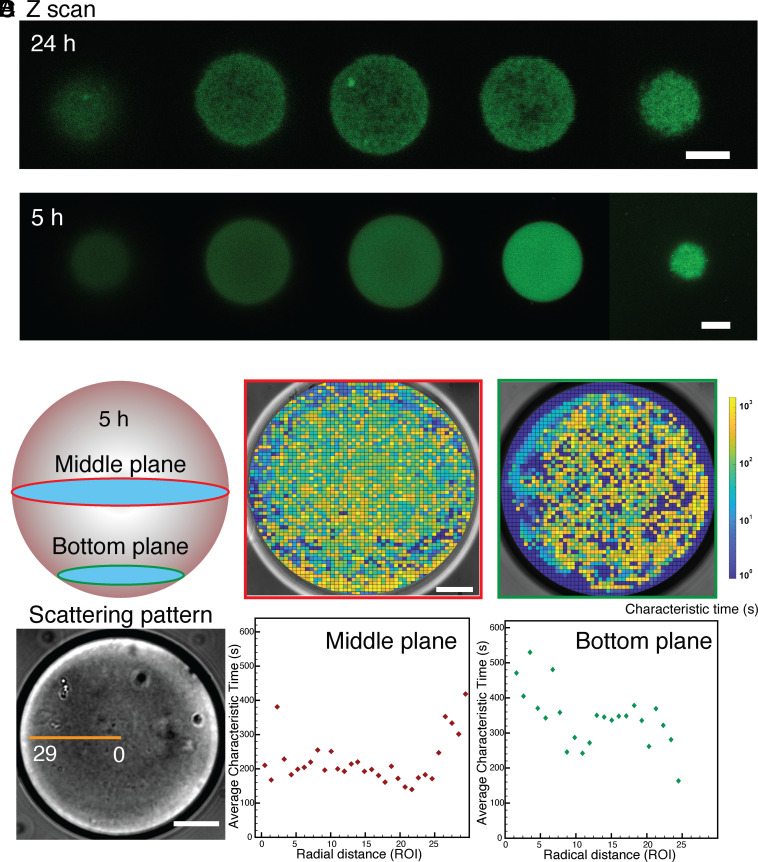
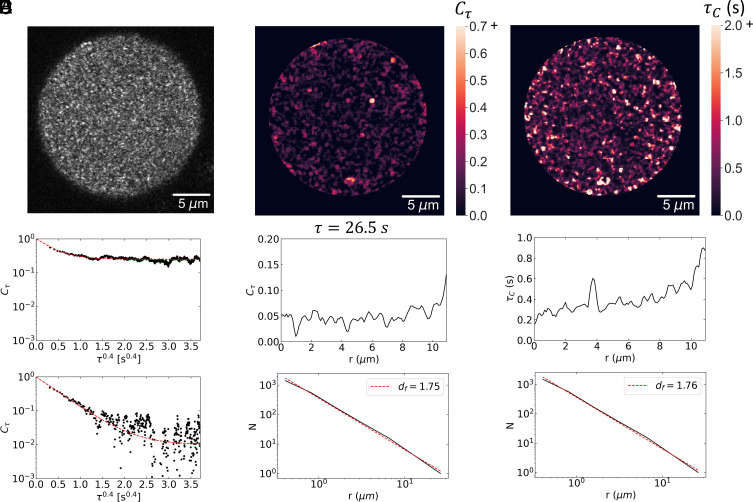
A wide range of macromolecules can undergo phase separation, forming biomolecular condensates in living cells. These membraneless organelles are typically highly dynamic, formed reversibly, and carry out essential functions in biological systems. Crucially, however, a further liquid-to-solid transition of the condensates can lead to irreversible pathological aggregation and cellular dysfunction associated with the onset and development of neurodegenerative diseases. Despite the importance of this liquid-to-solid transition of proteins, the mechanism by which it is initiated in normally functional condensates is unknown. Here we show, by measuring the changes in structure, dynamics, and mechanics in time and space, that single-component FUS condensates do not uniformly convert to a solid gel, but rather that liquid and gel phases coexist simultaneously within the same condensate, resulting in highly inhomogeneous structures. Furthermore, our results show that this transition originates at the interface between the condensate and the dilute continuous phase, and once initiated, the gelation process propagates toward the center of the condensate. To probe such spatially inhomogeneous rheology during condensate aging, we use a combination of established micropipette aspiration experiments together with two optical techniques, spatial dynamic mapping and reflective confocal dynamic speckle microscopy. These results reveal the importance of the spatiotemporal dimension of the liquid-to-solid transition and highlight the interface of biomolecular condensates as a critical element in driving pathological protein aggregation.
大量的生物大分子可以经历相分离,在活细胞中形成生物分子凝聚物。这些无膜细胞器通常具有高度的动态性,是可逆形成的,并在生物系统中执行重要功能。然而,凝聚物的进一步液-固转变可能导致与神经退行性疾病的发生和发展相关的不可逆转的病理性聚集和细胞功能障碍。尽管这种蛋白质的液-固转变很重要,但在正常功能的凝聚物中,它是如何启动的机制尚不清楚。在这里,我们通过测量结构、动力学和力学在时间和空间上的变化,表明单组分 FUS 凝聚物不会均匀地转化为固体凝胶,而是在同一凝聚物中同时存在液相和凝胶相,从而导致高度不均匀的结构。此外,我们的结果表明,这种转变起源于凝聚物和稀连续相之间的界面,一旦启动,凝胶化过程就会向凝聚物的中心传播。为了在凝聚物老化过程中探测这种空间不均匀的流变特性,我们结合了已建立的微管吸吮实验以及两种光学技术,即空间动态映射和反射共焦动态散斑显微镜。这些结果揭示了液-固转变的时空维度的重要性,并强调了生物分子凝聚物的界面作为驱动病理性蛋白质聚集的关键因素。