Department of General Surgery, Fujian Medical University Union Hospital, #29 Xinquan Road, Fuzhou, 350001, People's Republic of China.
Sci Rep. 2023 Aug 7;13(1):12824. doi: 10.1038/s41598-023-39980-z.
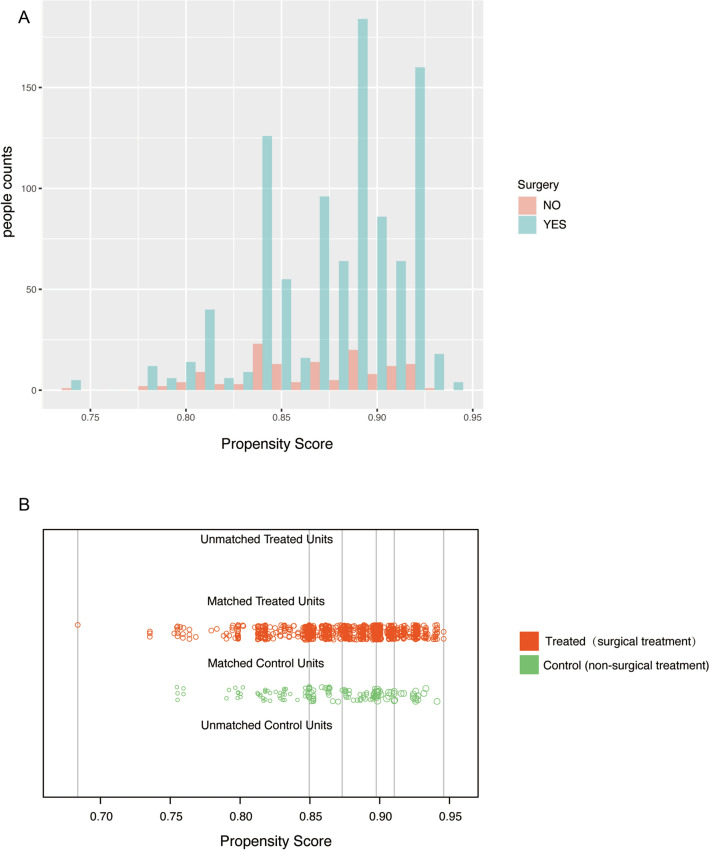
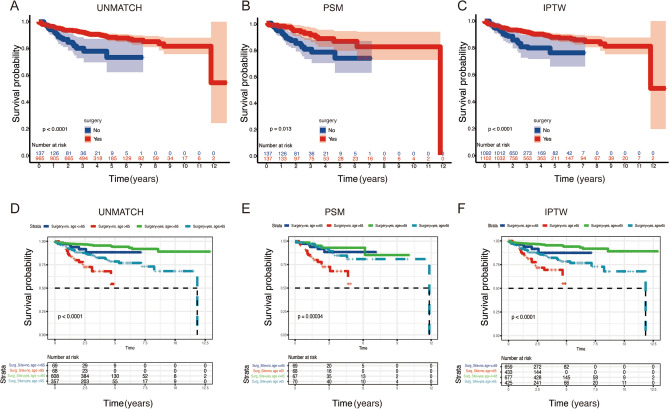
The potential benefits of surgical resection for small non-functional pancreatic neuroendocrine tumors (NF-PNETs) in terms of survival remain uncertain. This study aimed to evaluate the impact of surgical treatment on patients with NF-PNETs. Using SEER data, we identified 1102 patients from 2004 to 2015 with well and moderately differentiated pancreatic neuroendocrine tumors (PNETs). The associations between continuous variables and receipt of surgery were assessed using Wilcoxon rank-sum tests. Kaplan-Meier survival curves for OS were compared using the log-rank test. We compared outcomes in patients who received surgical resection with those in patients who did not, using a univariable Cox model with inverse probability weighting according to the propensity score and propensity-score matching. Among the cohort of 1102 patients, a majority of 965 individuals (87%) underwent surgical intervention. Upon conducting univariate analysis, we observed that surgical treatment significantly prolonged patients' survival [HR = 0.41, 95% CI [0.26-0.65] P < 0.001]. However, the old [HR = 3.27, 95% CI (2.24-4.76), P 0.001], male gender [HR = 1.82, 95% CI (1.23-2.68), P = 0.003], and moderately well-differentiated factors [HR = 1.71, 95% CI (1.04-2.80), P = 0.034] were found to potentially decrease patients' survival time. In the multivariate analysis, male gender [HR = 1.73, 95% CI (1.15-2.61), P = 0.009] and the old factor [HR = 3.52, 95% CI (2.33-5.31), P < 0.001] emerged as influential predictors with higher hazard ratios. Notably, surgical treatment remained a significant factor associated with improved overall survival [HR = 0.53, 95% CI (0.33-0.84), P = 0.007]. Propensity-score matching and inverse probability weighting were employed as analytical techniques. The univariate analysis results showed favorable outcomes in the weight group [HR = 0.48, 95% CI (0.29-0.78), P = 0.003] and matched group [HR = 0.44, 95% CI (0.22-0.85), P = 0.015], respectively. Survival analysis further confirmed that surgical treatment contributed to increased overall survival (log rank, P < 0.05) in both the matching and weight groups. Patients diagnosed with small, non-functioning pancreatic neuroendocrine tumors who undergo surgical intervention exhibit improved overall survival (OS) outcomes. Therefore, surgery is strongly recommended for this patient population.
对于体积较小且无功能性的胰腺神经内分泌肿瘤(NF-PNETs),手术切除在生存方面的潜在获益仍不确定。本研究旨在评估手术治疗对 NF-PNETs 患者的影响。我们使用 SEER 数据,从 2004 年至 2015 年确定了 1102 名分化良好或中度分化的胰腺神经内分泌肿瘤(PNETs)患者。使用 Wilcoxon 秩和检验评估连续变量与手术之间的相关性。使用对数秩检验比较 OS 的 Kaplan-Meier 生存曲线。我们使用单变量 Cox 模型,根据倾向评分进行逆概率加权,并进行倾向评分匹配,比较接受手术切除和未接受手术切除的患者的结果。在 1102 例患者队列中,965 例(87%)患者接受了手术干预。进行单因素分析后,我们发现手术治疗显著延长了患者的生存时间[HR=0.41,95%CI(0.26-0.65),P<0.001]。然而,年龄较大[HR=3.27,95%CI(2.24-4.76),P<0.001]、男性[HR=1.82,95%CI(1.23-2.68),P=0.003]和中度分化[HR=1.71,95%CI(1.04-2.80),P=0.034]是降低患者生存时间的潜在因素。在多变量分析中,男性[HR=1.73,95%CI(1.15-2.61),P=0.009]和年龄较大[HR=3.52,95%CI(2.33-5.31),P<0.001]是更高风险比的影响因素。值得注意的是,手术治疗仍然是与总体生存改善相关的显著因素[HR=0.53,95%CI(0.33-0.84),P=0.007]。我们使用倾向评分匹配和逆概率加权作为分析技术。单因素分析结果显示,在权重组[HR=0.48,95%CI(0.29-0.78),P=0.003]和匹配组[HR=0.44,95%CI(0.22-0.85),P=0.015]中,结果均具有优势。生存分析进一步证实,手术治疗在匹配组和权重组中均有助于提高总体生存率(对数秩,P<0.05)。诊断为体积较小且无功能性的胰腺神经内分泌肿瘤的患者,如果接受手术干预,其总体生存率(OS)将会得到改善。因此,强烈建议对该患者群体进行手术治疗。