Zeleke Tekalign, Ali Bereket, Tekalign Asenakech, Hailu Gudisa, Barbetti M J, Ayele Alemayehu, Aliyi Tajudin, Ayele Alemu, Kahsay Abadi, Tiruneh Belachew, Tewolde Fekadu
Ethiopian Institute of Agricultural Research,Ambo Agricultural Research Center, Ambo, Oromia, P.O. Box 37, Ethiopia.
Amhara Regional Agricultural Research Institute, Debre Berhan Agricultural Research Center, Debre Berhan, Amhara, P.O. Box 112, Ethiopia.
Plant Pathol J. 2023 Aug;39(4):335-350. doi: 10.5423/PPJ.OA.03.2023.0040. Epub 2023 Aug 1.
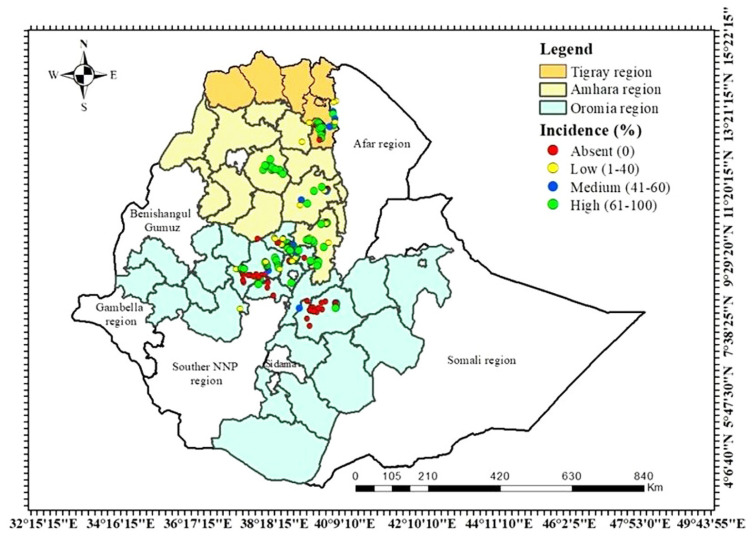
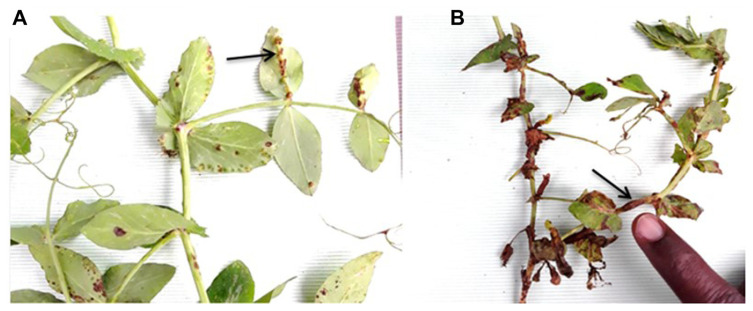
Physoderma fungal species cause faba bean gall (FBG) which devastates faba bean (Vicia faba L.) in the Ethiopian highlands. In three regions (Amahara, Oromia, and Tigray), the relative importance, distribution, intensity, and association with factors affecting FBG damage were assessed for the 2019 (283 fields) and 2020 (716 fields) main cropping seasons. A logistic regression model was used to associate biophysical factors with FBG incidence and severity. Amhara region has the highest prevalence of FBG (95.7%), followed by Tigray (83.3%), and the Oromia region (54%). Maximum FBG incidence (78.1%) and severity (32.8%) were recorded from Amhara and Tigray areas, respectively. The chocolate spot was most prevalent in West Shewa, Finfinne Special Zone, and North Shewa of the Oromia region. Ascochyta blight was found prevalent in North Shewa, West Shewa, Southwest Shewa of Oromia, and the South Gondar of Amhara. Faba bean rust was detected in all zones except for the South Gonder and North Shewa, and root rot disease was detected in all zones except South Gonder, South Wollo, and North Shewa of Amahara. Crop growth stage, cropping system, altitude, weed density, and fungicide, were all found to affect the incidence and severity of the FBG. Podding and maturity stage, mono-cropping, altitude (>2,400), high weed density, and non-fungicide were found associated with increased disease intensities. However, crop rotation, low weed infestation, and fungicide usage were identified as potential management options to reduce FBG disease.
集壶菌属真菌物种引发蚕豆瘿病(FBG),该病对埃塞俄比亚高地的蚕豆(Vicia faba L.)造成严重破坏。在三个地区(阿姆哈拉、奥罗米亚和提格雷),对2019年(283块田地)和2020年(716块田地)主要种植季节的蚕豆瘿病的相对重要性、分布、严重程度以及与影响蚕豆瘿病危害因素的关联进行了评估。使用逻辑回归模型将生物物理因素与蚕豆瘿病的发病率和严重程度相关联。阿姆哈拉地区蚕豆瘿病的患病率最高(95.7%),其次是提格雷(83.3%),奥罗米亚地区(54%)。阿姆哈拉和提格雷地区分别记录到最高的蚕豆瘿病发病率(78.1%)和严重程度(32.8%)。巧克力斑点病在奥罗米亚地区的西谢瓦、芬非涅特区和北谢瓦最为普遍。壳二孢叶枯病在奥罗米亚的北谢瓦、西谢瓦、西南谢瓦以及阿姆哈拉的南贡德尔被发现普遍存在。除南贡德尔和北谢瓦外,在所有区域均检测到蚕豆锈病,除阿姆哈拉的南贡德尔、南沃洛和北谢瓦外,在所有区域均检测到根腐病。作物生长阶段、种植制度、海拔、杂草密度和杀菌剂均被发现会影响蚕豆瘿病的发病率和严重程度。结荚期和成熟期、单作、海拔(>2400)、高杂草密度和未使用杀菌剂与病害严重程度增加有关。然而,作物轮作、低杂草侵扰和使用杀菌剂被确定为减少蚕豆瘿病的潜在管理措施。