Health and Medicine Division, National Academies of Sciences, Engineering, and Medicine, 500 Fifth St., NW, Washington, DC, 20001, USA.
The D.K. Kim International Center For Regulatory Science, University of Southern California, Alfred E. Mann School of Pharmacy and Pharmaceutical Sciences, 1540 Alcazar Street, Los Angeles, CA, 90089, USA.
Ther Innov Regul Sci. 2023 Nov;57(6):1260-1268. doi: 10.1007/s43441-023-00559-5. Epub 2023 Aug 8.
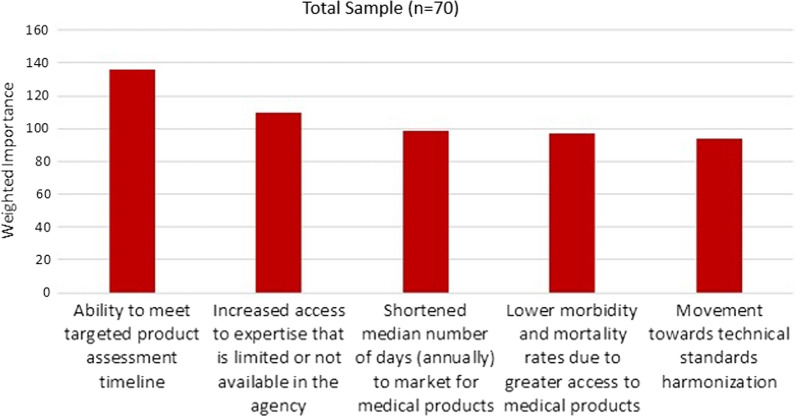
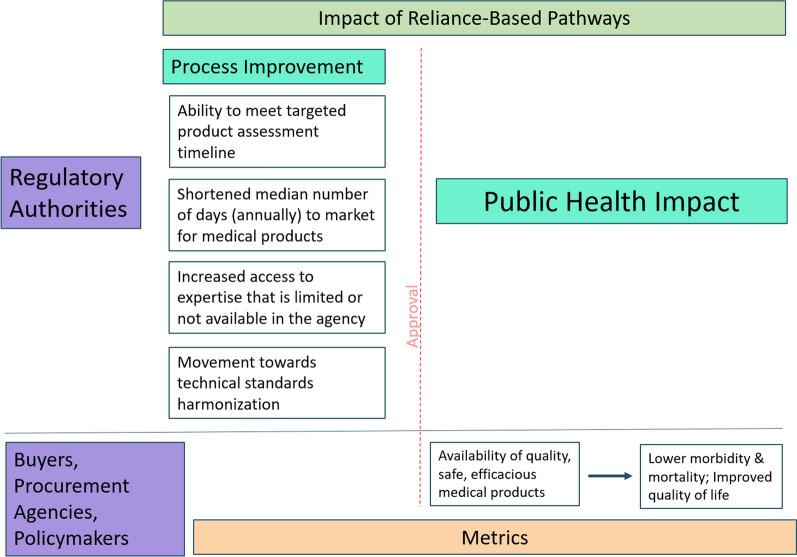
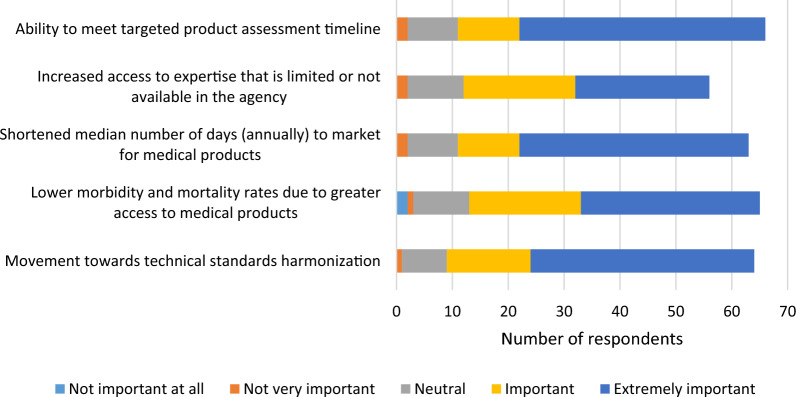
Reliance-based pathways for the marketing authorization of medical products have been identified as valuable regulatory tools for the timely provision of effective, safe, quality medicines for people worldwide; however, little research has been conducted on the best way to measure the public health impact of using reliance-based pathways. The current mixed methods study was designed to explore which characteristics or "metrics" could be used to measure the impact of reliance-based pathways. A quantitative survey (n = 70) and in-depth interviews (IDIs) (n = 10) were employed to query various stakeholders (e.g., industry, regulatory authorities, NGOs) about the metrics they believed would be important to include in a framework designed to measure the impact of reliance-based regulatory pathways on advancing public health. Based on survey results, (1) ability to meet targeted product assessment timeline, (2) increased access to expertise, which is limited or not available in the agency, (3) shortened median number of days (annually) to market for medical products, (4) lower morbidity and mortality rates due to greater access to medical products, and (5) movement toward technical standards harmonization were the Top Five most important metrics to be included in a framework. IDI results suggest that, while important, the relevance of the Top Five metrics may vary by region or regulatory authority. Interviewed stakeholders intuitively believe reliance-based regulatory pathways are a worthwhile endeavor; however, there must be "harmonization" within the reliance ecosystem that creates a strong understanding of the factors necessary for reliance-based pathways to be utilized in a successful manner.
基于信赖的药品上市途径已被确定为有价值的监管工具,可用于及时向全球人民提供有效、安全、高质量的药物;然而,对于如何衡量利用基于信赖的途径对公共卫生的影响,研究甚少。本研究采用混合方法,旨在探讨可以使用哪些特征或“指标”来衡量基于信赖的途径的影响。通过定量调查(n=70)和深入访谈(IDIs)(n=10),向各种利益攸关方(如行业、监管机构、非政府组织)查询他们认为纳入衡量基于信赖的监管途径对推进公共卫生的影响的框架中重要的指标。基于调查结果,(1)有能力满足目标产品评估时间表,(2)增加获取机构内有限或无法获得的专业知识的机会,(3)缩短产品上市的中位数天数(每年),(4)由于更多地获得医疗产品而降低发病率和死亡率,以及(5)向技术标准协调方向发展,是纳入框架的五个最重要的指标。IDIs 结果表明,虽然重要,但五个最重要指标的相关性可能因地区或监管机构而异。接受访谈的利益攸关方直观地认为基于信赖的监管途径是一项有价值的努力;然而,在信赖生态系统中必须有“协调”,以充分理解基于信赖的途径得以成功利用所需的因素。