Graduate Institute of Medicine, College of Medicine, Kaohsiung Medical University, Kaohsiung, Taiwan.
International Center for Wound Repair and Regeneration, National Cheng Kung University, Tainan, Taiwan.
Theranostics. 2023 Jul 14;13(12):4059-4078. doi: 10.7150/thno.84935. eCollection 2023.
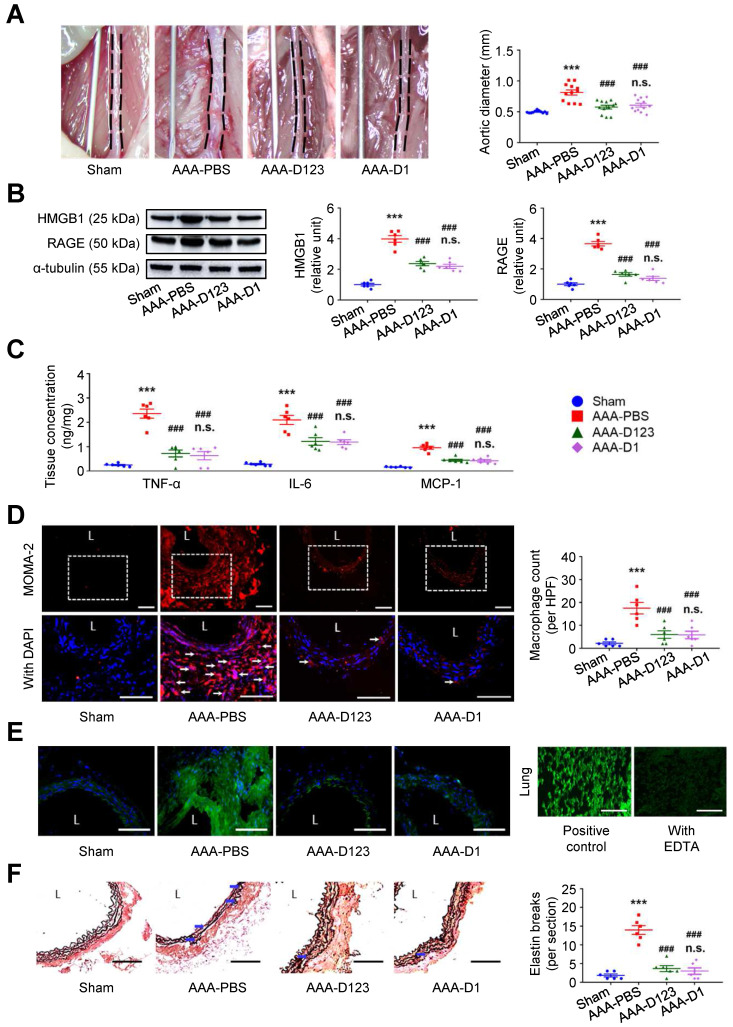
CD93, a C-type lectin-like transmembrane glycoprotein, can be shed in a soluble form (sCD93) upon inflammatory stimuli. sCD93 effectively enhances apoptotic cell clearance and has been proposed as an inflammatory disease biomarker. The function of sCD93 involved directly in inflammation remains to be determined. Herein, we attempted to examine the hypothesis that sCD93 might sequester proinflammatory high-mobility group box 1 protein (HMGB1), exerting anti-inflammatory properties. Different forms of soluble recombinant human CD93 (rCD93) were prepared by a mammalian protein expression system. rCD93-HMGB1 interaction was assessed using co-immunoprecipitation and solid-phase binding assays. Effects of soluble rCD93 were evaluated in HMGB1-induced macrophage and vascular smooth muscle cells (VSMC) activation and receptor activator of nuclear factor-κB ligand (RANKL)-induced osteoclastogenesis, CaCl-induced and angiotensin II-infused abdominal aortic aneurysm (AAA) formation and ovariectomized-induced osteoporosis in mice. Protein binding studies revealed that soluble rCD93, via the lectin-like domain (D1), can bind to HMGB1 and intercept HMGB1-receptor interaction. Soluble rCD93 containing D1 inhibited HMGB1-induced proinflammatory cytokine production and intracellular mitogen-activated protein kinase (MAPK)/nuclear factor (NF)-κB activation in macrophages and VSMCs, thereby attenuating CaCl-induced and angiotensin II-infused AAA models. During osteoclastogenesis, RANKL stimulated HMGB1 secretion that promoted RANKL-induced osteoclastogenesis in return. Soluble rCD93 containing D1 impeded RANKL-induced osteoclastogenic marker gene expression and intracellular MAPK/NF-κB signaling, thereby mitigating ovariectomized-induced osteoporosis. These findings demonstrate the therapeutic potential of soluble recombinant CD93 containing D1 in inflammatory diseases. Our study highlights a novel anti-inflammatory mechanism, i.e., sequestration of HMGB1, through which sCD93 prevents HMGB1-receptor interaction on effector cells and alleviates inflammation.
CD93 是一种 C 型凝集素样跨膜糖蛋白,在炎症刺激下可被水解为可溶性形式(sCD93)。sCD93 可有效增强凋亡细胞的清除,并被提议作为炎症性疾病的生物标志物。sCD93 直接参与炎症的功能仍有待确定。在此,我们试图检验 sCD93 可能通过结合高迁移率族蛋白 B1(HMGB1)来发挥抗炎作用的假说。我们通过哺乳动物蛋白表达系统制备了不同形式的可溶性重组人 CD93(rCD93)。通过免疫共沉淀和固相结合实验评估 rCD93-HMGB1 相互作用。评估可溶性 rCD93 在 HMGB1 诱导的巨噬细胞和血管平滑肌细胞(VSMC)激活以及核因子-κB 配体(RANKL)诱导的破骨细胞生成、CaCl2 诱导和血管紧张素 II 输注诱导的腹主动脉瘤(AAA)形成以及去卵巢诱导的骨质疏松症中的作用。蛋白结合研究表明,可溶性 rCD93 通过凝集素样结构域(D1)可与 HMGB1 结合并阻断 HMGB1-受体相互作用。含有 D1 的可溶性 rCD93 抑制 HMGB1 诱导的促炎细胞因子产生和巨噬细胞和 VSMC 中的丝裂原激活蛋白激酶(MAPK)/核因子(NF)-κB 激活,从而减轻 CaCl2 诱导和血管紧张素 II 输注诱导的 AAA 模型。在破骨细胞生成过程中,RANKL 刺激 HMGB1 分泌,反过来促进 RANKL 诱导的破骨细胞生成。含有 D1 的可溶性 rCD93 可阻断 RANKL 诱导的破骨细胞生成标记基因表达和细胞内 MAPK/NF-κB 信号转导,从而减轻去卵巢诱导的骨质疏松症。这些发现表明含有 D1 的可溶性重组 CD93 在炎症性疾病中的治疗潜力。我们的研究强调了一种新的抗炎机制,即通过 sCD93 结合 HMGB1 来防止 HMGB1-受体相互作用,从而减轻炎症。