Jain Akhil, Arora Shilpkumar, Patel Viral, Raval Maharshi, Modi Karnav, Arora Nirav, Desai Rupak, Bozorgnia Behnam, Bonita Raphael
Department of Internal Medicine, Mercy Fitzgerald Hospital, Darby, PA, USA.
Department of Interventional Cardiology, Houston Methodist Hospital, Houston, TX, USA.
Int J Heart Fail. 2023 Jun 1;5(3):159-168. doi: 10.36628/ijhf.2023.0015. eCollection 2023 Jul.
Readmissions in heart failure (HF), historically reported as 20%, contribute to significant patient morbidity and high financial cost to the healthcare system. The changing population landscape and risk factor dynamics mandate periodic epidemiologic reassessment of HF readmissions.
National Readmission Database (NRD, 2019) was used to identify HF-related hospitalizations and evaluated for demographic, admission characteristics, and comorbidity differences between patients readmitted vs. those not readmitted at 30-days. Causes of readmission and predictors of all-cause, HF-specific, and non-HF-related readmissions were analyzed.
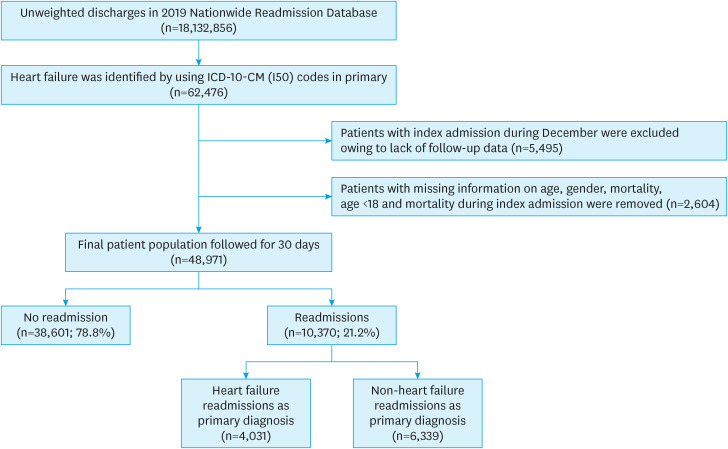
Of 48,971 HF patients, the readmitted cohort was younger (mean 67.4 vs. 68.9 years, p≤0.001), had higher proportion of males (56.3% vs. 53.7%), lowest income quartiles (33.3% vs. 28.9%), Charlson comorbidity index (CCI) ≥3 (61.7% vs. 52.8%), resource utilization including large bed-size hospitalizations, Medicaid enrollees, mean length of stay (6.2 vs. 5.4 days), and disposition to other facilities (23.9% vs. 20%) than non-readmitted. Readmission (30-day) rate was 21.2% (10,370) with cardiovascular causes in 50.3% (HF being the most common: 39%), and non-cardiac in 49.7%. Independent predictors for readmission were male sex, lower socioeconomic status, nonelective admissions, atrial fibrillation, chronic obstructive pulmonary disease, chronic kidney disease, anemia, and CCI ≥3. HF-specific readmissions were significantly associated with prior coronary artery disease and Medicaid enrollment.
Our analysis revealed cardiac and noncardiac causes of readmission were equally common for 30-day readmissions in HF patients with HF itself being the most common etiology highlighting the importance of addressing the comorbidities, both cardiac and non-cardiac, to mitigate the risk of readmission.
心力衰竭(HF)患者再入院率历来报告为20%,这会导致患者出现严重发病情况,并给医疗系统带来高昂的经济成本。不断变化的人口格局和风险因素动态变化要求对HF再入院情况进行定期的流行病学重新评估。
使用国家再入院数据库(NRD,2019)来确定与HF相关的住院情况,并评估30天内再入院患者与未再入院患者之间的人口统计学、入院特征和合并症差异。分析了再入院原因以及全因、HF特异性和非HF相关再入院的预测因素。
在48971例HF患者中,再入院队列更年轻(平均年龄67.4岁对68.9岁,p≤0.001),男性比例更高(56.3%对53.7%),收入最低四分位数的比例更高(33.3%对28.9%),Charlson合并症指数(CCI)≥3的比例更高(61.7%对52.8%),资源利用情况包括入住大床位医院、医疗补助参保者、平均住院时间(6.2天对5.4天)以及转至其他机构的比例(23.9%对20%)均高于未再入院患者。30天再入院率为21.2%(10370例),其中心血管原因占50.3%(HF最为常见:39%),非心脏原因占49.7%。再入院的独立预测因素为男性、社会经济地位较低、非选择性入院、心房颤动、慢性阻塞性肺疾病、慢性肾脏病、贫血以及CCI≥3。HF特异性再入院与既往冠状动脉疾病和医疗补助参保显著相关。
我们的分析显示,HF患者30天再入院的心脏和非心脏原因同样常见,HF本身是最常见的病因,这突出了处理心脏和非心脏合并症以降低再入院风险的重要性。