Kim Soo A, Lee Yeontaek, Park Kijun, Park Jae, An Soohwan, Oh Jinseok, Kang Minkyong, Lee Yurim, Jo Yejin, Cho Seung-Woo, Seo Jungmok
School of Electrical and Electronic Engineering, Yonsei University, Seoul 03722, Republic of Korea.
LYNK Solutec Inc., Seoul 03722, Republic of Korea.
Int J Bioprint. 2023 May 31;9(5):765. doi: 10.18063/ijb.765. eCollection 2023.
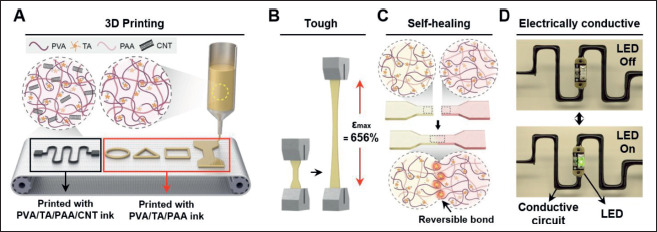
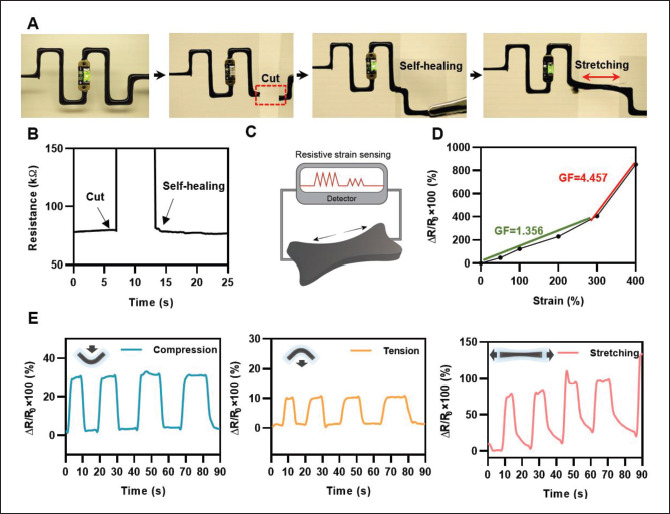
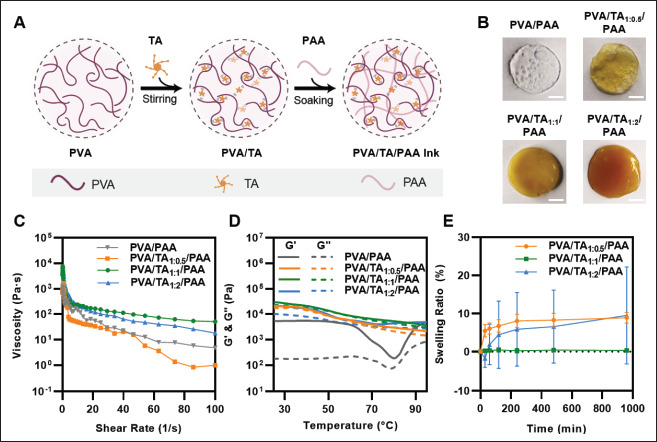
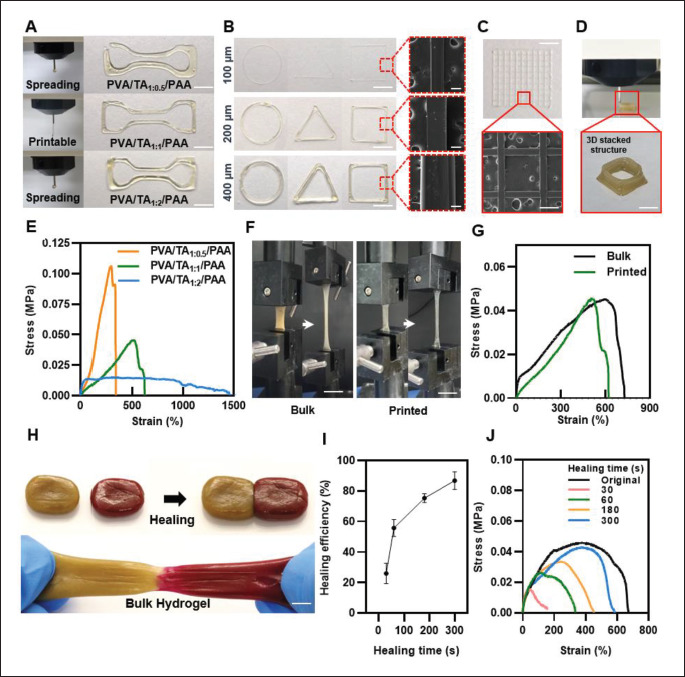
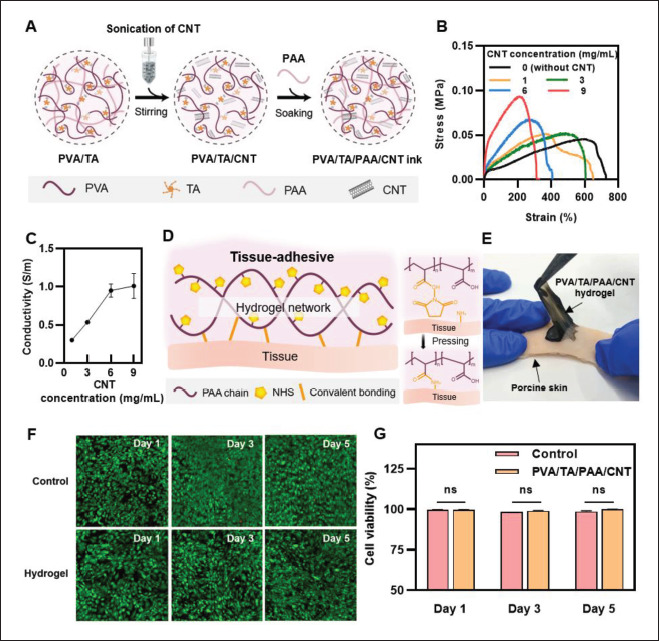
Hydrogels have the potential to play a crucial role in bioelectronics, as they share many properties with human tissues. However, to effectively bridge the gap between electronics and biological systems, hydrogels must possess multiple functionalities, including toughness, stretchability, self-healing ability, three-dimensional (3D) printability, and electrical conductivity. Fabricating such tough and self-healing materials has been reported, but it still remains a challenge to fulfill all of those features, and in particular, 3D printing of hydrogel is in the early stage of the research. In this paper, we present a 3D printable, tough, and self-healing multi-functional hydrogel in one platform made from a blend of poly(vinyl alcohol) (PVA), tannic acid (TA), and poly(acrylic acid) (PAA) hydrogel ink (PVA/TA/PAA hydrogel ink). Based on a reversible hydrogen-bond (H-bond)-based double network, the developed 3D printable hydrogel ink showed excellent printability via shear-thinning behavior, allowing high printing resolution (100 μm) and successful fabrication of 3D-printed structure by layer-by-layer printing. Moreover, the PVA/TA/PAA hydrogel ink exhibited high toughness (tensile loading of up to ~45.6 kPa), stretchability (elongation of approximately 650%), tissue-like Young's modulus (15 kPa), and self-healing ability within 5 min. Furthermore, carbon nanotube (CNT) fillers were successfully added to enhance the electrical conductivity of the hydrogel. We confirmed the practicality of the hydrogel inks for bioelectronics by demonstrating biocompatibility, tissue adhesiveness, and strain sensing ability through PVA/TA/PAA/CNT hydrogel ink.
水凝胶在生物电子学中具有发挥关键作用的潜力,因为它们与人体组织具有许多共同特性。然而,为了有效弥合电子学与生物系统之间的差距,水凝胶必须具备多种功能,包括韧性、拉伸性、自愈能力、三维(3D)可打印性和导电性。虽然已经报道了制造这种坚韧且自愈的材料,但要实现所有这些特性仍然是一个挑战,特别是水凝胶的3D打印尚处于研究初期。在本文中,我们展示了一种由聚乙烯醇(PVA)、单宁酸(TA)和聚丙烯酸(PAA)水凝胶墨水(PVA/TA/PAA水凝胶墨水)混合制成的、在一个平台上具有3D可打印性、坚韧且自愈的多功能水凝胶。基于可逆氢键(H键)的双网络,所开发的3D可打印水凝胶墨水通过剪切变稀行为表现出优异的可打印性,允许高打印分辨率(约100μm)并通过逐层打印成功制造出3D打印结构。此外,PVA/TA/PAA水凝胶墨水表现出高韧性(拉伸载荷高达约45.6kPa)、拉伸性(伸长率约为650%)、类似组织的杨氏模量(约15kPa)以及在5分钟内的自愈能力。此外,成功添加了碳纳米管(CNT)填料以提高水凝胶的导电性。我们通过PVA/TA/PAA/CNT水凝胶墨水展示了生物相容性、组织粘附性和应变传感能力,从而证实了水凝胶墨水在生物电子学中的实用性。