Lee Yoonhang, Kim Nameun, Roh HeyongJin, Ho Diem Tho, Park Jiyeon, Lee Ju Yeop, Kim Yoon-Jae, Kang Hyo-Young, Lee Jungmin, Song Jun-Young, Kim Ahran, Kim Myoung Sug, Cho Miyoung, Choi Hye Sung, Park Chan-Il, Kim Do-Hyung
Department of Aquatic Life Medicine, Pukyong National University , Busan, South Korea.
Pathology Research Division, National Institute of Fisheries Science , Busan, South Korea.
Microbiol Spectr. 2023 Aug 9;11(5):e0440022. doi: 10.1128/spectrum.04400-22.
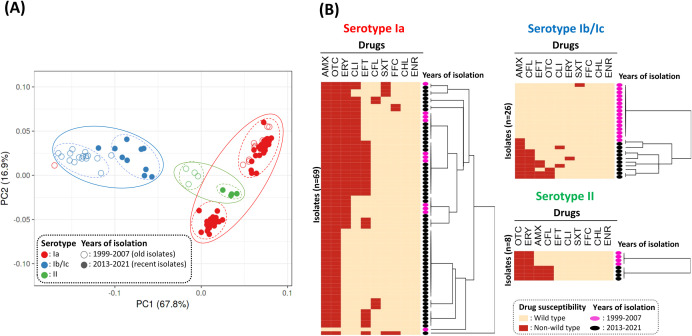
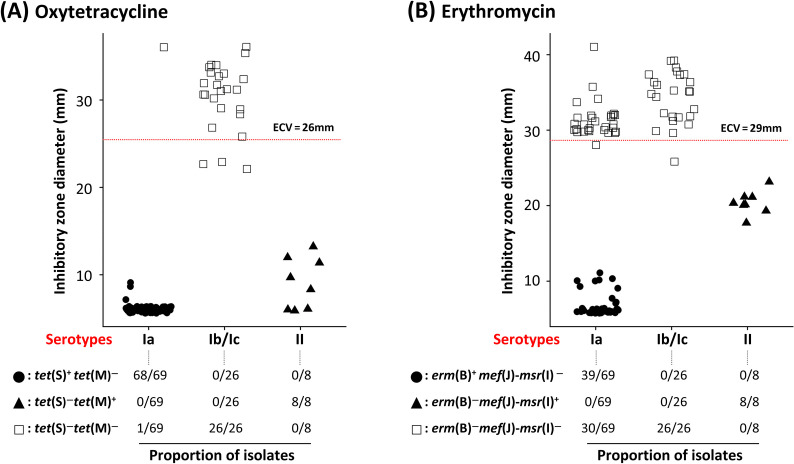
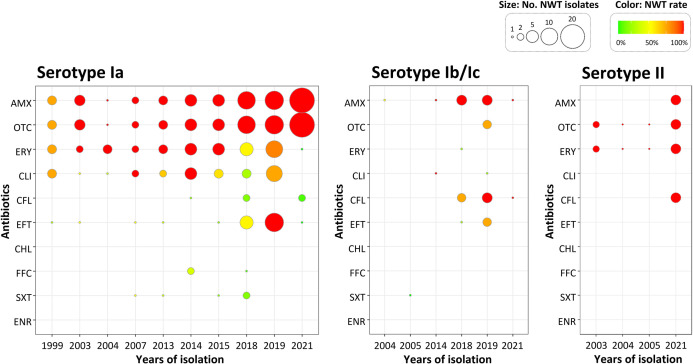
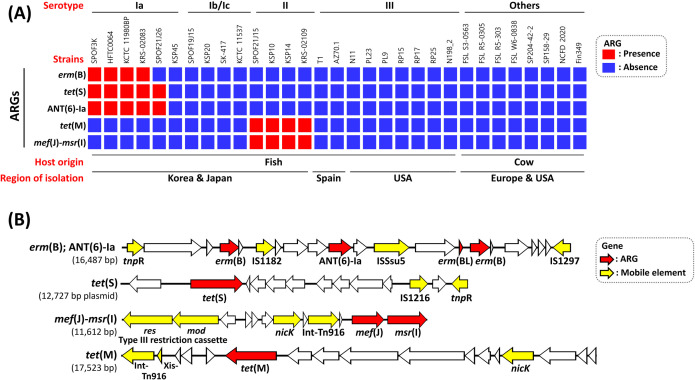
is the dominant etiological agent of streptococcosis, the most devastating bacterial disease in the olive flounder farming industry in South Korea. In this study, the distribution of serotypes, antimicrobial susceptibility, and presence of antimicrobial resistance genes (ARGs) in isolates obtained between 1999 and 2021 was thoroughly investigated to gain insight into the dynamics of their presence and the relationship between serotypes and antimicrobial resistance. Disk diffusion testing of 103 isolates against 10 antimicrobial agents was performed, and epidemiological cut-off values generated through normalized resistance interpretation analysis were used to classify wild-type (WT) and non-wild-type (NWT) populations. Principal component analysis and hierarchical clustering were implemented to achieve an understanding on the relationship between serotypes and antimicrobial resistance patterns. PCR-based serotyping showed that serotype Ia (67.1%) was the most prevalent in South Korea, followed by serotypes Ib/Ic (25.2%) and II (7.7%). The highest proportion of isolates was assigned to NWT against amoxicillin (80.6%), followed by oxytetracycline (77.7%) and erythromycin (48.5%). The time-scale data showed that recently obtained serotypes Ib/Ic and II isolates tended to be categorized as NWT populations resistant to more antibiotics, possibly due to microbial adaptation to antibiotic pressure. ARGs responsible for resistance to oxytetracycline and erythromycin were found only in NWT populations in serotype Ia [(S) and (B), respectively], and serotype II [(M) and (J)-(I), respectively]. We also found that the gene pair in serotype II might be involved in low-level resistance to erythromycin. IMPORTANCE This study presents serotype distribution and antimicrobial susceptibility data along with the antimicrobial resistance genes (ARGs) of , which is an important bacterial fish pathogen worldwide. In particular, almost all oxytetracycline and erythromycin non-wild-type (NWT) populations harbored (S) or (M), and (B) or (J)-(I), respectively. Interestingly, these ARGs were distributed in a highly serotype-dependent manner, resulting in a clear correlation between the antibiogram and serotype distribution. Moreover, recent isolates belonging to serotypes Ib/Ic and II tended to be more frequently categorized as NWT against antimicrobials, including amoxicillin and cefalexin compared to old isolates, while a dramatic decrease in erythromycin and clindamycin NWT frequencies was observed in recent serotype Ia isolates, which lacked (B). These variations might be attributed to shifts in the antibiotics employed in South Korean aquaculture over time. The overall findings would provide important background knowledge for understanding the epidemiology of infection in aquaculture.
是链球菌病的主要病原体,链球菌病是韩国牙鲆养殖业中最具破坏性的细菌性疾病。在本研究中,对1999年至2021年间获得的分离株的血清型分布、抗菌药物敏感性以及抗菌抗性基因(ARGs)的存在情况进行了全面调查,以深入了解它们的存在动态以及血清型与抗菌抗性之间的关系。对103株分离株进行了针对10种抗菌药物的纸片扩散试验,并通过标准化抗性解释分析生成的流行病学临界值用于分类野生型(WT)和非野生型(NWT)群体。实施主成分分析和层次聚类以了解血清型与抗菌抗性模式之间的关系。基于PCR的血清分型显示,血清型Ia(67.1%)在韩国最为普遍,其次是血清型Ib/Ic(25.2%)和II(7.7%)。分离株中对阿莫西林的NWT比例最高(80.6%),其次是土霉素(77.7%)和红霉素(48.5%)。时间尺度数据表明,最近获得的血清型Ib/Ic和II分离株倾向于被归类为对更多抗生素耐药的NWT群体,这可能是由于微生物对抗生素压力的适应。仅在血清型Ia [分别为(S)和(B)]以及血清型II [分别为(M)和(J)-(I)]的NWT群体中发现了对土霉素和红霉素耐药的ARGs。我们还发现血清型II中的基因对可能与对红霉素的低水平耐药有关。重要性本研究展示了血清型分布、抗菌药物敏感性数据以及重要细菌鱼类病原体的抗菌抗性基因(ARGs),该病原体在全球范围内都很重要。特别是,几乎所有土霉素和红霉素非野生型(NWT)群体分别携带(S)或(M)以及(B)或(J)-(I)。有趣的是,这些ARGs以高度血清型依赖性方式分布,导致抗菌谱与血清型分布之间存在明显相关性。此外,与旧分离株相比,最近属于血清型Ib/Ic和II的分离株更频繁地被归类为对包括阿莫西林和头孢氨苄在内的抗菌药物的NWT,而在最近缺乏(B)的血清型Ia分离株中观察到红霉素和克林霉素NWT频率显著下降。这些变化可能归因于韩国水产养殖中使用的抗生素随时间的变化。总体研究结果将为了解水产养殖中感染的流行病学提供重要的背景知识。