Owusu Richmond, Mvundura Mercy, Nonvignon Justice, Armah George, Bawa John, Antwi-Agyei Kwadwo Odei, Amponsa-Achiano Kwame, Dadzie Frederick, Bonsu George, Clark Andrew, Pecenka Clint, Debellut Frederic
School of Public Health, University of Ghana, Accra, Ghana.
Center for Vaccine Innovation and Access, PATH, Seattle, Washington, United States of America.
PLOS Glob Public Health. 2023 Aug 9;3(8):e0001328. doi: 10.1371/journal.pgph.0001328. eCollection 2023.
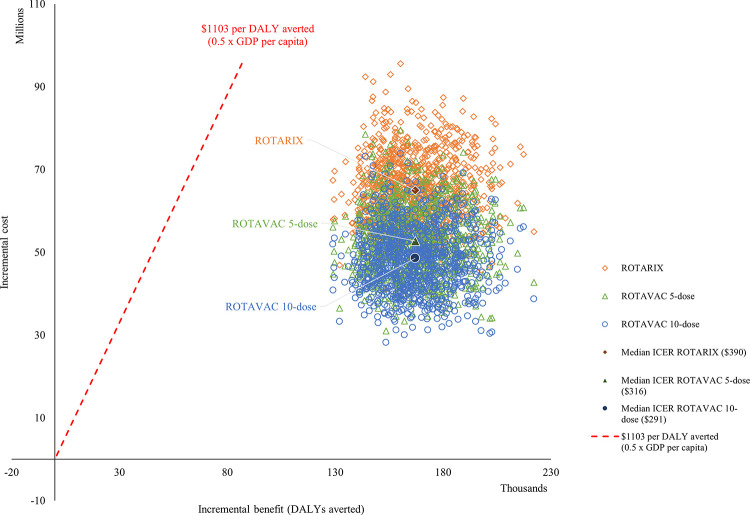
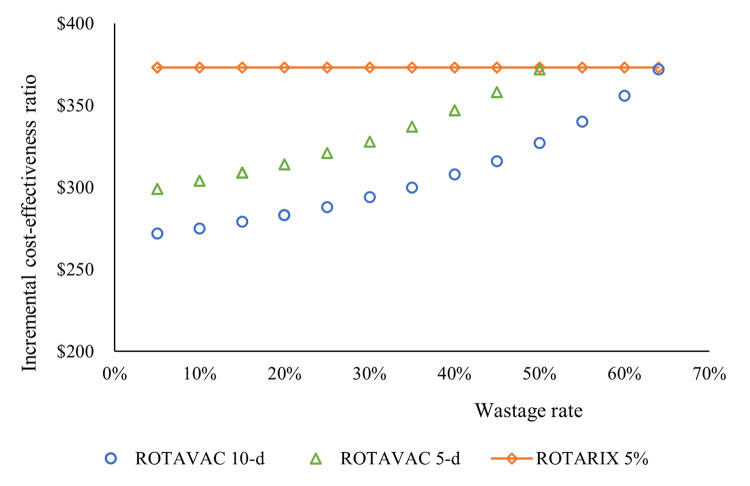
Ghana introduced rotavirus vaccine (ROTARIX 1-dose presentation) into the routine national immunization program in 2012 and switched to a different product (ROTAVAC 5-dose presentation) in 2020. ROTAVAC has a lower price per dose (US$0.85 versus US$2.15 for ROTARIX) and smaller cold chain footprint but requires more doses per regimen (three versus two). This study estimates the supply chain and service delivery costs associated with each product, the costs involved in switching products, and compares the cost-effectiveness of both products over the next ten years. We estimated the supply chain and service delivery costs associated with ROTARIX and ROTAVAC (evaluating both the 5-dose and 10-dose presentations) using primary data collected from health facilities in six of the 14 regions in the country. We estimated the costs of switching from ROTARIX to ROTAVAC using information collected from key informant interviews and financial records provided by the government. All costs were reported in 2020 US$. We used the UNIVAC decision-support model to evaluate the cost-effectiveness (US$ per disability-adjusted life-year (DALY) averted from government and societal perspectives) of ROTARIX and ROTAVAC (5-dose or 10-dose presentations) compared to no vaccination, and to each other, over a ten-year period (2020 to 2029). We ran probabilistic sensitivity analyses and other threshold analyses. The supply chain and service delivery economic cost per dose was $2.40 for ROTARIX, $1.81 for ROTAVAC 5-dose, and $1.76 for ROTAVAC 10-dose. The financial and economic cost of switching from ROTARIX to ROTAVAC 5-dose was $453,070 and $883,626, respectively. Compared to no vaccination, the cost per DALY averted was $360 for ROTARIX, $298 for ROTAVAC 5-dose, and $273 for ROTAVAC 10-dose. ROTAVAC 10-dose was the most cost-effective option and would be cost-effective at willingness-to-pay thresholds exceeding 0.12 times the national GDP per capita ($2,206 in the year 2020). The switch from ROTARIX to ROTAVAC 5-dose in 2020 was cost-saving. Rotavirus vaccination is highly cost-effective in Ghana. A switch from ROTAVAC 5-dose to ROTAVAC 10-dose would be cost-saving and should be considered.
加纳于2012年将轮状病毒疫苗(单剂量剂型的ROTARIX)纳入国家常规免疫规划,并于2020年改用另一种产品(五剂量剂型的ROTAVAC)。ROTAVAC每剂价格较低(每剂0.85美元,而ROTARIX为2.15美元),冷链需求较小,但每个免疫程序所需剂量更多(三剂而非两剂)。本研究估算了与每种产品相关的供应链和服务提供成本、产品转换所涉及的成本,并比较了两种产品在未来十年的成本效益。我们使用从该国14个地区中的6个地区的卫生机构收集的原始数据,估算了与ROTARIX和ROTAVAC(评估五剂量和十剂量剂型)相关的供应链和服务提供成本。我们利用从关键信息访谈和政府提供的财务记录中收集的信息,估算了从ROTARIX转换为ROTAVAC的成本。所有成本均以2020年美元报告。我们使用UNIVAC决策支持模型,从政府和社会角度评估了ROTARIX和ROTAVAC(五剂量或十剂量剂型)相较于不接种疫苗以及相互之间在十年期(2020年至2029年)内的成本效益(每避免一个伤残调整生命年(DALY)的美元数)。我们进行了概率敏感性分析和其他阈值分析。ROTARIX每剂的供应链和服务提供经济成本为2.40美元,五剂量剂型的ROTAVAC为1.81美元,十剂量剂型的ROTAVAC为1.76美元。从ROTARIX转换为五剂量剂型的ROTAVAC的财务和经济成本分别为453,070美元和883,626美元。与不接种疫苗相比,ROTARIX每避免一个DALY的成本为360美元,五剂量剂型的ROTAVAC为298美元,十剂量剂型的ROTAVAC为273美元。十剂量剂型的ROTAVAC是最具成本效益的选择,在支付意愿阈值超过人均国内生产总值的0.12倍(2020年为2,206美元)时具有成本效益。2020年从ROTARIX转换为五剂量剂型的ROTAVAC节省了成本。在加纳,轮状病毒疫苗具有很高的成本效益。从五剂量剂型的ROTAVAC转换为十剂量剂型的ROTAVAC将节省成本,应予以考虑。