Wellcome Centre for Integrative Neuroimaging, FMRIB Division, Nuffield Department of Clinical Neurosciences, University of Oxford, Oxford, United Kingdom.
Athinoula A. Martinos Center for Biomedical Imaging, Massachusetts General Hospital, Charlestown, MA, United States of America.
PLoS One. 2023 Aug 9;18(8):e0288529. doi: 10.1371/journal.pone.0288529. eCollection 2023.
Accurate assessment of plaque accumulation near the carotid bifurcation is important for the effective prevention and treatment of stroke. However, vessel and plaque delineation using MRI can be limited by low contrast-to-noise ratio (CNR) and long acquisition times. In this work, a 10-channel phased-array receive coil design for bilateral imaging of the carotid bifurcation using 3T MRI is proposed.
The proposed 10-channel receive coil was compared to a commercial 4-channel receive coil configuration using data acquired from phantoms and healthy volunteers (N = 9). The relative performance of the coils was assessed, by comparing signal-to-noise ratio (SNR), noise correlation, g-factor noise amplification, and the CNR between vessel wall and lumen using black-blood sequences. Patient data were acquired from 12 atherosclerotic carotid artery disease patients.
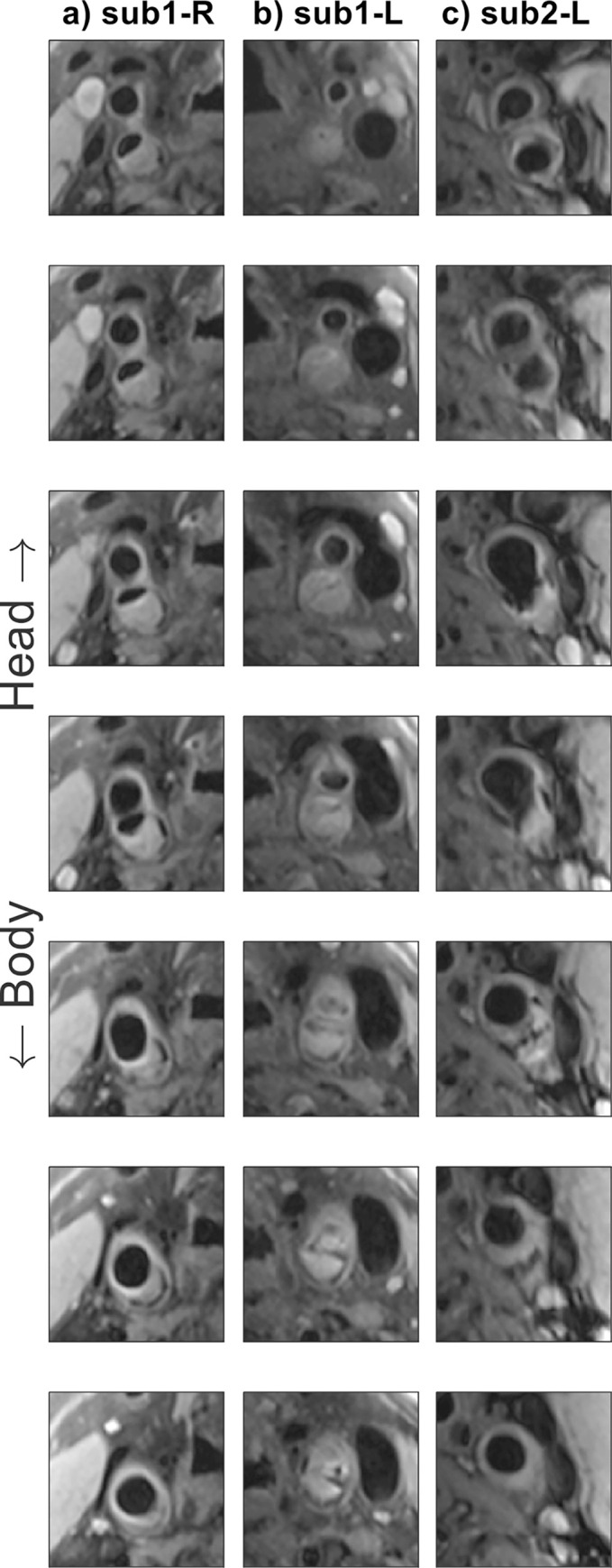
The 10-channel coil consistently provided substantially increased SNR in phantoms (+77 ± 27%) and improved CNR in healthy carotid arteries (+62 ± 11%), or reduced g-factor noise amplification. Patient data showed excellent delineation of atherosclerotic plaque along the length of the carotid bifurcation using the 10-channel coil.
The proposed 10-channel coil design allows for improved visualization of the carotid arteries and the carotid bifurcation and increased parallel imaging acceleration factors relative to a commercial 4-channel coil design.
准确评估颈动脉分叉处的斑块积累对于有效预防和治疗中风非常重要。然而,使用 MRI 进行血管和斑块描绘可能会受到低对比噪声比(CNR)和较长采集时间的限制。在这项工作中,提出了一种用于使用 3T MRI 对颈动脉分叉进行双侧成像的 10 通道相控阵接收线圈设计。
使用来自体模和健康志愿者的数据(N = 9),将提出的 10 通道接收线圈与商业 4 通道接收线圈配置进行比较。通过比较黑血序列中的信噪比(SNR)、噪声相关性、g 因子噪声放大和血管壁与管腔之间的 CNR,评估线圈的相对性能。从 12 例动脉粥样硬化性颈动脉疾病患者中获取患者数据。
10 通道线圈在体模中始终提供了显著增加的 SNR(+77 ± 27%),并在健康颈动脉中提高了 CNR(+62 ± 11%)或降低了 g 因子噪声放大。患者数据显示,使用 10 通道线圈可极好地描绘颈动脉分叉处的动脉粥样硬化斑块。
与商业 4 通道线圈设计相比,所提出的 10 通道线圈设计允许更好地可视化颈动脉和颈动脉分叉,并增加并行成像加速因子。