Department of Family Medicine, University of California San Diego, San Diego, California.
Center for Medicinal Cannabis Research, Department of Psychiatry, University of California San Diego, San Diego, California.
Am J Cardiol. 2023 Oct 1;204:226-233. doi: 10.1016/j.amjcard.2023.07.065. Epub 2023 Aug 7.
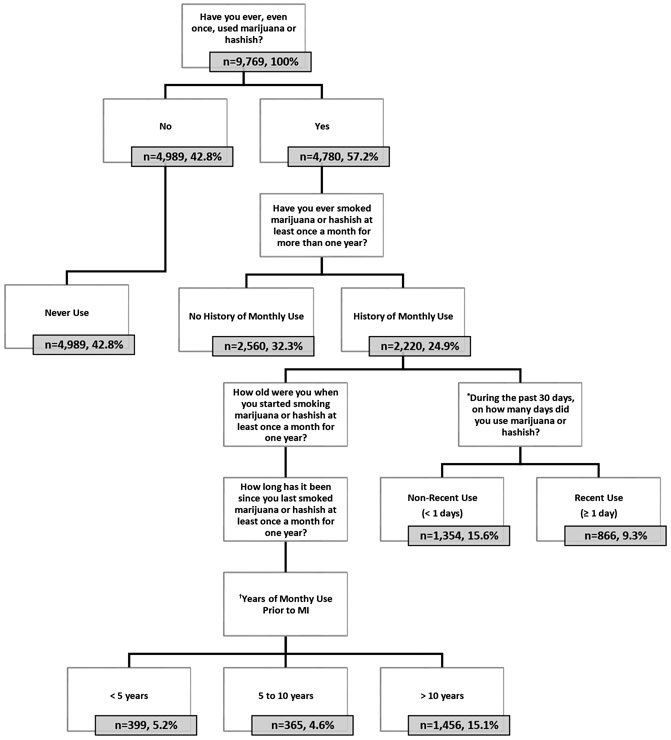
Mechanistic research suggests using Cannabis sativa L. (cannabis or marijuana) may increase the risk of cardiometabolic disease, but observational studies investigating associations between cannabis use and myocardial infarction (MI) have reported inconsistent results. Cross-sectional National Health and Nutrition Examination Survey data from five 2-year cycles between 2009 and 2018 and representing 9,769 middle-aged adults (35 to 59 years old) were analyzed. Multivariable logistic regression models accounting for sampling weights and adjusting for cardiovascular risk factors were used to assess associations between a history of monthly cannabis use before MI and a subsequent MI. A quarter of respondents (n = 2,220) reported a history of monthly use >1 year before an MI. A history of MI was reported by 2.1% of all respondents and 3.2.% of those who reported a history of monthly use. In fully adjusted multivariable models, and compared with never use, a history of monthly cannabis use preceding an MI was not associated with an MI (odds ratio [OR] 0.78, 95% confidence interval [CI] 0.35 to 1.71). However, when stratified by recent use, the odds of MI were threefold greater (OR 2.98, 95% CI 1.08 to 8.60) when no use was reported within the past month than when use was reported within the past month. Duration of monthly use was also not significantly associated with MI, including monthly use >10 years (OR 0.78, 95% CI 0.30 to 2.01). In conclusion, in a representative sample of middle-aged US adults, a history of monthly cannabis use >1 year before an MI was not associated with a subsequent physician-diagnosed MI, except for threefold greater odds when cannabis was not used within the past month.
机制研究表明,使用大麻植物(大麻或大麻)可能会增加患心血管疾病的风险,但观察性研究调查大麻使用与心肌梗死(MI)之间的关联报告结果不一致。分析了 2009 年至 2018 年五个 2 年周期的全国健康和营养调查横断面数据,共代表 9769 名中年成年人(35 至 59 岁)。使用多变量逻辑回归模型,考虑到抽样权重,并调整心血管危险因素,评估 MI 前每月大麻使用史与随后 MI 之间的关联。四分之一的受访者(n=2220)报告了 MI 前 >1 年的每月使用史。所有受访者中有 2.1%报告了 MI 病史,而报告每月使用史的受访者中有 3.2%报告了 MI 病史。在完全调整后的多变量模型中,与从未使用相比,MI 前每月使用大麻史与 MI 无关(比值比[OR]0.78,95%置信区间[CI]0.35 至 1.71)。然而,当按近期使用情况分层时,与报告过去一个月内没有使用相比,当报告过去一个月内没有使用时,MI 的可能性增加了三倍(OR 2.98,95%CI 1.08 至 8.60)。每月使用时间与 MI 也没有显著相关,包括每月使用 >10 年(OR 0.78,95%CI 0.30 至 2.01)。总之,在代表美国中年成年人的样本中,MI 前 >1 年的每月大麻使用史与随后的医生诊断 MI 无关,除非在过去一个月内未使用大麻,否则可能性增加三倍。