Centre for Family and Population Research, National University of Singapore, Singapore, Singapore.
Department of Sociology and Anthropology, Centre for Family and Population Research, National University of Singapore, Singapore, Singapore.
BMC Public Health. 2023 Aug 9;23(1):1508. doi: 10.1186/s12889-023-16426-9.
To investigate the impact of the COVID-19 pandemic on life expectancy at birth (e) for 51 Asian countries and territories from January 1, 2020 to December 31, 2021.
Based on age-sex-specific mortality used for estimating the changes in e for years 2019, 2020, and 2021 from the 2022 revision of the World Population Prospects, we employed Arriaga's discrete method to decompose changes in e into both absolute and relative contributions of changes in age-specific death rate, and further obtained the age-sex-specific contribution to changes in e by country/territory and period (i.e., 2019-2020 and 2020-2021) for Asia.
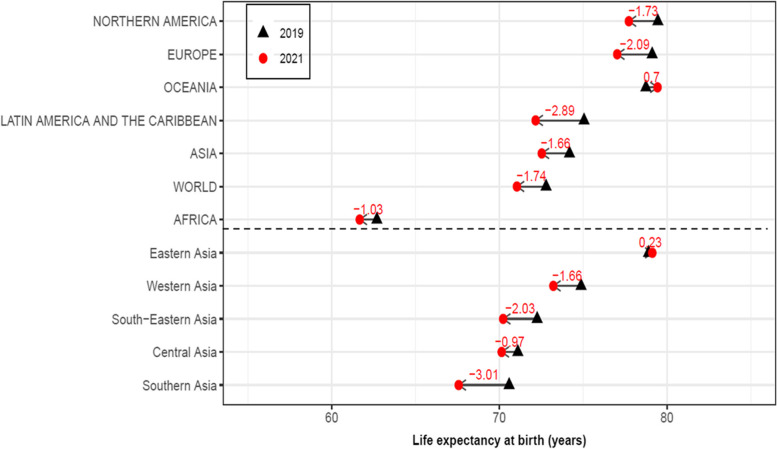
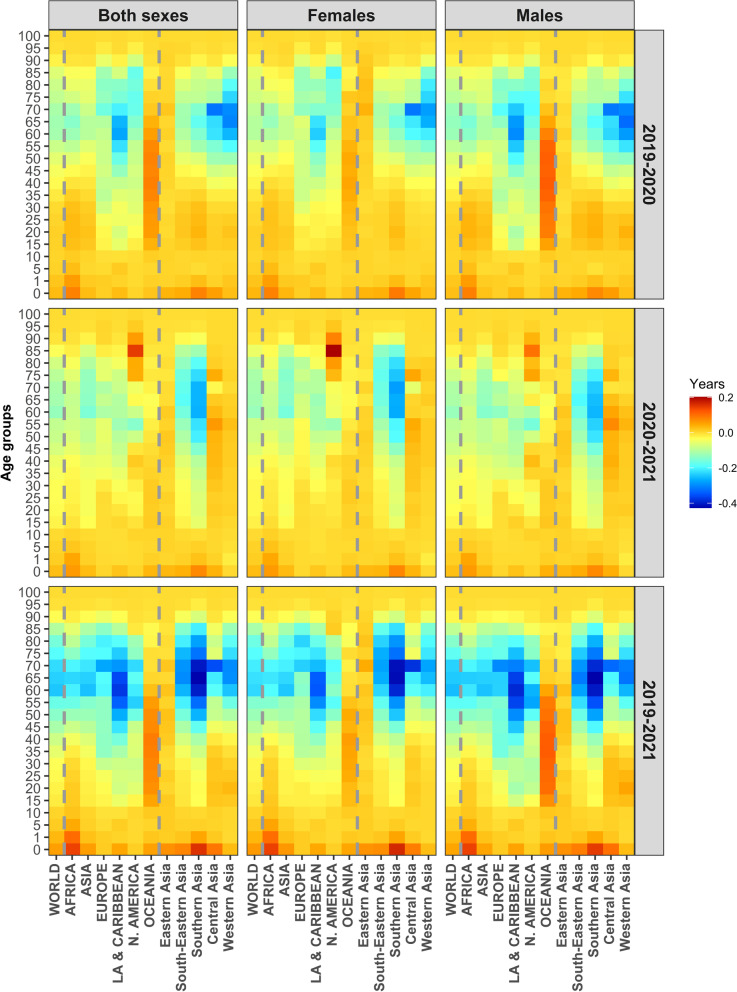
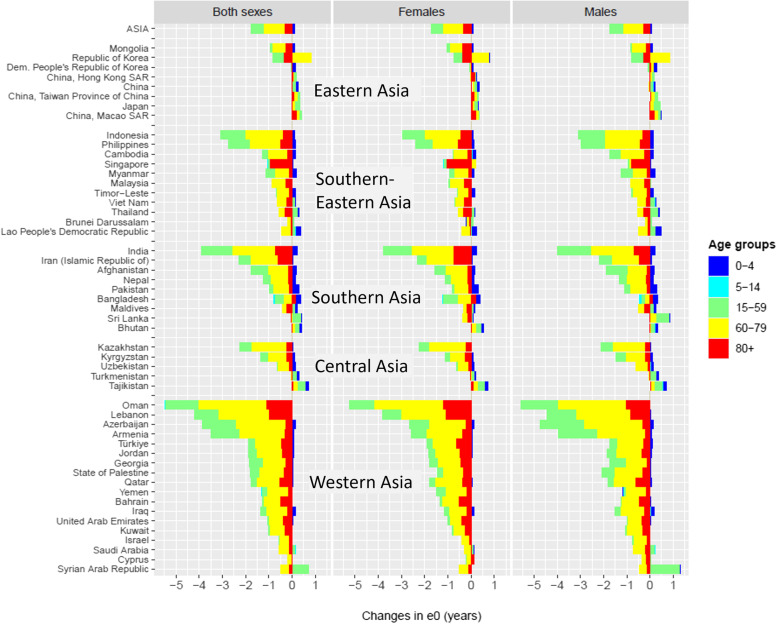
The COVID-19 pandemic reduced 1.66 years in e of the Asian population from 2019 to 2021, slightly lower than the world average of 1.74 years. South Asia had a high loss of 3.01 years, whereas Eastern Asia had almost no changes. Oman, Lebanon, India, Armenia, Azerbaijan, Indonesia, and the Philippines experienced a high loss of above 2.5 years in e. Despite significant national and territorial variations, the decline of e in Asia was mostly from the age group of 60-79 years, followed by age groups of 80 + and 45-59 years; and age groups of children contributed little (i.e., 0-4 and 5-14 years old). Males suffered more losses than females in this pandemic. Asian nations saw less loss in e in the second year of the pandemic, i.e., 2020-2021, than in the first year, i.e., 2019-2020, but this recovery trend was not observed in Southern Asia and South-Eastern Asia. Countries from Central Asia and Western Asia, such as Kazakhstan, Armenia, Azerbaijan, Lebanon, and Oman, had extraordinarily more losses in e in the first year at ages around 70.
The COVID-19 pandemic had significantly affected e of Asian populations, and most contribution to the reduction of e came from the three older age groups, 60-79 years, 80 + years, and 45-59 years, with great variations across countries/territories. Our findings could have important implications for development of more resilient public health systems in Asian societies with better policy interventions for vulnerable demographic groups.
研究 2020 年 1 月 1 日至 2021 年 12 月 31 日期间,COVID-19 大流行对 51 个亚洲国家和地区出生时预期寿命(e)的影响。
我们利用 2022 年《世界人口展望》修订版中用于估计 2019 年、2020 年和 2021 年 e 变化的年龄性别特定死亡率,采用 Arriaga 的离散方法将 e 的变化分解为年龄别死亡率变化的绝对和相对贡献,进一步按国家/地区和时期(即 2019-2020 年和 2020-2021 年)获得 e 变化对各年龄段的贡献。
COVID-19 大流行使亚洲人口的 e 从 2019 年到 2021 年减少了 1.66 年,略低于全球平均水平 1.74 年。南亚的损失高达 3.01 年,而东亚几乎没有变化。阿曼、黎巴嫩、印度、亚美尼亚、阿塞拜疆、印度尼西亚和菲律宾的 e 损失超过 2.5 年。尽管存在显著的国家和地区差异,但亚洲 e 的下降主要来自 60-79 岁年龄组,其次是 80 岁及以上年龄组和 45-59 岁年龄组;儿童年龄组(0-4 岁和 5-14 岁)贡献很小。在这场大流行中,男性比女性遭受的损失更大。亚洲国家在疫情第二年(即 2020-2021 年)的 e 损失比第一年(即 2019-2020 年)要小,但这种恢复趋势在南亚和东南亚没有观察到。中亚和西亚国家,如哈萨克斯坦、亚美尼亚、阿塞拜疆、黎巴嫩和阿曼,在 70 岁左右的年龄组中,e 的损失在第一年异常增加。
COVID-19 大流行对亚洲人口的 e 产生了重大影响,e 减少的主要贡献来自 60-79 岁、80 岁及以上和 45-59 岁这三个较年长的年龄组,各国/地区之间存在很大差异。我们的研究结果可能对亚洲社会制定更具弹性的公共卫生系统和为弱势人口群体实施更好的政策干预措施具有重要意义。