Kim Eun-Sook, Kim Sun Young, Moon Aree
Duksung Innovative Drug Center, College of Pharmacy, Duksung Women's University, Seoul 01369, Republic of Korea.
Department of Chemistry, College of Science and Technology, Duksung Women's University, Seoul 01369, Republic of Korea.
Biomol Ther (Seoul). 2023 Sep 1;31(5):473-483. doi: 10.4062/biomolther.2023.132. Epub 2023 Aug 11.
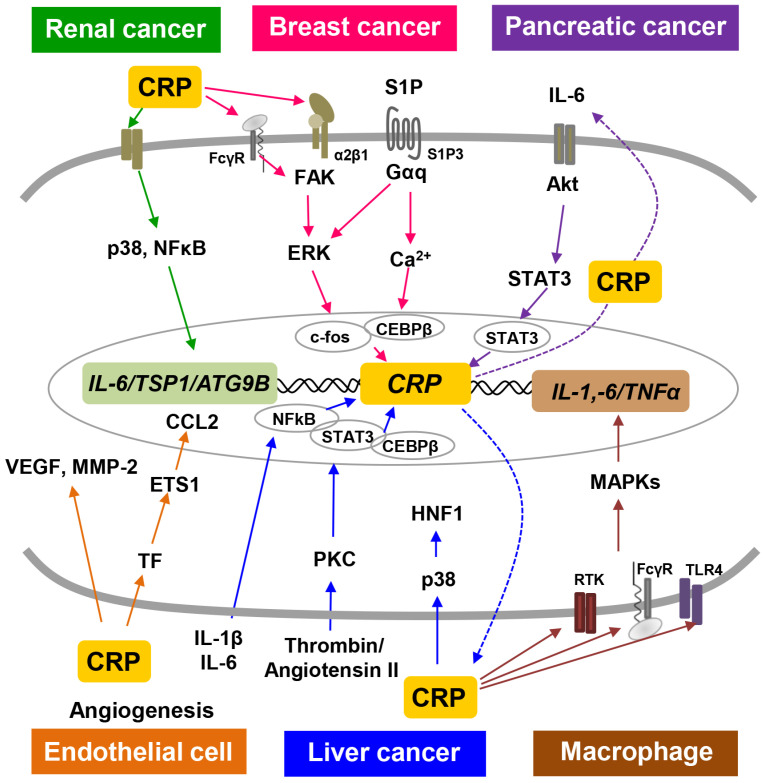
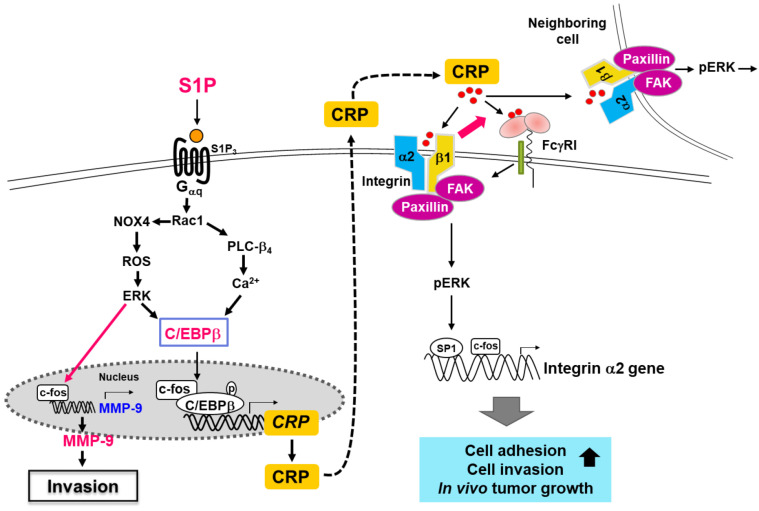
Many cancers arise from sites of chronic inflammation, which creates an inflammatory microenvironment surrounding the tumor. Inflammatory substances secreted by cells in the inflammatory environment can induce the proliferation and survival of cancer cells, thereby promoting cancer metastasis and angiogenesis. Therefore, it is important to identify the role of inflammatory factors in cancer progression. This review summarizes the signaling pathways and roles of C-reactive protein (CRP) in various cancer types, including breast, liver, renal, and pancreatic cancer, and the tumor microenvironment. Mounting evidence suggests the role of CRP in breast cancer, particularly in triple-negative breast cancer (TNBC), which is typically associated with a worse prognosis. Increased CRP in the inflammatory environment contributes to enhanced invasiveness and tumor formation in TNBC cells. CRP promotes endothelial cell formation and angiogenesis and contributes to the initiation and progression of atherosclerosis. In pancreatic and kidney cancers, CRP contributes to tumor progression. In liver cancer, CRP regulates inflammatory responses and lipid metabolism. CRP modulates the activity of various signaling molecules in macrophages and monocytes present in the tumor microenvironment, contributing to tumor development, the immune response, and inflammation. In the present review, we overviewed the role of CRP signaling pathways and the association between inflammation and cancer in various types of cancer. Identifying the interactions between CRP signaling pathways and other inflammatory mediators in cancer progression is crucial for understanding the complex relationship between inflammation and cancer.
许多癌症起源于慢性炎症部位,这会在肿瘤周围形成炎症微环境。炎症环境中的细胞分泌的炎症物质可诱导癌细胞增殖和存活,从而促进癌症转移和血管生成。因此,确定炎症因子在癌症进展中的作用很重要。本综述总结了C反应蛋白(CRP)在包括乳腺癌、肝癌、肾癌和胰腺癌等各种癌症类型以及肿瘤微环境中的信号通路和作用。越来越多的证据表明CRP在乳腺癌中发挥作用,尤其是在三阴性乳腺癌(TNBC)中,三阴性乳腺癌通常预后较差。炎症环境中CRP的增加会导致TNBC细胞的侵袭性增强和肿瘤形成。CRP促进内皮细胞形成和血管生成,并有助于动脉粥样硬化的发生和发展。在胰腺癌和肾癌中,CRP促进肿瘤进展。在肝癌中,CRP调节炎症反应和脂质代谢。CRP调节肿瘤微环境中巨噬细胞和单核细胞中各种信号分子的活性,促进肿瘤发展、免疫反应和炎症。在本综述中,我们概述了CRP信号通路的作用以及炎症与各种癌症类型中癌症之间的关联。确定CRP信号通路与癌症进展中其他炎症介质之间的相互作用对于理解炎症与癌症之间的复杂关系至关重要。