Adelaide Medical School, The University of Adelaide, Adelaide, SA, Australia.
Precision Cancer Medicine Theme, South Australian Health and Medical Research Institute, Adelaide, SA, Australia.
Br J Cancer. 2023 Oct;129(9):1442-1450. doi: 10.1038/s41416-023-02392-x. Epub 2023 Aug 10.
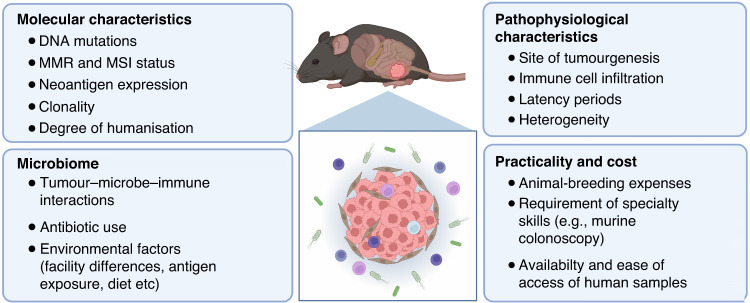
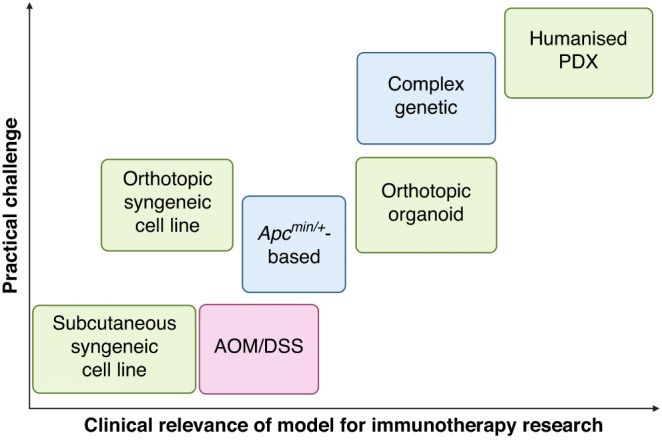
Colorectal cancer (CRC) is a common and deadly disease. Unfortunately, immune checkpoint inhibitors (ICIs) fail to elicit effective anti-tumour responses in the vast majority of CRC patients. Patients that are most likely to respond are those with DNA mismatch repair deficient (dMMR) and microsatellite instability (MSI) disease. However, reliable predictors of ICI response are lacking, even within the dMMR/MSI subtype. This, together with identification of novel mechanisms to increase response rates and prevent resistance, are ongoing and vitally important unmet needs. To address the current challenges with translation of early research findings into effective therapeutic strategies, this review summarises the present state of preclinical testing used to inform the development of immuno-regulatory treatment strategies for CRC. The shortfalls and advantages of commonly utilised mouse models of CRC, including chemically induced, transplant and transgenic approaches are highlighted. Appropriate use of existing models, incorporation of patient-derived data and development of cutting-edge models that recapitulate important features of human disease will be key to accelerating clinically relevant research in this area.
结直肠癌(CRC)是一种常见且致命的疾病。不幸的是,免疫检查点抑制剂(ICIs)在绝大多数 CRC 患者中未能引发有效的抗肿瘤反应。最有可能产生反应的患者是那些具有 DNA 错配修复缺陷(dMMR)和微卫星不稳定(MSI)疾病的患者。然而,即使在 dMMR/MSI 亚型内,ICI 反应的可靠预测因子也仍然缺乏。这一点,以及确定增加反应率和预防耐药性的新机制,是正在进行的、至关重要的未满足需求。为了解决将早期研究发现转化为有效治疗策略的当前挑战,本综述总结了目前用于为 CRC 的免疫调节治疗策略的开发提供信息的临床前测试的现状。突出了常用于 CRC 的常见小鼠模型(包括化学诱导、移植和转基因方法)的缺点和优点。适当使用现有的模型,结合患者衍生的数据,并开发能够重现人类疾病重要特征的最先进模型,将是加速该领域临床相关研究的关键。