Chan Tzu-Chi, Ullah Aman, Roy Bedanta, Chang Shinn-Liang
Department of Mechanical and Computer-Aided Engineering, National Formosa University, Yunlin County, 632, Taiwan, R.O.C.
Department of Power Mechanical Engineering, National Formosa University, Yunlin County, 632, Taiwan, R.O.C..
Sci Rep. 2023 Aug 10;13(1):13006. doi: 10.1038/s41598-023-40214-5.
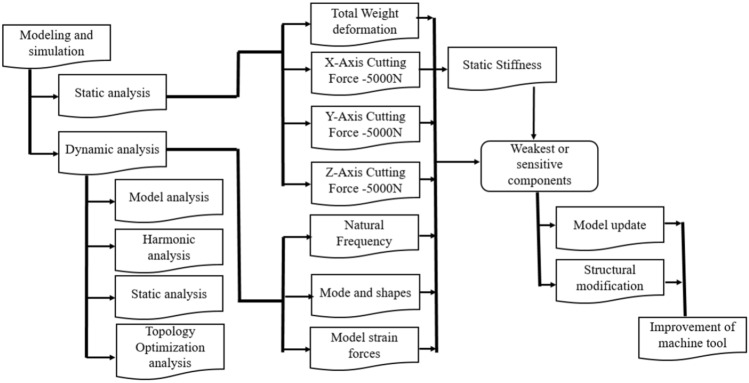
The high-precision machine tool's dynamic, static, and rigid nature directly affects the machining efficiency and surface quality. Static and dynamic analyses are essential for the design and improvement of precision machine to ensure good tool performance under difficult and demanding machining conditions. In this study, the performance of a high-precision machine tool was analyzed using its virtual model created using CAD. Static and model analysis using ANSYS Workbench software was conducted to establish the tool's static deformation and static stiffness. Furthermore, the static and dynamic characteristics of the tool were explored using a finite element modeling approach to study their performance. In particular, the structure, static force, modal, frequency spectrum, and topology optimization of machine tools were primarily analyzed. Using model analysis, we found the first four different frequencies (22.5, 28.9, 40.6, and 47.4 Hz) and vibration type, which suggested of a weak link. Further static structural analysis revealed that the deformation of the spindle was 67.26 μm. An experimental static rigidity analysis was performed, and the experimental deformation values of the tool and spindle were obtained. The static and dynamic characteristics, as well as the accuracy and efficiency of the finite element model, were verified by comparing the data with the finite element analysis (FEA) results. Subsequently, we modified the settings and analysis model to ensure that the analysis results were consistent with the experimental findings. The error between the two results was within 1.56%. For an applied load of 5000 N on the spindle nose, the tool nose transient response was 0.5 s based on transient analysis. Under the condition that the structural deformation is as constant as possible, the lightweight structure may achieve the minimum weight and enhance the natural frequency; thus, the ideal structure will be obtained, and finite element analysis will then be performed. The optimal conditions for topology optimization include a lightweight structure, reduced structural deformation, and increased natural frequency of the structure. The developed method improves structural optimization, increases the ability of the product to be manufactured, and offers designers a variety of price-effective options.
高精度机床的动态、静态和刚性特性直接影响加工效率和表面质量。静态和动态分析对于精密机床的设计和改进至关重要,以确保在困难和苛刻的加工条件下具有良好的刀具性能。在本研究中,使用CAD创建的虚拟模型对高精度机床的性能进行了分析。使用ANSYS Workbench软件进行了静态和模态分析,以确定刀具的静态变形和静态刚度。此外,采用有限元建模方法探索了刀具的静态和动态特性,以研究其性能。特别是,主要分析了机床的结构、静力、模态、频谱和拓扑优化。通过模态分析,我们发现了前四个不同的频率(22.5、28.9、40.6和47.4Hz)和振动类型,这表明存在薄弱环节。进一步的静态结构分析表明,主轴的变形为67.26μm。进行了实验静态刚度分析,并获得了刀具和主轴的实验变形值。通过将数据与有限元分析(FEA)结果进行比较,验证了有限元模型的静态和动态特性以及精度和效率。随后,我们修改了设置和分析模型,以确保分析结果与实验结果一致。两个结果之间的误差在1.56%以内。基于瞬态分析,对于主轴端部施加5000N的载荷,刀尖瞬态响应为0.5s。在结构变形尽可能恒定的条件下,轻量化结构可以实现最小重量并提高固有频率;因此,将获得理想结构,然后进行有限元分析。拓扑优化的最佳条件包括轻量化结构、减少结构变形和提高结构固有频率。所开发的方法改进了结构优化,提高了产品的可制造性,并为设计人员提供了各种性价比高的选择。