Department of Infectious Diseases, The Second Affiliated Hospital, Zhejiang University School of Medicine, Hangzhou, 310009, Zhejiang, China.
Mol Diagn Ther. 2023 Nov;27(6):685-701. doi: 10.1007/s40291-023-00669-8. Epub 2023 Aug 11.
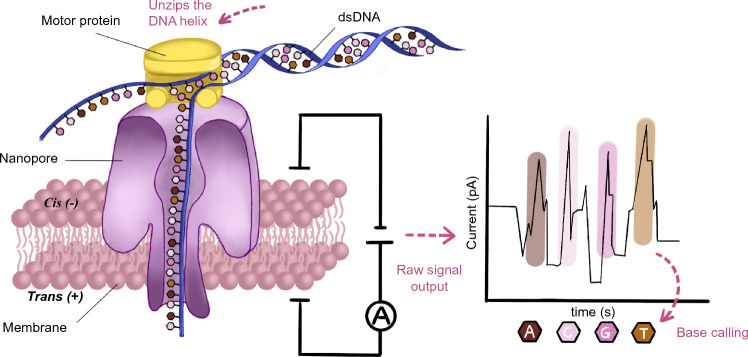
This review provides an in-depth discussion of the development, principles and utility of nanopore sequencing technology and its diverse applications in the identification of various pulmonary pathogens. We examined the emergence and advancements of nanopore sequencing as a significant player in this field. We illustrate the challenges faced in diagnosing mixed infections and further scrutinize the use of nanopore sequencing in the identification of single pathogens, including viruses (with a focus on its use in epidemiology, outbreak investigation, and viral resistance), bacteria (emphasizing 16S targeted sequencing, rare bacterial lung infections, and antimicrobial resistance studies), fungi (employing internal transcribed spacer sequencing), tuberculosis, and atypical pathogens. Furthermore, we discuss the role of nanopore sequencing in metagenomics and its potential for unbiased detection of all pathogens in a clinical setting, emphasizing its advantages in sequencing genome repeat areas and structural variant regions. We discuss the limitations in dealing with host DNA removal, the inherent high error rate of nanopore sequencing technology, along with the complexity of operation and processing, while acknowledging the possibilities provided by recent technological improvements. We compared nanopore sequencing with the BioFire system, a rapid molecular diagnostic system based on polymerase chain reaction. Although the BioFire system serves well for the rapid screening of known and common pathogens, it falls short in the identification of unknown or rare pathogens and in providing comprehensive genome analysis. As technological advancements continue, it is anticipated that the role of nanopore sequencing technology in diagnosing and treating lung infections will become increasingly significant.
本文深入探讨了纳米孔测序技术的发展、原理和应用,及其在各种肺部病原体鉴定中的广泛应用。我们考察了纳米孔测序作为该领域重要技术的出现和发展。我们说明了在诊断混合感染方面所面临的挑战,并进一步探讨了纳米孔测序在单一致病菌鉴定中的应用,包括病毒(重点介绍其在流行病学、暴发调查和病毒耐药性研究中的应用)、细菌(强调 16S 靶向测序、罕见细菌肺部感染和抗菌药物耐药性研究)、真菌(采用内部转录间隔区测序)、结核病和非典型病原体。此外,我们还讨论了纳米孔测序在宏基因组学中的作用及其在临床环境中对所有病原体进行无偏检测的潜力,强调其在测序基因组重复区域和结构变异区域方面的优势。我们讨论了在去除宿主 DNA、纳米孔测序技术固有高错误率以及操作和处理的复杂性方面的限制,同时承认了最近技术改进所提供的可能性。我们将纳米孔测序与基于聚合酶链反应的快速分子诊断系统——BioFire 系统进行了比较。虽然 BioFire 系统在快速筛选已知和常见病原体方面表现出色,但在鉴定未知或罕见病原体以及提供全面基因组分析方面存在不足。随着技术的不断进步,可以预见纳米孔测序技术在肺部感染的诊断和治疗中的作用将变得越来越重要。