Teaching Hospital of the Federal University of Uberlândia (UFU), Minas Gerais, Uberlândia, Brazil.
Instituto de Medicina Integral Prof. Fernando Figueira (IMIP), Recife, Pernambuco, Brazil.
BMC Pregnancy Childbirth. 2023 Aug 10;23(1):573. doi: 10.1186/s12884-023-05874-1.
Postpartum hemorrhage (PPH) is the leading cause of maternal death worldwide, particularly in low- and middle-income countries; however, the majority of these deaths could be avoided with adequate obstetric care. Analyzing severe maternal outcomes (SMO) has been a major approach for evaluating the quality of the obstetric care provided, since the morbid events that lead to maternal death generally occur in sequence. The objective of this study was to analyze the clinical profile, management, maternal outcomes and factors associated with SMO in women who developed PPH and were admitted to an obstetric intensive care unit (ICU) in northeastern Brazil.
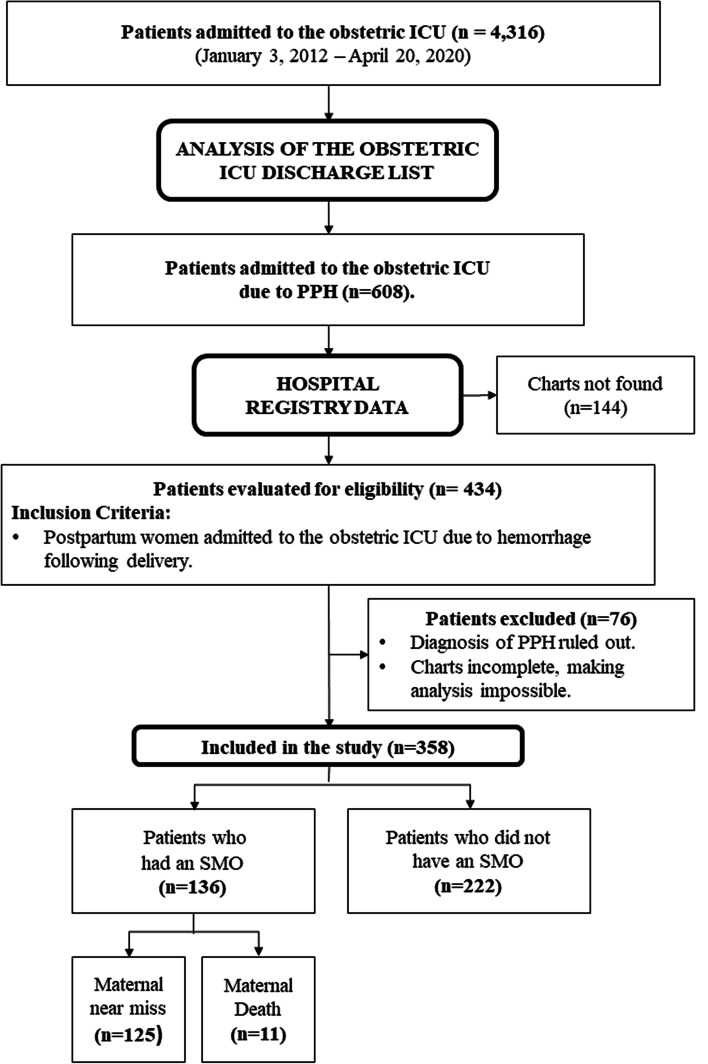
This retrospective cohort study included a non-probabilistic, consecutive sample of postpartum women with a diagnosis of PPH who were admitted to the obstetric ICU of the Instituto de Medicina Integral Prof. Fernando Figueira (IMIP) between January 2012 and March 2020. Sociodemographic, biological and obstetric characteristics and data regarding childbirth, the management of PPH and outcomes were collected and analyzed. The frequency of maternal near miss (MNM) and death was calculated. Multiple logistic regression analysis was performed to determine the adjusted odd ratios (AOR) and their 95% confidence intervals (95% CI) for a SMO.
Overall, 136 cases of SMO were identified (37.9%), with 125 cases of MNM (34.9%) and 11 cases of maternal death (3.0%). The factors that remained associated with an SMO following multivariate analysis were gestational age ≤ 34 weeks (AOR = 2.01; 95% CI: 1.12-3.64; p < 0.02), multiparity (AOR = 2.20; 95% CI: 1.10-4.68; p = 0.02) and not having delivered in the institute (AOR = 2.22; 955 CI: 1.02-4.81; p = 0.04).
Women admitted to the obstetric ICU with a diagnosis of PPH who had had two or more previous deliveries, gestational age ≤ 34 weeks and who had delivered elsewhere were more likely to have a SMO.
产后出血(PPH)是全球范围内导致产妇死亡的主要原因,尤其是在中低收入国家;然而,通过充分的产科护理,大多数此类死亡是可以避免的。分析严重产妇结局(SMO)一直是评估所提供产科护理质量的主要方法,因为导致产妇死亡的病态事件通常是按顺序发生的。本研究的目的是分析在巴西东北部一家产科重症监护病房(ICU)接受治疗的患有 PPH 的女性的临床特征、处理方法、产妇结局以及与 SMO 相关的因素。
本回顾性队列研究包括 2012 年 1 月至 2020 年 3 月期间在费尔南多·菲格雷多综合医学研究所(IMIP)产科 ICU 就诊并诊断为 PPH 的产后女性的非概率连续样本。收集并分析了社会人口学、生物学和产科特征以及与分娩、PPH 处理和结局相关的数据。计算了产妇接近死亡(MNM)和死亡的发生率。采用多变量逻辑回归分析确定 SMO 的调整比值比(AOR)及其 95%置信区间(95%CI)。
总体而言,确定了 136 例 SMO(37.9%),其中 125 例 MNM(34.9%)和 11 例产妇死亡(3.0%)。多变量分析后与 SMO 相关的因素包括胎龄≤34 周(AOR=2.01;95%CI:1.12-3.64;p<0.02)、多胎妊娠(AOR=2.20;95%CI:1.10-4.68;p=0.02)和非本院分娩(AOR=2.22;955CI:1.02-4.81;p=0.04)。
在产科 ICU 就诊并诊断为 PPH 的女性中,有两次或两次以上分娩史、胎龄≤34 周且在其他地方分娩的女性更有可能出现 SMO。