Sharbafchi Mohammad Reza, Malekian Azadeh, Ahmadzadeh Zahra, Torkian Samaneh, Baharizadeh Alireza, Zarean Elham
Department of Psychiatry, School of Medicine, Isfahan University of Medical Sciences and Iranian Cancer Control Center (MACSA), Isfahan, Iran.
Clinical Research Development Center (CRDC), Islamic Azad University, Najafabad Independent Branch, Najafabad, Iran.
Adv Biomed Res. 2023 Jun 28;12:151. doi: 10.4103/abr.abr_137_22. eCollection 2023.
One of the most debilitating symptoms in breast cancer survivors is cancer-related fatigue (CRF). CRF weakens patients' physical, cognitive, and occupational functions. It is associated with poorer quality of life and may reduce recurrence-free and overall survival. This study aimed to evaluate the efficacy of a group psychoeducational intervention in improving CRF in breast cancer patients.
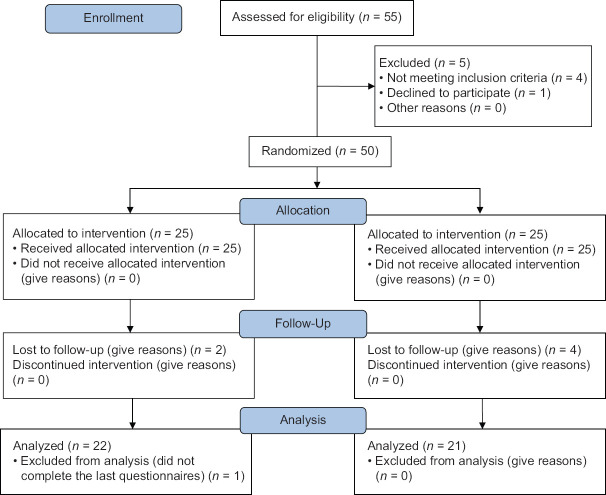
Fifty breast cancer patients who suffered from CRF were randomly assigned to receive a group psychoeducational intervention or control group. This study was designed as an eight weeks clinical trial. The psychoeducational intervention mainly consisted of concentrative movement therapy and energy conservation strategies. Primary outcome measures were the changes in the Fatigue Visual Analogue scale, Cancer Fatigue scale, and Piper Fatigue scale at the study endpoint. Measure assessments were made on four occasions: at baseline, after the intervention, one week, and four weeks post intervention. Statistical analysis was performed using SPSS26.
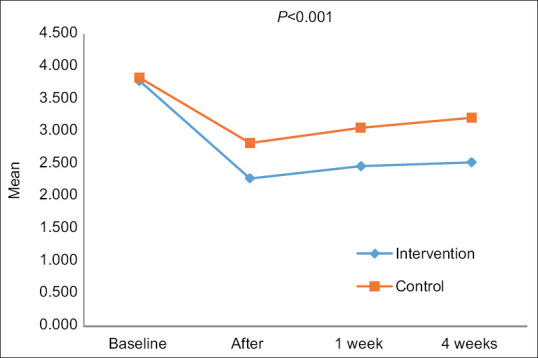
The intervention improved CRF significantly ( < 0.001). All subscales of the Cancer Fatigue scale and the sensory, affective, and cognitive subscales of the Piper Fatigue scale showed statistically significant effects ( < 0.001) at all time points. However, the behavioral subscale of the Piper Fatigue scale was different only at the end of the study ( < 0.001).
The group psychoeducational intervention improved CRF significantly. All the sensory, behavioral, physical, affective, and cognitive subscales improved. Accessible and confirmatory treatment can help patients to cope with fatigue in communities.
乳腺癌幸存者最使人衰弱的症状之一是癌症相关疲劳(CRF)。CRF会削弱患者的身体、认知和职业功能。它与较差的生活质量相关,可能会降低无复发生存率和总生存率。本研究旨在评估团体心理教育干预对改善乳腺癌患者CRF的疗效。
50名患有CRF的乳腺癌患者被随机分配接受团体心理教育干预或对照组。本研究设计为一项为期八周的临床试验。心理教育干预主要包括集中运动疗法和能量节约策略。主要结局指标是研究终点时疲劳视觉模拟量表、癌症疲劳量表和派珀疲劳量表的变化。在四个时间点进行测量评估:基线时、干预后、干预后一周和四周。使用SPSS26进行统计分析。
干预显著改善了CRF(<0.001)。癌症疲劳量表的所有子量表以及派珀疲劳量表的感觉、情感和认知子量表在所有时间点均显示出统计学显著效果(<0.001)。然而,派珀疲劳量表的行为子量表仅在研究结束时有所不同(<0.001)。
团体心理教育干预显著改善了CRF。所有感觉、行为、身体、情感和认知子量表均有所改善。可及且有效的治疗有助于患者在社区应对疲劳。