Liu Weimin, Geng Haimei, Ma Lan, Liu Fang, Wei Xia, Tian Xuechun, Liu Lihui
Department of Oncology, Beijing Shijitan Hospital Affiliated to Capital Medical University, Beijing, China.
Department of Breast Surgery, Beijing Shijitan Hospital Affiliated to Capital Medical University, Beijing, China.
Transl Cancer Res. 2020 Dec;9(12):7405-7414. doi: 10.21037/tcr-20-2734.
Cancer-related fatigue (CRF) is a severe symptom in breast cancer survivors. We aimed to explore the effects of the solution-focused brief therapy (SFBT) on CRF in breast cancer patients after lumpectomy or mastectomy under adjuvant chemotherapy.
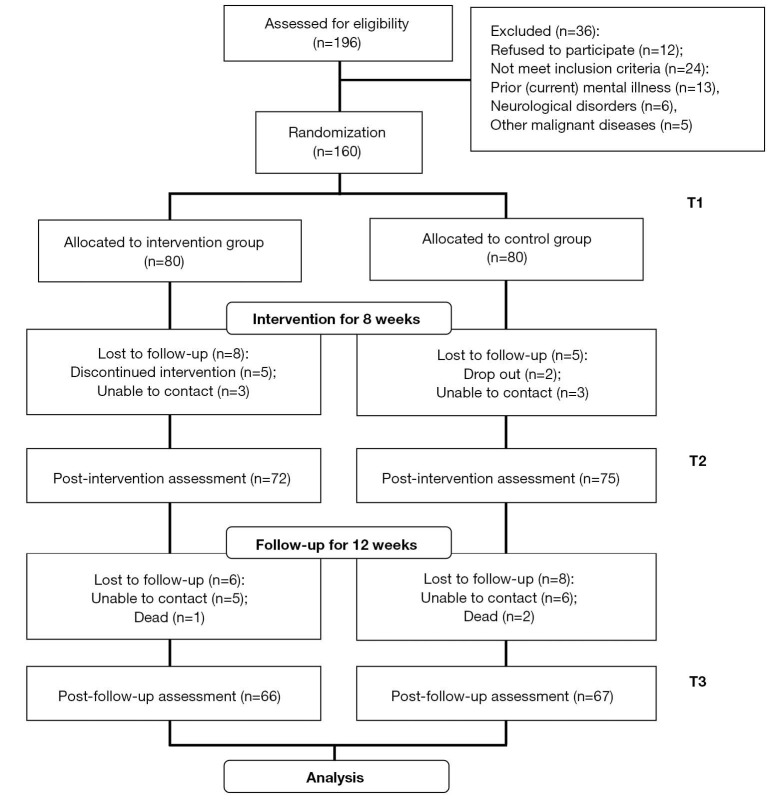
First, 196 patients with primarily diagnosed breast cancer were recruited, screened, and the qualified 160 patients were randomly assigned into the control (routine nursing interventions), and intervention (routine nursing interventions and SFBT) groups. CRF was evaluated using the Chinese version of revised Piper Fatigue Scale. Data were collected at baseline (T1), post-intervention (T2), and post-follow-up (T3).
Mild to severe fatigue existed in all qualified participants at T1 and the fatigue symptom went worse with the chemotherapy in control group. In intervention group, the fatigue level decreased at T2 (P<0.05), and went to the similar level at T3 as that at T1. The levels of behavioral, affective, and sensory fatigues in the control group significantly increased at T3 (P<0.05), while no difference was found in the intervention group. This study showed that SFBT effectively decreased CRF in breast cancer survivors after surgery under adjuvant chemotherapy.
Hence, SFBT might be a beneficial non-pharmacological intervention alone or in combination with other interventions to improve patients' quality of life.
癌症相关疲劳(CRF)是乳腺癌幸存者的一种严重症状。我们旨在探讨聚焦解决短期治疗(SFBT)对接受保乳手术或乳房切除术后辅助化疗的乳腺癌患者CRF的影响。
首先,招募、筛选出196例初诊乳腺癌患者,将符合条件的160例患者随机分为对照组(常规护理干预)和干预组(常规护理干预加SFBT)。使用中文版修订的派珀疲劳量表评估CRF。在基线期(T1)、干预后(T2)和随访后(T3)收集数据。
所有符合条件的参与者在T1时均存在轻至重度疲劳,且对照组中疲劳症状随化疗加重。干预组在T2时疲劳水平降低(P<0.05),并在T3时降至与T1时相似的水平。对照组在T3时行为、情感和感觉疲劳水平显著升高(P<0.05),而干预组未发现差异。本研究表明,SFBT能有效降低辅助化疗后乳腺癌幸存者术后的CRF。
因此,SFBT可能是一种有益的非药物干预措施,单独使用或与其他干预措施联合使用可改善患者生活质量。