ChemDiv, 12760 High Bluff Drive, Ste. 370 San Diego, CA, 92130, USA.
Department of Infectious Diseases, St. Jude Children's Research Hospital, Memphis, TN, 38105, USA.
Antiviral Res. 2023 Sep;217:105701. doi: 10.1016/j.antiviral.2023.105701. Epub 2023 Aug 9.
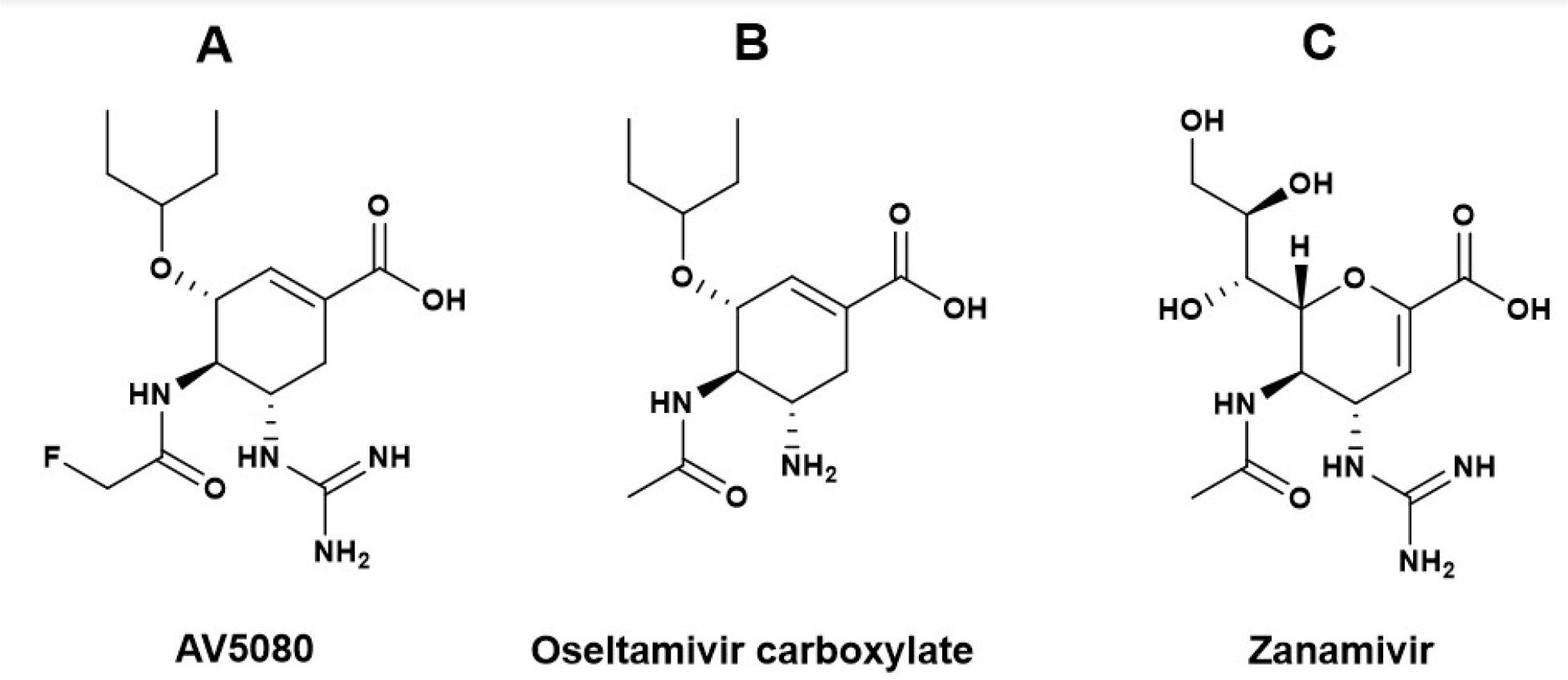
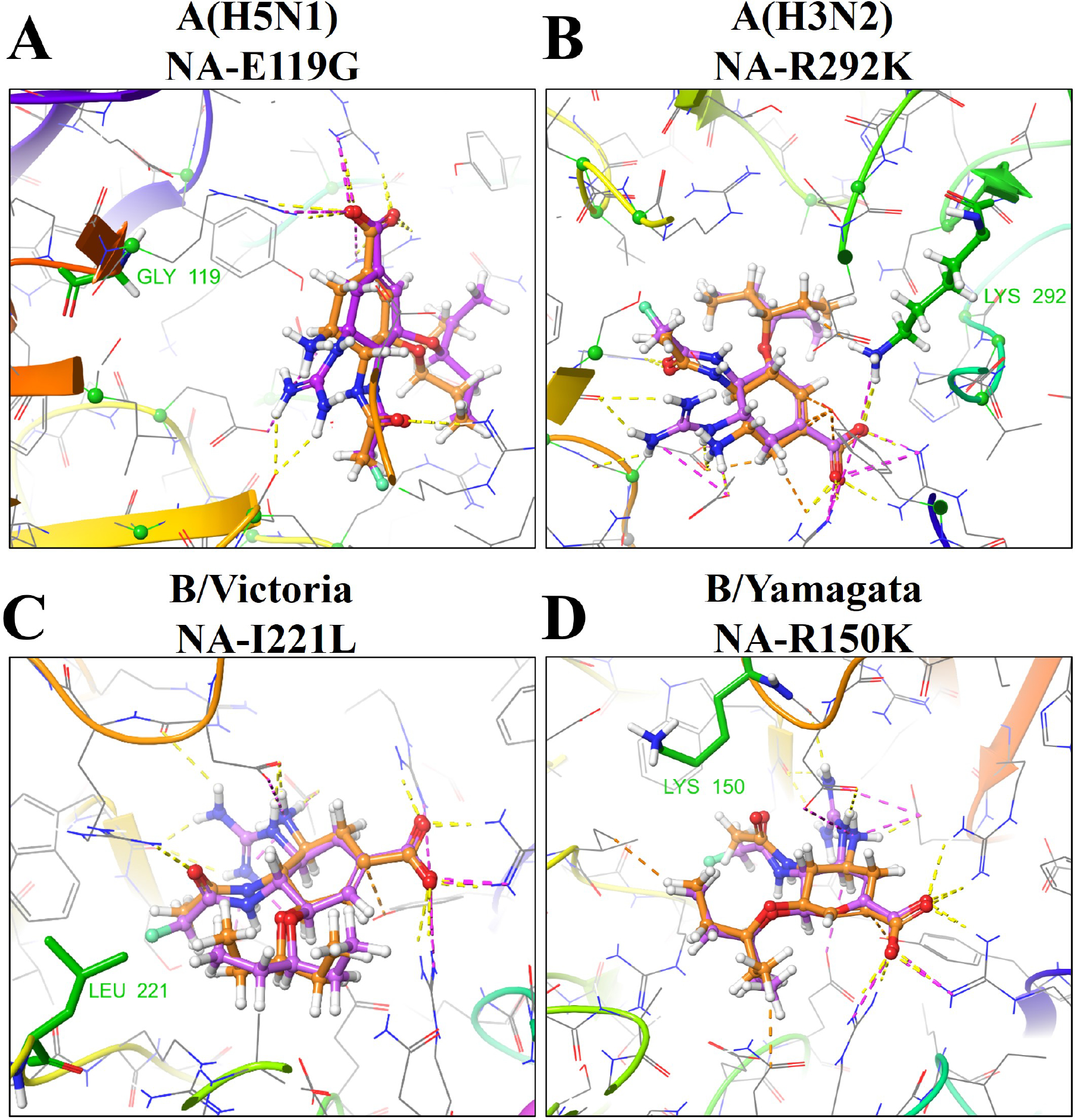
Neuraminidase inhibitors (NAIs) are recommended for influenza treatment and prevention worldwide. The most widely prescribed NAI is oral oseltamivir, while inhaled zanamivir is less commonly used. Using phenotypic neuraminidase (NA) enzymatic assays and molecular modeling approaches, we examined the ability of the investigational orally-dosed NAI AV5080 to inhibit viruses of the influenza A(H1N1)pdm09, A(H3N2), A(H5N1), and A(H7N9) subtypes and the influenza B/Victoria- and B/Yamagata-lineages containing NA substitutions conferring oseltamivir or zanamivir resistance including: NA-R292K, NA-E119G/V, NA-H274Y, NA-I122L/N, and NA-R150K. Broadly, AV5080 showed enhanced in vitro efficacy when compared with oseltamivir and/or zanamivir. Reduced AV5080 inhibition was determined for influenza A viruses with NA-E119G and NA-R292K, and for B/Victoria-lineage viruses with NA-I122N/L and B/Yamagata-lineage virus with NA-R150K. Molecular modeling suggested loss of the short hydrogen bond to the carboxyl group of AV5080 affected inhibition of NA-R292K viruses, whereas loss of the salt bridge with the guanidine group of AV5080 affected inhibition of NA-E119G. The resistance profiles and predicted binding modes of AV5080 and zanamivir are most similar, but dissimilar to those of oseltamivir, in part because of a guanidine moiety compensatory binding effect. Overall, our data suggests that AV5080 is a promising orally-dosed NAI that exhibited similar or superior in vitro efficacy against viruses with reduced or highly reduced inhibition phenotypes with respect to currently approved NAIs.
神经氨酸酶抑制剂(NAIs)被推荐用于全球范围内的流感治疗和预防。最广泛使用的 NAI 是口服奥司他韦,而吸入扎那米韦则较少使用。我们使用表型神经氨酸酶(NA)酶促测定和分子建模方法,研究了新型口服 NAI AV5080 抑制流感 A(H1N1)pdm09、A(H3N2)、A(H5N1)和 A(H7N9)亚型病毒以及含有奥司他韦或扎那米韦耐药性的流感 B/维多利亚和 B/山形谱系病毒的能力,这些耐药性包括:NA-R292K、NA-E119G/V、NA-H274Y、NA-I122L/N 和 NA-R150K。总的来说,与奥司他韦和/或扎那米韦相比,AV5080 在体外显示出增强的疗效。对于具有 NA-E119G 和 NA-R292K 的流感 A 病毒以及具有 NA-I122N/L 的 B/维多利亚谱系病毒和具有 NA-R150K 的 B/山形谱系病毒,AV5080 的抑制作用降低。分子建模表明,与 AV5080 的羧基失去短氢键影响了对 NA-R292K 病毒的抑制,而与 AV5080 的胍基失去盐桥影响了对 NA-E119G 的抑制。AV5080 和扎那米韦的耐药谱和预测的结合模式最相似,但与奥司他韦的耐药谱和预测的结合模式不同,部分原因是胍基的补偿结合效应。总体而言,我们的数据表明,AV5080 是一种有前途的口服 NAI,与目前批准的 NAI 相比,对具有降低或高度降低抑制表型的病毒具有相似或更优的体外疗效。