Bhardwaj Kiran, Meneely Julie P, Haughey Simon A, Dean Moira, Wall Patrick, Petchkongkaew Awanwee, Baker Bob, Zhang Guangtao, Elliott Christopher T
Institute for Global Food Security, School of Biological Sciences, Queen's University Belfast, Belfast, BT9 5DL, Northern Ireland, United Kingdom.
University College Dublin, School of Public Health Physiotherapy and Sports Science, Woodview House Belfield Dublin 4, Dublin, Ireland.
NPJ Sci Food. 2023 Aug 11;7(1):40. doi: 10.1038/s41538-023-00217-y.
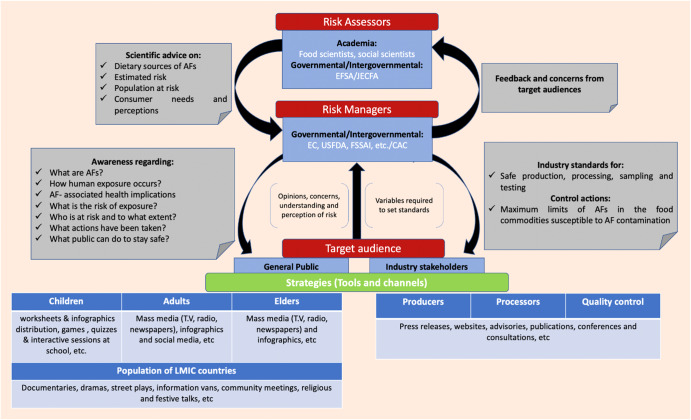
Risk communication is defined as the interactive exchange of information and opinions concerning risk, risk-related factors and risk perceptions amongst all the stakeholders of food safety throughout the risk analysis process. The interactive exchange of information occurs at three different levels i.e. informed level, dialogue level and engagement level. For an effective food safety risk communication (FSRC), it is important that the information should adhere to the core principles of risk communication which are transparency, openness, responsiveness and timeliness. Communication of a food safety risk within all the components of risk communication strategy constitutes a complex network of information flow that can be better understood with the help of a framework. Therefore, a model framework to communicate the risks associated with aflatoxins (AFs) dietary intake has been developed with the aim of (a) creating general awareness amongst public and (b) involving industry stakeholders in the prevention and control of risk. The framework has been motivated by the learnings and best practices outlined in the identified technical guidance documents for risk communication. Risk assessors, risk managers, industry stakeholders and general public have been identified as the major stakeholders for the present framework. Amongst them, industry stakeholders and general public has been selected as the major target audience for risk managers. Moreover, population residing in low- and middle-income countries (LMIC) has been identified as the main target group to reach.
风险沟通被定义为在整个风险分析过程中,食品安全所有利益相关者之间就风险、风险相关因素和风险认知进行的信息和意见的互动交流。信息的互动交流发生在三个不同层面,即告知层面、对话层面和参与层面。对于有效的食品安全风险沟通(FSRC)而言,信息应遵循风险沟通的核心原则,即透明度、开放性、响应性和及时性,这一点很重要。在风险沟通策略的所有组成部分内进行食品安全风险沟通,构成了一个复杂的信息流网络,借助一个框架能更好地理解这一网络。因此,已开发出一个用于传达黄曲霉毒素(AFs)膳食摄入相关风险的模型框架,目的是(a)提高公众的总体认识,以及(b)让行业利益相关者参与风险的预防和控制。该框架的灵感来源于已确定的风险沟通技术指导文件中概述的经验教训和最佳实践。风险评估者、风险管理者、行业利益相关者和公众已被确定为当前框架的主要利益相关者。其中,行业利益相关者和公众已被选为风险管理者的主要目标受众。此外,低收入和中等收入国家(LMIC)的居民已被确定为主要的目标群体。