Department of Nutrition and Dietetics, Imperial College Healthcare NHS Trust, London, UK.
Department of Surgery and Cancer, Imperial College London, London, UK.
BMC Cancer. 2023 Aug 11;23(1):747. doi: 10.1186/s12885-023-11254-x.
Lung cancer is the third most common type of cancer in the UK. Treatment outcomes are poor and UK deaths from lung cancer are higher than any other cancer. Prehabilitation has shown to be an important means of preparing patients both physically and psychologically for cancer treatment. However, little is understood about the context and mechanisms of prehabilitation that can impact physiological and psychological wellbeing. Our aim was to review and summarise primary research on prehabilitation in the lung cancer pathway using a realist approach.
A scoping review of empirical primary research was conducted. Five online medical databases from 2016 - February 2023 were searched. All articles reporting on prehabilitation in lung cancer were included in the review. For this review, prehabilitation was defined as either a uni-modal or multi-modal intervention including exercise, nutrition and/or psychosocial support within a home, community or hospital based setting. A realist framework of context, mechanism and outcome was used to assist with the interpretation of findings.
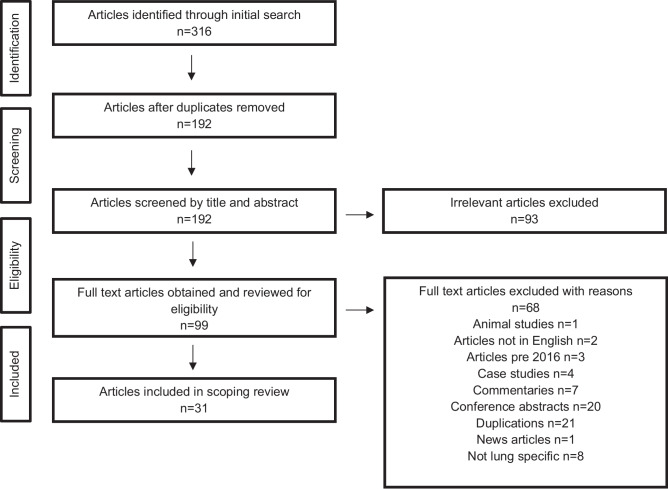
In total, 31 studies were included in the review, of which, three were published study protocols. Over 95% of studies featured an exercise component as part of a prehabilitation programme. Twenty-six of the studies had a surgical focus. Only two studies reported using theory to underpin the design of this complex intervention. There was large heterogeneity across all studies as well as a lack of clinical trials to provide definitive evidence on the programme design, setting, type of intervention, patient criteria, delivery, duration and outcome measures used.
A standardised prehabilitation programme for lung cancer patients does not yet exist. Future lung cancer prehabilitation programmes should take into account patient led values, needs, goals, support structures and beliefs, as these factors can affect the delivery and engagement of interventions. Future research should consider using a conceptual framework to conceptualise the living with and beyond cancer experience to help shape and inform personalised prehabilitation services.
肺癌是英国第三大常见癌症类型。治疗效果不佳,英国因肺癌死亡的人数高于其他任何癌症。预康复已被证明是一种重要的手段,可以使患者在身体和心理上为癌症治疗做好准备。然而,对于能够影响生理和心理健康的预康复的背景和机制知之甚少。我们的目的是使用现实主义方法回顾和总结肺癌途径中预康复的主要研究。
对实证性初级研究进行了范围界定审查。从 2016 年至 2023 年 2 月,我们在五个在线医学数据库中进行了搜索。所有报告肺癌预康复的文章都包含在审查中。在本次审查中,预康复被定义为在家庭、社区或医院环境中进行的单一或多模式干预,包括运动、营养和/或社会心理支持。使用现实主义的背景、机制和结果框架来帮助解释研究结果。
共有 31 项研究被纳入综述,其中 3 项为已发表的研究方案。超过 95%的研究都包含作为预康复计划一部分的运动部分。26 项研究具有手术重点。只有两项研究报告了使用理论来为这种复杂干预措施的设计提供依据。所有研究之间存在很大的异质性,并且缺乏临床试验来提供关于方案设计、设置、干预类型、患者标准、实施、持续时间和使用的结果测量的明确证据。
目前还没有为肺癌患者制定的标准化预康复计划。未来的肺癌预康复计划应考虑到患者的主导价值观、需求、目标、支持结构和信念,因为这些因素会影响干预措施的实施和参与。未来的研究应考虑使用概念框架来构想癌症患者的生活经历,以帮助塑造和告知个性化的预康复服务。