Faculty of Information and Media Studies, Western University, 1151 Richmond St, N6A 5B7, London, ON, Canada.
School of Architecture and Landscape Architecture, University of British Columbia, Vancouver, BC, Canada.
BMC Womens Health. 2023 Aug 11;23(1):427. doi: 10.1186/s12905-023-02541-7.
Guidelines and regulations in response to the COVID-19 pandemic have significantly impacted the health care sector. We explore these impacts in the gender-based violence (GBV) services sector and, more specifically, in the context of women's shelters.
Using an interpretive description and integrated knowledge mobilization approach, we interviewed 8 women's shelter clients, 26 staff, and conducted focus groups with 24 Executive Directors.
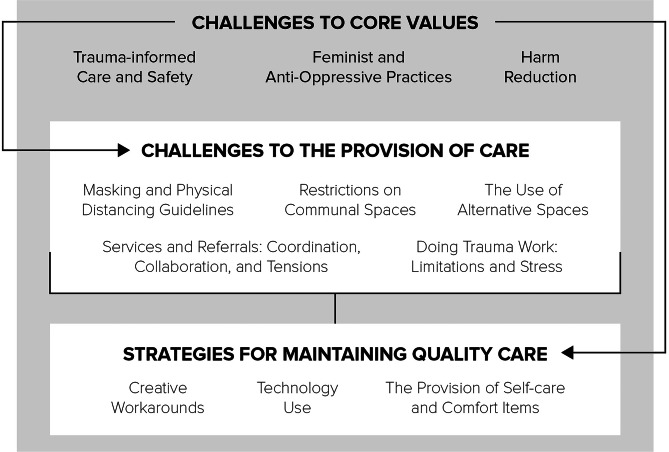
We found that pandemic responses challenged longstanding values that guide work in women's shelters, specifically feminist and anti-oppressive practices. Physical distancing, masking, and closure of communal spaces intended to slow or stop the spread of the novel coronavirus created barriers to the provision of care, made it difficult to maintain or create positive connections with and among women and children, and re-traumatized some women and children. Despite these challenges, staff and leaders were creative in their attempts to provide quality care, though these efforts, including workarounds, were not without their own challenges.
This research highlights the need to tailor crisis response to sector-specific realities that support service values and standards of care.
应对 COVID-19 大流行的准则和法规对医疗保健部门产生了重大影响。我们探讨了这些影响在基于性别的暴力(GBV)服务部门的情况,更具体地说,是在妇女庇护所的背景下。
使用解释性描述和综合知识动员方法,我们采访了 8 名妇女庇护所的客户、26 名工作人员,并与 24 名执行主任进行了焦点小组讨论。
我们发现,大流行的应对措施挑战了指导妇女庇护所工作的长期价值观,特别是女权主义和反压迫实践。为减缓或阻止新型冠状病毒的传播而实施的保持身体距离、戴口罩和关闭公共空间,给提供护理带来了障碍,使妇女和儿童难以保持或建立积极的联系,使一些妇女和儿童再次受到创伤。尽管面临这些挑战,工作人员和领导还是在努力提供优质护理方面具有创造力,尽管这些努力包括解决办法,但并非没有自己的挑战。
这项研究强调了需要根据支持服务价值观和护理标准的特定部门现实来调整危机应对措施。