Kaida Tomoko, Ono Takashi, Tokunaga Tadatoshi, Takada Keita, Tokuda Shota, Kuwabara Naoto, Kawamorita Takushi, Kamiya Kazutaka, Shoji Nobuyuki, Miyata Kazunori
Department of Ophthalmology, Miyata Eye Hospital, Miyazaki 885-0051, Japan.
Department of Ophthalmology, Graduate School of Medicine, University of Tokyo, Tokyo 113-8654, Japan.
J Clin Med. 2023 Aug 5;12(15):5135. doi: 10.3390/jcm12155135.
We aimed to evaluate the existence of accommodative microfluctuations in eyes after cataract surgery.
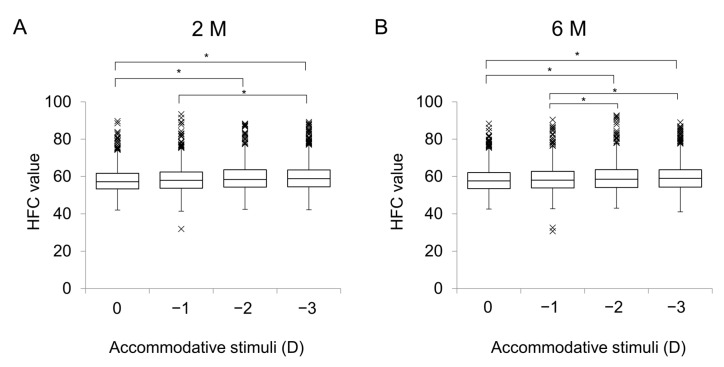
This retrospective observational cohort study included 1160 eyes of 713 patients (mean age: 72.5 ± 8.3 years) who underwent phacoemulsification, intraocular lens insertion, and an evaluation of accommodative microfluctuations with an autorefractometer. Patients with posterior segment disorders resulting in visual acuity impairment and those with unavailable medical information were excluded. High-frequency components (HFCs), between 1.0-2.3 Hz, based on fast Fourier transform analysis of the accommodative microfluctuation data were examined at postoperative 2-3 (2 M) and 6 months (6 M). The relationships between the HFCs and patient age, manifest refraction, and axial length were analyzed.
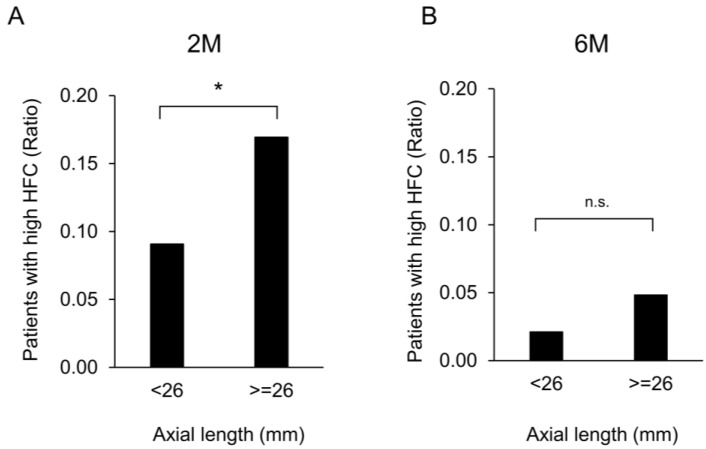
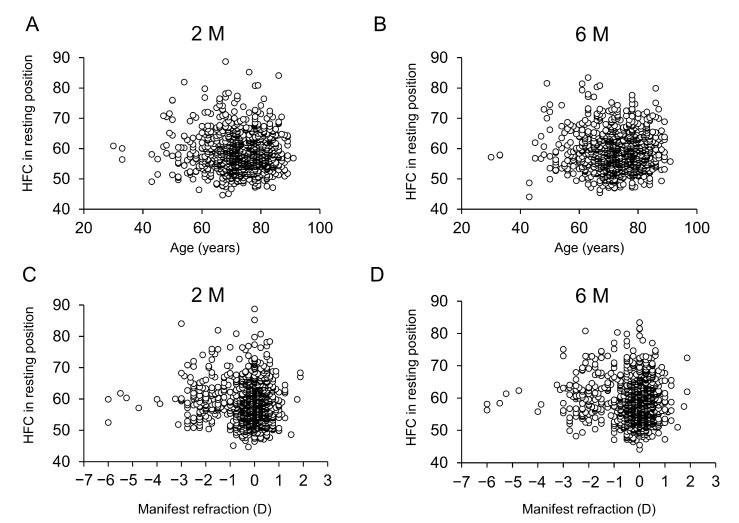
Increased HFC values (>65) were observed at a constant rate after cataract surgery, with prevalence rates of 33.4% at 2 M and 34.7% at 6 M. Postoperatively, at 2 M, increased HFC values were significantly more common for eyes with axial length ≥26 mm than for those with axial length <26 mm ( = 0.0056). However, they were not significantly correlated to age or postoperative manifest refraction.
At 2 M postoperatively, increased HFC values presented more frequently in eyes with a greater axial length; hence, the precise detection and understanding of postoperative accommodative spasms in high myopia patients is important.
我们旨在评估白内障手术后眼睛中调节性微波动的存在情况。
这项回顾性观察性队列研究纳入了713例患者的1160只眼睛(平均年龄:72.5±8.3岁),这些患者接受了超声乳化白内障吸除术、人工晶状体植入术,并使用自动验光仪对调节性微波动进行了评估。排除了因后段疾病导致视力受损的患者以及医疗信息不完整的患者。基于调节性微波动数据的快速傅里叶变换分析,在术后2至3个月(2M)和6个月(6M)时检查了1.0 - 2.3赫兹之间的高频成分(HFCs)。分析了HFCs与患者年龄、显验光和眼轴长度之间的关系。
白内障手术后,HFC值升高(>65)的发生率呈恒定上升趋势,2M时患病率为33.4%,6M时为34.7%。术后2M时,眼轴长度≥26mm的眼睛HFC值升高的情况明显比眼轴长度<26mm的眼睛更常见(P = 0.0056)。然而,它们与年龄或术后显验光无显著相关性。
术后2M时,眼轴长度较长的眼睛中HFC值升高更为频繁;因此,精确检测和了解高度近视患者术后的调节痉挛很重要。