Department of Cardiac Physiology, Institute of Physiology, Komi Science Center, Ural Branch of the Russian Academy of Sciences, 167982 Syktyvkar, Russia.
Center of Experimental Medicine, Institute for Heart Research, Slovak Academy of Sciences, 81438 Bratislava, Slovakia.
Int J Mol Sci. 2023 Jul 25;24(15):11931. doi: 10.3390/ijms241511931.
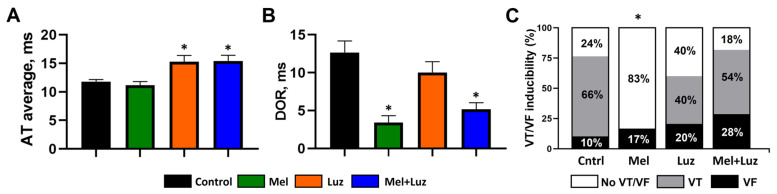
Melatonin has been reported to cause myocardial electrophysiological changes and prevent ventricular tachycardia or fibrillation (VT/VF) in ischemia and reperfusion. We sought to identify electrophysiological targets responsible for the melatonin antiarrhythmic action and to explore whether melatonin receptor-dependent pathways or its antioxidative properties are essential for these effects. Ischemia was induced in anesthetized rats given a placebo, melatonin, and/or luzindole (MT1/MT2 melatonin receptor blocker), and epicardial mapping with reperfusion VT/VFs assessment was performed. The oxidative stress assessment and Western blotting analysis were performed in the explanted hearts. Transmembrane potentials and ionic currents were recorded in cardiomyocytes with melatonin and/or luzindole application. Melatonin reduced reperfusion VT/VF incidence associated with local activation time in logistic regression analysis. Melatonin prevented ischemia-related conduction slowing and did not change the total connexin43 (Cx43) level or oxidative stress markers, but it increased the content of a phosphorylated Cx43 variant (P-Cx43). Luzindole abolished the melatonin antiarrhythmic effect, slowed conduction, decreased total Cx43, protein kinase Cε and P-Cx43 levels, and the IK1 current, and caused resting membrane potential (RMP) depolarization. Neither melatonin nor luzindole modified INa current. Thus, the antiarrhythmic effect of melatonin was mediated by the receptor-dependent enhancement of impulse conduction, which was associated with Cx43 phosphorylation and maintaining the RMP level.
褪黑素已被报道可引起心肌电生理变化,并可预防缺血再灌注中的室性心动过速或颤动(VT/VF)。我们试图确定负责褪黑素抗心律失常作用的电生理靶点,并探讨褪黑素受体依赖性途径或其抗氧化特性是否对这些作用至关重要。在给予安慰剂、褪黑素和/或 luzindole(MT1/MT2 褪黑素受体阻滞剂)的麻醉大鼠中诱导缺血,并进行心外膜标测和再灌注 VT/VF 评估。在离体心脏中进行氧化应激评估和 Western blot 分析。在应用褪黑素和/或 luzindole 的情况下记录心肌细胞的跨膜电位和离子电流。逻辑回归分析表明,褪黑素降低了再灌注 VT/VF 的发生率,并与局部激活时间相关。褪黑素可预防与缺血相关的传导减慢,且不改变总连接蛋白 43(Cx43)水平或氧化应激标志物,但增加了磷酸化 Cx43 变体(P-Cx43)的含量。Luzindole 消除了褪黑素的抗心律失常作用,减慢了传导,降低了总 Cx43、蛋白激酶 Cε 和 P-Cx43 水平,以及 IK1 电流,并导致静息膜电位(RMP)去极化。褪黑素和 luzindole 均未改变 INa 电流。因此,褪黑素的抗心律失常作用是通过受体依赖性增强冲动传导介导的,这与 Cx43 磷酸化和维持 RMP 水平有关。