Tobacco Research Institute of Chinese Academy of Agricultural Sciences, Qingdao 266101, China.
Graduate School of Chinese Academy of Agricultural Sciences, Beijing 100081, China.
Int J Mol Sci. 2023 Jul 31;24(15):12226. doi: 10.3390/ijms241512226.
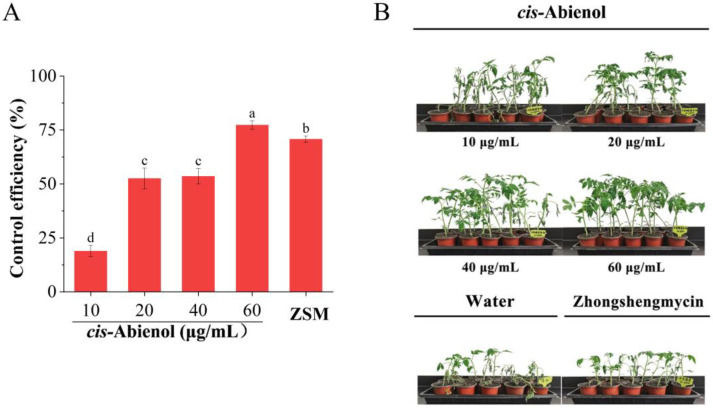
Bacterial wilt negatively impacts the yield and quality of tomatoes. -Abienol, a labdane diterpenoid abundantly produced in the trichome secretion of spp., can induce bacterial wilt resistance in plants; however, study on its practical application and acting mechanism is very limited. This study established the application conditions of -abienol for inducing tomato bacterial wilt resistance by pot-inoculation experiments and investigated the underlying mechanism by determining the physio-biochemical indexes and transcriptomic changes. The results showed that applying -abienol to the roots was the most effective approach for inducing tomato bacterial wilt resistance. The optimal concentration was 60 μg/mL, and 2-3 consecutive applications with 3-6 days intervals were sufficient to induce the bacterial wilt resistance of tomato plants. -Abienol could enhance the antioxidant enzyme activity and stimulate the defensive signal transduction in tomato roots, leading to the upregulation of genes involved in the mitogen-activated protein kinase cascade. It also upregulated the expression of genes and increased the content of jasmonic acid (JA) and salicylic acid (SA), which control the expression of flavonoid biosynthetic genes and the content of phytoalexins in tomato roots. -Abienol-induced resistance mainly depends on the JA signalling pathway, and the SA signalling pathway is also involved in this process. This study established the feasibility of applying the plant-derived terpenoid -abienol to induce plant bacterial wilt resistance, which is of great value for developing eco-friendly bactericides.
细菌性萎蔫病会降低番茄的产量和品质。-abienol 是一种在 spp. 的毛状体分泌物中大量产生的拉伯烷二萜,它可以诱导植物对细菌性萎蔫病产生抗性;然而,对其实际应用和作用机制的研究非常有限。本研究通过盆栽接种实验确定了 -abienol 诱导番茄细菌性萎蔫病抗性的应用条件,并通过测定生理生化指标和转录组变化来研究其作用机制。结果表明,将 -abienol 施用于根部是诱导番茄细菌性萎蔫病抗性最有效的方法。最佳浓度为 60 μg/mL,连续应用 2-3 次,间隔 3-6 天即可诱导番茄植株的细菌性萎蔫病抗性。-abienol 可以增强番茄根部的抗氧化酶活性,刺激防御信号转导,导致与丝裂原活化蛋白激酶级联相关的基因上调。它还上调了 基因的表达,增加了茉莉酸(JA)和水杨酸(SA)的含量,从而控制了番茄根部类黄酮生物合成基因的表达和植物抗毒素的含量。-abienol 诱导的抗性主要依赖于 JA 信号通路,SA 信号通路也参与了这一过程。本研究确立了应用植物来源的萜烯 -abienol 诱导植物细菌性萎蔫病抗性的可行性,这对于开发环保型杀菌剂具有重要价值。