Peter MacCallum Cancer Centre, Melbourne, VIC Australia.
Ovarian Cancer Australia, Melbourne, VIC, Australia.
Integr Cancer Ther. 2023 Jan-Dec;22:15347354231191701. doi: 10.1177/15347354231191701.
About 1 in 3 people experience persistent fatigue after cancer treatment. People with severe fatigue describe a disabling lack of stamina, anxiety, depression and distressing cognitive changes. Cognitive behavior therapy (CBT) is recommended for people with severe fatigue after cancer treatment, however due to limited resources and lack of available clinicians very few people with cancer have access. This study explored feasibility of a virtual stepped-care CBT program.
English speaking adults experiencing persistent fatigue who had either completed cancer treatment, or with stable disease on maintenance therapies were recruited. All participants engaged in a 6-week supported self-help program using a CBT workbook targeting fatigue (STEP 1). After the self-help program, participants with severe ongoing fatigue were stepped-up to a telehealth CBT group focused to fatigue led by a Clinical Psychologist (STEP 2). Feasibility and perceived changes were assessed at baseline, 6 and 12 weeks.
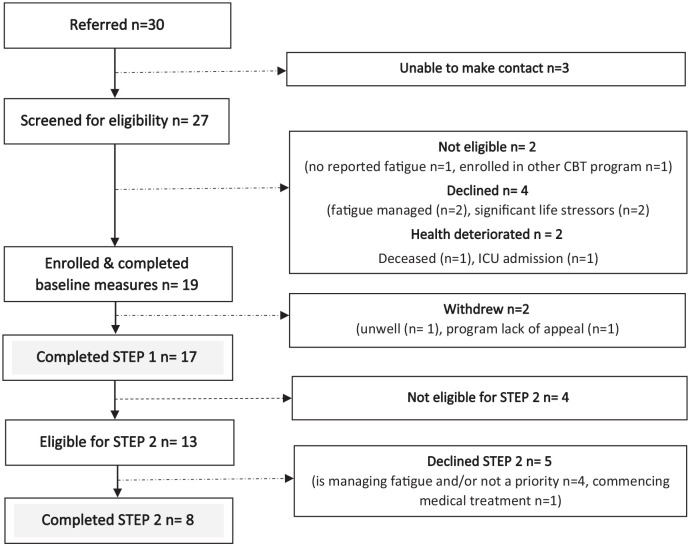
Of 19 participants, 17 completed STEP 1 and 8 completed STEP 2. Remotely delivered CBT was feasible with high retention, adherence, participant feasibility and satisfaction scores. Cost to deliver STEP 1 was AUD $145 and STEP 2, AUD $280 per participant. Overall, fatigue and self-efficacy improved significantly following STEP 1. Participants with higher baseline fatigue achieved limited improvements with self-help alone, requiring guidance to set achievable goals and reframe cognitions. Fatigue, self-efficacy and mood improved with STEP 2.
Remotely delivered CBT for cancer fatigue was feasible. The effectiveness of stratified rather than stepped CBT approach, based on fatigue severity should be trialed.
Australian and New Zealand Clinical Trials Registry (ACTRN # 11 12622000420741).
大约每 3 人中就有 1 人在癌症治疗后持续感到疲劳。严重疲劳的人会感到无法忍受的缺乏耐力、焦虑、抑郁和令人痛苦的认知变化。对于癌症治疗后严重疲劳的人,推荐使用认知行为疗法(CBT),但由于资源有限,且可提供服务的临床医生缺乏,因此很少有癌症患者能够获得这种治疗。本研究探讨了虚拟分级照护 CBT 方案的可行性。
招募了英语为母语、经历过持续性疲劳且要么已完成癌症治疗,要么正在接受维持治疗且疾病稳定的成年人。所有参与者都使用针对疲劳的 CBT 工作簿(STEP 1)参与了为期 6 周的支持性自助计划。在自助计划之后,持续存在严重疲劳的参与者被提升至由临床心理学家主导的专注于疲劳的远程 CBT 小组(STEP 2)。在基线、6 周和 12 周时评估可行性和感知变化。
19 名参与者中,有 17 名完成了 STEP 1,8 名完成了 STEP 2。远程提供的 CBT 具有较高的保留率、依从性、参与者可行性和满意度评分,具有可行性。提供 STEP 1 的成本为每位参与者 145 澳元,提供 STEP 2 的成本为每位参与者 280 澳元。总体而言,STEP 1 后疲劳和自我效能感显著改善。仅通过自助疗法,基线疲劳较高的参与者仅取得有限的改善,需要指导他们设定可实现的目标并重新构建认知。STEP 2 后疲劳、自我效能感和情绪均有所改善。
远程提供的癌症疲劳 CBT 是可行的。基于疲劳严重程度的分层而不是分级 CBT 方法的有效性应进行试验。
澳大利亚和新西兰临床试验注册中心(ACTRN # 11 12622000420741)。