Centre for Public Health Research, School of Health & Life Sciences, Teesside University, Middlesbrough TS1 3BA, UK.
Fuse, The Centre for Translational Research in Public Health, Newcastle upon Tyne, UK Email: c.o'
Perspect Public Health. 2023 Nov;143(6):313-323. doi: 10.1177/17579139231187492. Epub 2023 Aug 12.
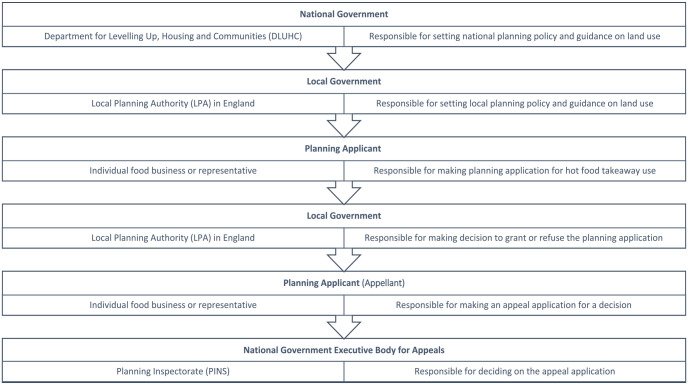
To explore existing regulatory mechanisms to restrict hot food takeaway (HFT) outlets through further understanding processes at local and national levels.
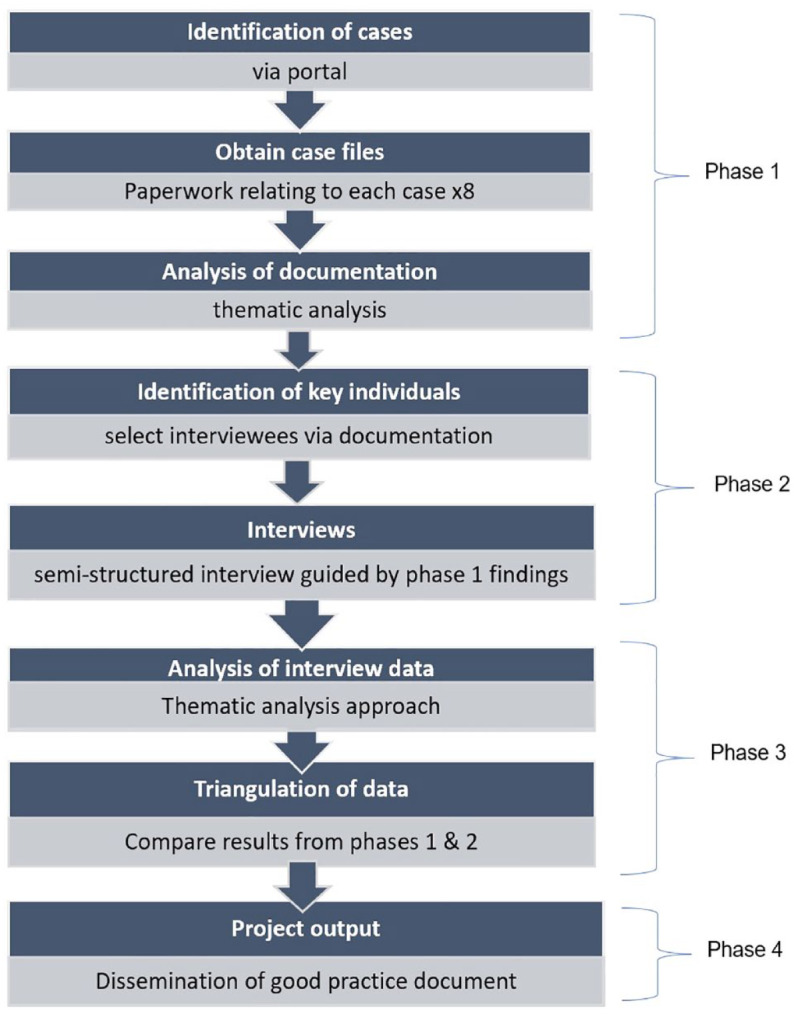
The Planning Appeals Portal was utilised to identify recent HFT appeal cases across England between December 2016 and March 2020. Eight case study sites were identified using a purposive sampling technique and interviews carried out with 12 professionals involved in planning and health to explore perceptions of and including factors that may impact on the HFT appeal process. Additionally, documents applicable to each case were analysed and a survey completed by seven Local Authority (LA) health professionals. To confirm findings, interpretation meetings were conducted with participants and a wider group of planning and public health professionals, including a representative from the Planning Inspectorate.
Eight case study sites were identified, and 12 interviews conducted. Participants perceived that LAs would be better able to work on HFT appeal cases if professionals had a good understanding of the planning process/the application of local planning policy and supplementary planning documents; adequate time and capacity to deal with appeals cases; access to accurate, robust, and up to date information; support and commitment from elected members and senior management; good lines of communication with local groups/communities interested in the appeal; information and resources that are accessible and easy to interpret across professional groups.
Communication across professional groups appeared to be a key factor in successfully defending decisions. Understanding the impact of takeaway outlets on health and communities in the long term was also important. To create a more robust appeals case and facilitate responsiveness, professionals involved in an appeal should know where to locate current records and statistical data. The enthusiasm of staff and support from senior management/elected officials will play a significant role in driving these agendas forward.
通过进一步了解地方和国家层面的流程,探索现有的监管机制来限制热食外卖(HFT)门店。
利用规划上诉门户,在 2016 年 12 月至 2020 年 3 月期间,确定了英格兰最近的 HFT 上诉案例。使用目的性抽样技术确定了 8 个案例研究地点,并对 12 名参与规划和健康的专业人员进行了访谈,以探讨他们对 HFT 上诉流程的看法以及可能影响上诉流程的因素。此外,还对每个案例适用的文件进行了分析,并对 7 名地方当局(LA)卫生专业人员进行了调查。为了确认研究结果,与参与者和更广泛的规划和公共卫生专业人员,包括规划督察局的代表进行了解释性会议。
确定了 8 个案例研究地点,并进行了 12 次访谈。参与者认为,如果专业人员对规划流程/地方规划政策和补充规划文件的应用有很好的了解;有足够的时间和能力来处理上诉案件;能够获得准确、可靠和最新的信息;得到民选成员和高级管理人员的支持和承诺;与对上诉感兴趣的当地团体/社区保持良好的沟通渠道;信息和资源在专业群体之间易于访问和解释,那么地方当局将能够更好地处理 HFT 上诉案件。
跨专业群体的沟通似乎是成功辩护决策的关键因素。了解外卖店对健康和社区的长期影响也很重要。为了提出更有力的上诉案件并促进响应能力,参与上诉的专业人员应该知道在哪里找到当前的记录和统计数据。员工的积极性和高级管理人员/民选官员的支持将在推动这些议程方面发挥重要作用。