Department of Immunology, Mayo Clinic, 13400 E. Shea Blvd., Scottsdale, AZ, USA; Department of Cancer Biology, Mayo Clinic, 13400 E. Shea Blvd., Scottsdale, AZ, USA.
Semin Immunol. 2023 Nov;70:101817. doi: 10.1016/j.smim.2023.101817. Epub 2023 Aug 10.
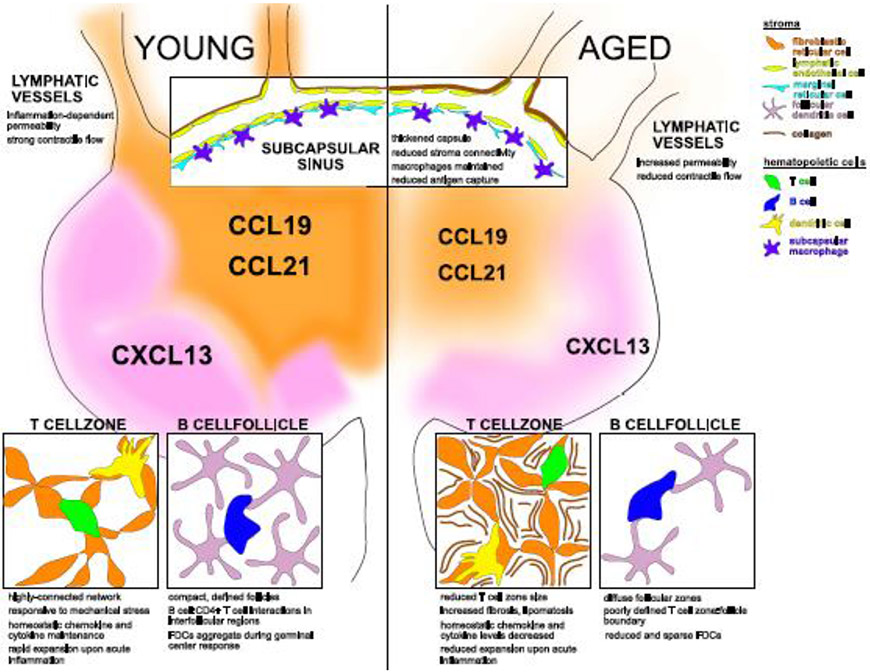
The secondary lymphoid organs (SLOs) undergo structural changes with age, which correlates with diminishing immune responses against infectious disease. A growing body of research suggests that the aged tissue microenvironment can contribute to decreased immune function, independent of intrinsic changes to hematopoietic cells with age. Stromal cells impart structural integrity, facilitate fluid transport, and provide chemokine and cytokine signals that are essential for immune homeostasis. Mechanisms that drive SLO development have been described, but their roles in SLO maintenance with advanced age are unknown. Disorganization of the fibroblasts of the T cell and B cell zones may reduce the maintenance of naïve lymphocytes and delay immune activation. Reduced lymphatic transport efficiency with age can also delay the onset of the adaptive immune response. This review focuses on recent studies that describe age-associated changes to the stroma of the lymph nodes and spleen. We also review recent investigations into stromal cell biology, which include high-dimensional analysis of the stromal cell transcriptome and viscoelastic testing of lymph node mechanical properties, as they constitute an important framework for understanding aging of the lymphoid tissues.
次级淋巴器官(SLO)随年龄发生结构变化,这与针对传染病的免疫反应减弱相关。越来越多的研究表明,衰老组织的微环境可能导致免疫功能下降,而与造血细胞随年龄增长的内在变化无关。基质细胞赋予组织结构完整性,促进液体转运,并提供趋化因子和细胞因子信号,这些对免疫稳态至关重要。已经描述了驱动 SLO 发育的机制,但它们在 SLO 维持中的作用尚不清楚。T 细胞和 B 细胞区的成纤维细胞的紊乱可能会减少幼稚淋巴细胞的维持,并延迟免疫激活。随着年龄的增长,淋巴管转运效率的降低也会延迟适应性免疫反应的发生。这篇综述重点介绍了最近描述淋巴结和脾脏基质随年龄变化的研究。我们还回顾了基质细胞生物学的最新研究,包括基质细胞转录组的高维分析和淋巴结机械特性的粘弹性测试,因为它们构成了理解淋巴组织衰老的重要框架。