Department of Anesthesiology and Intensive Care, Rangueil University Hospital, University Hospital of Toulouse, University Paul Sabatier, Avenue Jean Poulhès, Toulouse, France.
RESTORE, UMR 1301, Inserm CNRS-Université Paul Sabatier, Université de Toulouse, 5070, Toulouse, France.
J Transl Med. 2023 Aug 12;21(1):541. doi: 10.1186/s12967-023-04407-w.
Renal artery Doppler sonography with resistive index (RI) determination is a noninvasive, fast, and reliable diagnostic tool increasingly used in the intensive care unit (ICU) to predict and assess the reversibility of acute kidney injury (AKI). However, interpreting the RI can be challenging due to numerous influencing factors. While some studies have explored various confounding factors, arterial blood gases have received limited attention. Therefore, our study aims to evaluate the impact of arterial blood gases on the RI in the ICU setting.
This prospective observational study enrolled ICU patients who required blood gas analysis and had not experienced significant hemodynamic changes recently. The RI was measured using standardized Doppler ultrasound within an hour of the arterial blood gases sampling and analysis.
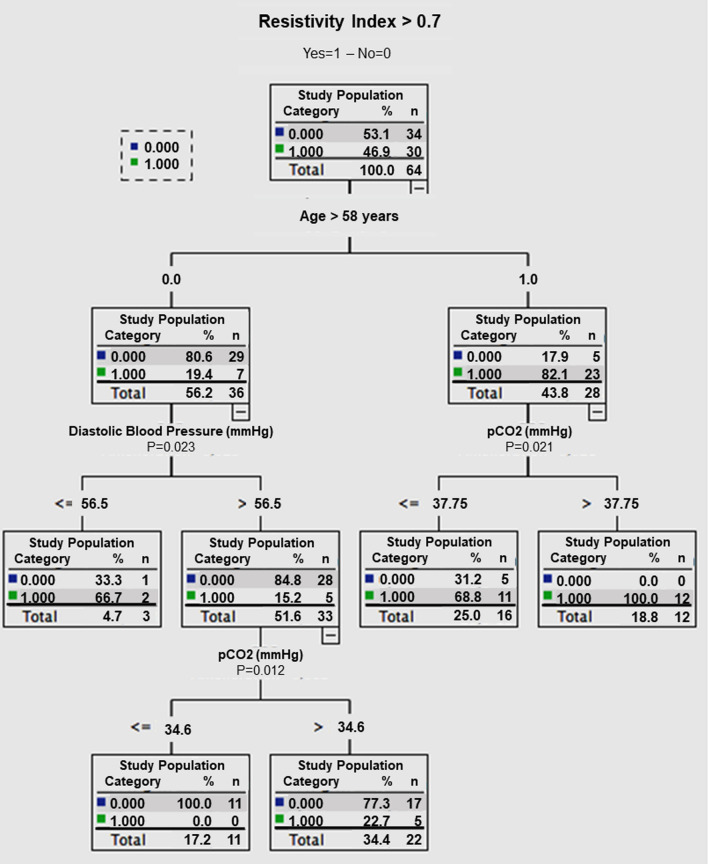
A total of sixty-four patients were included in the analysis. Univariate analysis revealed a correlation between the RI and several variables, including PaCO (R = 0.270, p = 0.03), age (R = 0.574, p < 0.0001), diastolic arterial pressure (DAP) (R = - 0.368, p = 0.0028), and SaO (R = - 0.284, p = 0.0231). Multivariate analysis confirmed that age > 58 years and PaCO2 were significant factors influencing the RI, with respective odds ratios of 18.67 (p = 0.0003) and 1.132 (p = 0.0267).
The interpretation of renal arterial RI should take into account thresholds for PaCO, age, and diastolic arterial pressure. Further studies are needed to develop a comprehensive scoring system that incorporates all these cofactors for a reliable analysis of RI levels. Trial registration This observational study, registered under number 70-0914, received approval from local Ethical Committee of Toulouse University Hospital.
肾动脉多普勒超声检查并测定阻力指数(RI)是一种非侵入性、快速且可靠的诊断工具,在重症监护病房(ICU)中越来越多地用于预测和评估急性肾损伤(AKI)的可逆性。然而,由于存在许多影响因素,解读 RI 具有一定挑战性。虽然一些研究已经探讨了各种混杂因素,但动脉血气分析受到的关注有限。因此,我们的研究旨在评估 ICU 环境中动脉血气对 RI 的影响。
这是一项前瞻性观察性研究,纳入了需要进行血气分析且近期无明显血流动力学变化的 ICU 患者。在进行动脉血气采样和分析的 1 小时内,使用标准化的多普勒超声测量 RI。
共有 64 例患者纳入分析。单因素分析显示,RI 与多个变量相关,包括 PaCO2(R=0.270,p=0.03)、年龄(R=0.574,p<0.0001)、舒张压(DAP)(R=-0.368,p=0.0028)和 SaO2(R=-0.284,p=0.0231)。多因素分析证实,年龄>58 岁和 PaCO2是影响 RI 的重要因素,其优势比分别为 18.67(p=0.0003)和 1.132(p=0.0267)。
在解读肾动脉 RI 时,应考虑 PaCO2、年龄和舒张压的阈值。需要进一步研究以制定一种全面的评分系统,该系统将所有这些混杂因素纳入其中,以便对 RI 水平进行可靠分析。
这项观察性研究在图卢兹大学医院当地伦理委员会的批准下,注册号为 70-0914。