Hailemeskel Habtamu Shimels, Dagnaw Fentaw Teshome, Demis Solomon, Birhane Binyam Minuye, Azanaw Melkalem Mamuye, Chanie Ermias Sisay, Asferie Worku Necho, Fetene Metsihet Tariku, Mose Ayenew, Belay Demeke Mesfin, Kefale Demewoz, Kassaw Amare, Tiruneh Mulu, Tesfaw Aragaw, Tilaye Birara Aychew, Arage Getachew, Kebede Alemwork Baye, Tiruneh Sofonyas Abebaw
Department of Pediatrics and Neonatal Nursing, College of Health Sciences, Debre Tabor University, Debre Tabor, Ethiopia.
Department of Public Health, College of Health Sciences, Debre Tabor University, Debre Tabor, Ethiopia.
Heliyon. 2023 Jul 22;9(8):e18534. doi: 10.1016/j.heliyon.2023.e18534. eCollection 2023 Aug.
Preterm birth remains the most significant clinical and public health encounter. Preterm infant outcomes pose key evidence for clinicians and policymakers and are extensively used to set clinical and policy verdicts to improve services. It is necessary to conduct the outcomes of neonates frequently, as it varies from place to place and even from time to time in a similar place. There is limited literature in Ethiopia about preterm neonates' outcomes and their predictors.
This study aimed to assess the neonatal outcomes of preterm neonates and their predictors in South Gondar zone public hospitals, Northwest Ethiopia, 2021.
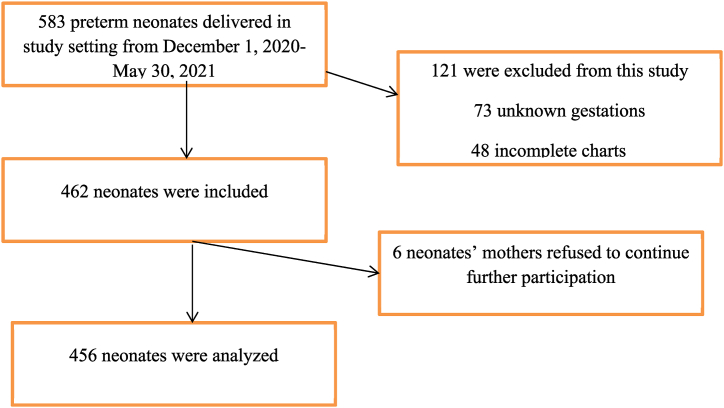
A prospective observational study was employed on 462 preterm neonates in South Gondar Zone Public Hospitals. The data were entered into Epidata 4.6 and analyzed using STATA version 16/MP software. A parametric log-normal survival model was used to identify possible predictors for preterm neonate death. Statistical significance was declared at a -value less than 0.05.
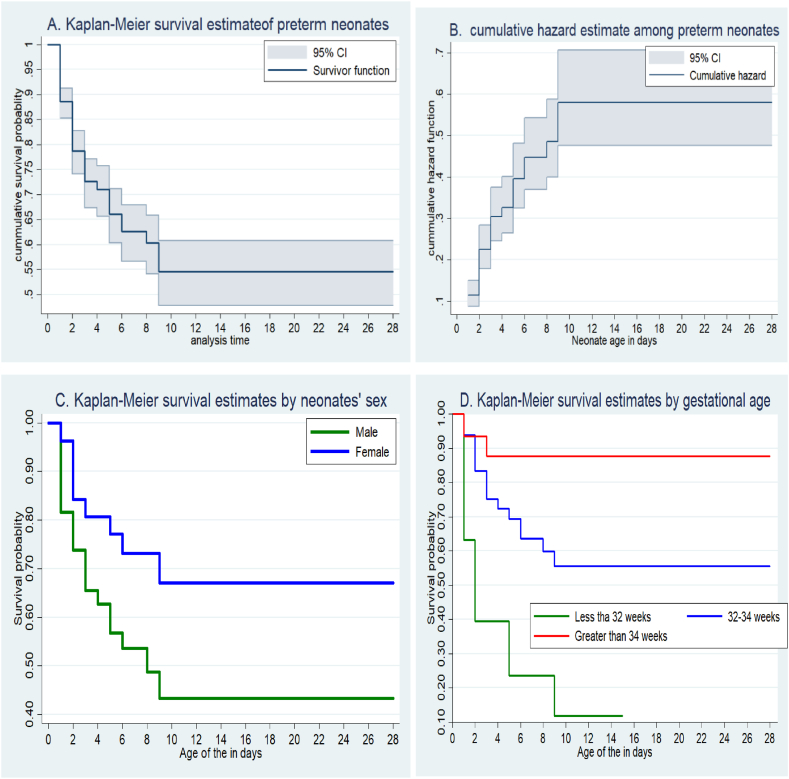
The overall preterm survival rate was 71.1% (95% CI: 66.7, 75.1). Thirty-six percent of preterm neonates were diagnosed with sepsis. One-fourth of the neonates had respiratory distress syndrome. Gestational age greater than 34 weeks (β = 1.04; 95% CI: 0.53, 1.56), respiratory distress syndrome (β = 0.85; 95% CI: 0.49, 1.22), body mass index (β = -1.34; 95% CI: -1.87, -0.80), non-union marital status (β = -0.71; 95% CI: -1.34, -0.09), multiple pregnancies (β = -0.66; 95% CI: -0.99-0.32), multiparous (β = 0.35; 95% CI: 0.01, 0.69), hypothermia (β = -1.19; 95% CI: -1.76, -0.62), Kangaroo Mother Care (β = -1.9; 95% CI: -2.34, -1.41) and non-cephalic presentation (β = -1.23; 95% CI: -1.99,-0.46) were significant predictors.
In this study, the preterm survival rate was low. Gestational age greater than 34 weeks, no respiratory distress syndrome, and multiparous mothers were positively associated with the survival of preterm neonates. Though, high pre-pregnancy maternal body mass index, non-union marital status of mothers, multiple pregnancies, hypothermia, Kangaroo mother care is not given, and non-cephalic presentation were negatively associated. A significant focus should be given to implementing WHO recommendations on preventing and caring for preterm births.
早产仍然是最重要的临床和公共卫生问题。早产婴儿的结局是临床医生和政策制定者的关键证据,并广泛用于制定临床和政策裁决以改善服务。由于新生儿结局因地点而异,甚至在同一地点也会随时间变化,因此有必要经常对其进行评估。埃塞俄比亚关于早产新生儿结局及其预测因素的文献有限。
本研究旨在评估2021年埃塞俄比亚西北部南贡德尔地区公立医院早产新生儿的结局及其预测因素。
对南贡德尔地区公立医院的462例早产新生儿进行了一项前瞻性观察研究。数据录入Epidata 4.6,并使用STATA 16/MP软件进行分析。采用参数对数正态生存模型来确定早产新生儿死亡的可能预测因素。当P值小于0.05时具有统计学意义。
早产新生儿的总体生存率为71.1%(95%可信区间:66.7,75.1)。36%的早产新生儿被诊断为败血症。四分之一的新生儿患有呼吸窘迫综合征。孕周大于34周(β = 1.04;95%可信区间:0.53,1.56)、呼吸窘迫综合征(β = 0.85;95%可信区间:0.49,1.22)、体重指数(β = -1.34;95%可信区间:-1.87,-0.80)、非婚同居状态(β = -0.71;95%可信区间:-1.34,-0.09)、多胎妊娠(β = -0.66;95%可信区间:-0.99,-0.32)、经产妇(β = 0.35;95%可信区间:0.01,0.69)、体温过低(β = -1.19;95%可信区间:-1.76,-0.62)、袋鼠式护理(β = -1.9;95%可信区间:-2.34,-1.41)和非头位分娩(β = -1.23;95%可信区间:-1.99,-0.46)是显著预测因素。
在本研究中,早产新生儿的生存率较低。孕周大于34周、无呼吸窘迫综合征和经产妇与早产新生儿的存活呈正相关。然而,孕前母亲高体重指数、母亲非婚同居状态、多胎妊娠、体温过低、未给予袋鼠式护理和非头位分娩与存活呈负相关。应高度重视实施世界卫生组织关于预防和护理早产的建议。