School of Traditional Chinese Medicine, Beijing University of Chinese Medicine, Beijing, China.
The Research Center for Ubiquitous Computing Systems (CUbiCS), Institute of Computing Technology, Chinese Academy of Sciences, Beijing, China.
PeerJ. 2023 Aug 7;11:e15621. doi: 10.7717/peerj.15621. eCollection 2023.
Lung adenocarcinoma (LUAD) is a common lung cancer with a poor prognosis under standard chemotherapy. Hypoxia is a crucial factor in the development of solid tumors, and hypoxia-related genes (HRGs) are closely associated with the proliferation of LUAD cells.
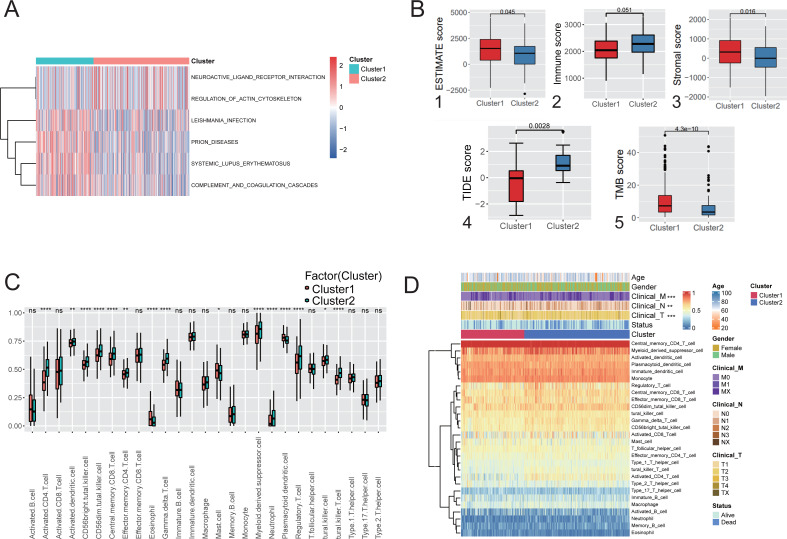
In this study, LUAD HRGs were screened, and bioinformatics analysis and experimental validation were conducted. The Cancer Genome Atlas (TCGA) and the Gene Expression Omnibus (GEO) databases were used to gather LUAD RNA-seq data and accompanying clinical information. LUAD subtypes were identified by unsupervised cluster analysis, and immune infiltration analysis of subtypes was conducted by GSVA and ssGSEA. Cox regression and LASSO regression analyses were used to obtain prognosis-related HRGs. Prognostic analysis was used to evaluate HRGs. Differences in enrichment pathways and immunotherapy were observed between risk groups based on GSEA and the TIDE method. Finally, RT-PCR and in vitro experiments were used to confirm prognosis-related HRG expression in LUAD cells.
Two hypoxia-associated subtypes of LUAD were distinguished, demonstrating significant differences in prognostic analysis and immunological characteristics between subtypes. A prognostic model based on six HRGs (HK1, PDK3, PFKL, SLC2A1, STC1, and XPNPEP1) was developed for LUAD. HK1, SLC2A1, STC1, and XPNPEP1 were found to be risk factors for LUAD. PDK3 and PFKL were protective factors in LUAD patients.
This study demonstrates the effect of hypoxia-associated genes on immune infiltration in LUAD and provides options for immunotherapy and therapeutic strategies in LUAD.
肺腺癌(LUAD)是一种常见的肺癌,在标准化疗下预后较差。缺氧是实体瘤发展的关键因素,与 LUAD 细胞增殖密切相关的是缺氧相关基因(HRGs)。
本研究筛选 LUAD HRGs,并进行生物信息学分析和实验验证。使用癌症基因组图谱(TCGA)和基因表达综合数据库(GEO)收集 LUAD RNA-seq 数据和相关临床信息。通过无监督聚类分析确定 LUAD 亚型,并通过 GSVA 和 ssGSEA 对亚型进行免疫浸润分析。Cox 回归和 LASSO 回归分析获得与预后相关的 HRGs。预后分析用于评估 HRGs。基于 GSEA 和 TIDE 方法,观察风险组之间富集途径和免疫治疗的差异。最后,通过 RT-PCR 和体外实验验证 LUAD 细胞中与预后相关的 HRG 表达。
区分出两种与缺氧相关的 LUAD 亚型,在预后分析和免疫特征方面显示出亚型间的显著差异。建立了一个基于六个 HRGs(HK1、PDK3、PFKL、SLC2A1、STC1 和 XPNPEP1)的 LUAD 预后模型。发现 HK1、SLC2A1、STC1 和 XPNPEP1 是 LUAD 的危险因素。PDK3 和 PFKL 是 LUAD 患者的保护因素。
本研究表明缺氧相关基因对 LUAD 免疫浸润的影响,并为 LUAD 的免疫治疗和治疗策略提供了选择。