Zhao Wenhao, Huang Hua, Zhao Zexia, Ding Chen, Jia Chaoyi, Wang Yingjie, Wang Guannan, Li Yongwen, Liu Hongyu, Chen Jun
Department of Lung Cancer Surgery, Tianjin Medical University General Hospital, Tianjin 300052, People's Republic of China.
Tianjin Key Laboratory of Lung Cancer Metastasis and Tumor Microenvironment, Tianjin Lung Cancer Institute, Tianjin Medical University General Hospital, Tianjin 300052, People's Republic of China.
J Cancer. 2024 Jun 17;15(14):4513-4526. doi: 10.7150/jca.97374. eCollection 2024.
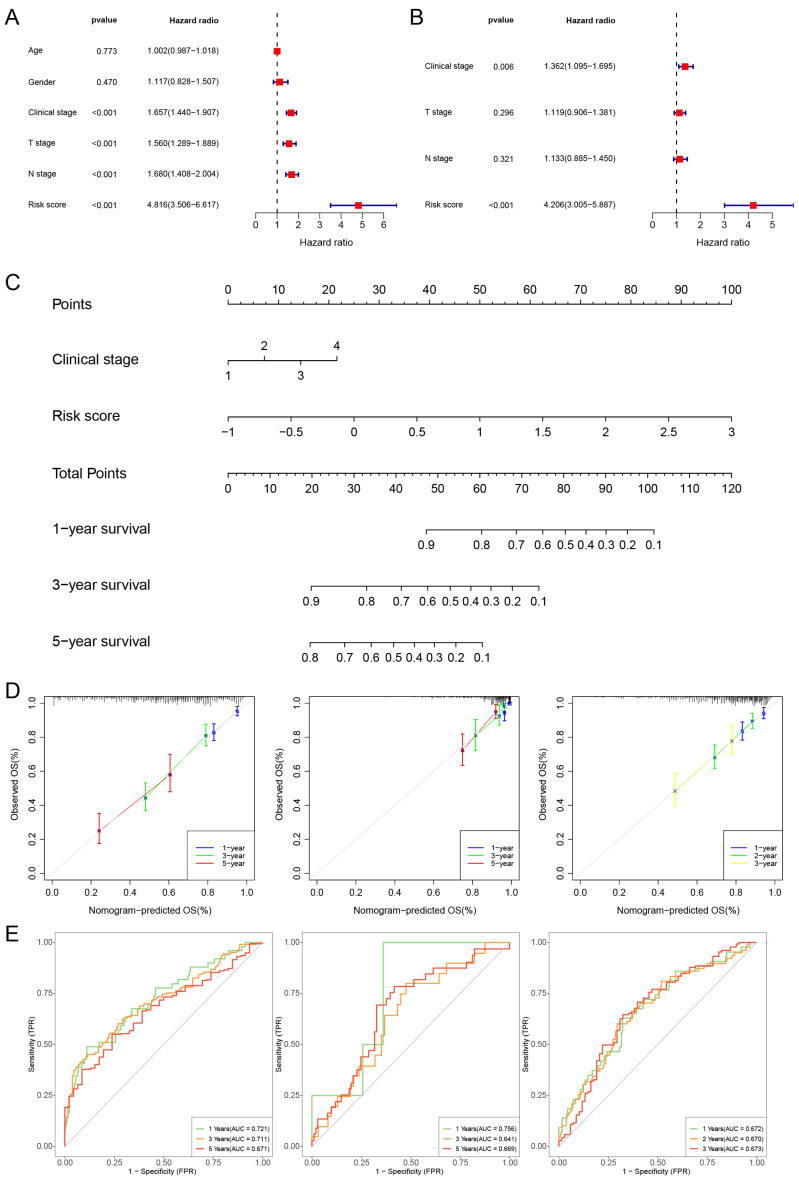
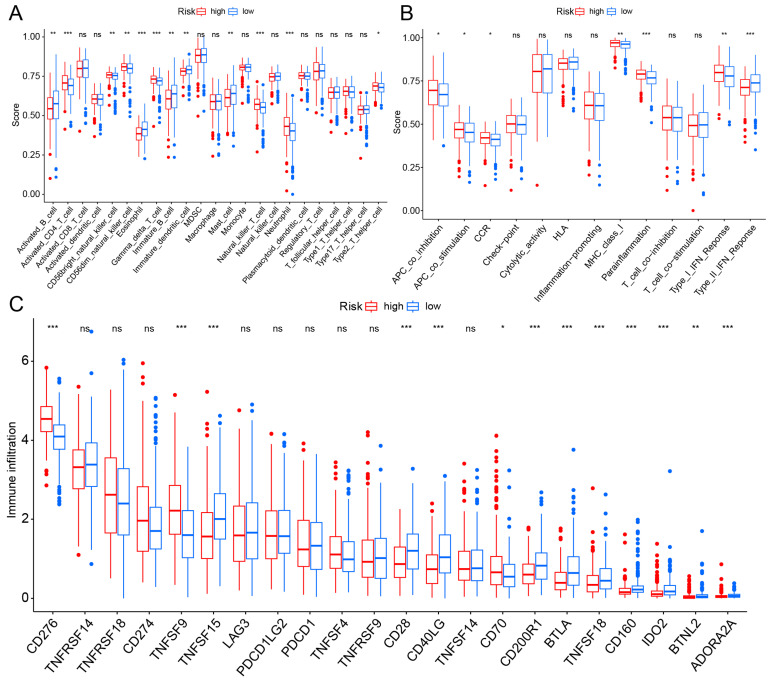
The correlation between hypoxia and tumor development is widely acknowledged. Meanwhile, the foremost organelle affected by hypoxia is mitochondria. This study aims to determine whether they possess prognostic characteristics in lung adenocarcinoma (LUAD). For this purpose, a bioinformatics analysis was conducted to assess hypoxia and mitochondrial scores related genes, resulting in the successful establishment of a prognostic model. Using the single sample Gene Set Enrichment Analysis algorithm, the hypoxia and mitochondrial scores were computed. Differential expression analysis and weighted correlation network analysis were employed to identify genes associated with hypoxia and mitochondrial scores. Prognosis-related genes were obtained through univariate Cox regression, followed by the establishment of a prognostic model using least absolute shrinkage and selection operator Cox regression. Two independent validation datasets were utilized to verify the accuracy of the prognostic model using receiver operating characteristic and calibration curves. Additionally, a nomogram was employed to illustrate the clinical significance of this study. 318 differentially expressed genes associated with hypoxia and mitochondrial scores were identified for the construction of a prognostic model. The prognostic model based on 16 genes, including PKM, S100A16, RRAS, TUBA4A, PKP3, KCTD12, LPGAT1, ITPRID2, MZT2A, LIFR, PTPRM, LATS2, PDIK1L, GORAB, PCDH7, and CPED1, demonstrates good predictive accuracy for LUAD prognosis. Furthermore, tumor microenvironments analysis and drug sensitivity analysis indicate an association between risk scores and certain immune cells, and a higher risk scores suggesting improved chemotherapy efficacy. The research established a prognostic model consisting of 16 genes, and a nomogram was developed to accurately predict the prognosis of LUAD patients. These findings may contribute to guiding clinical decision-making and treatment selection for patients with LUAD, ultimately leading to improved treatment outcomes.
缺氧与肿瘤发展之间的相关性已得到广泛认可。同时,受缺氧影响最主要的细胞器是线粒体。本研究旨在确定它们在肺腺癌(LUAD)中是否具有预后特征。为此,进行了一项生物信息学分析,以评估与缺氧和线粒体评分相关的基因,从而成功建立了一个预后模型。使用单样本基因集富集分析算法计算缺氧和线粒体评分。采用差异表达分析和加权相关网络分析来鉴定与缺氧和线粒体评分相关的基因。通过单变量Cox回归获得预后相关基因,随后使用最小绝对收缩和选择算子Cox回归建立预后模型。利用两个独立的验证数据集,通过受试者工作特征曲线和校准曲线验证预后模型的准确性。此外,还使用了列线图来说明本研究的临床意义。为构建预后模型,鉴定出318个与缺氧和线粒体评分相关的差异表达基因。基于16个基因(包括PKM、S100A16、RRAS、TUBA4A、PKP3、KCTD12、LPGAT1、ITPRID2、MZT2A、LIFR、PTPRM、LATS2、PDIK1L、GORAB、PCDH7和CPED1)的预后模型对LUAD预后具有良好的预测准确性。此外,肿瘤微环境分析和药物敏感性分析表明风险评分与某些免疫细胞之间存在关联,且较高的风险评分提示化疗疗效提高。该研究建立了一个由16个基因组成的预后模型,并开发了列线图以准确预测LUAD患者的预后。这些发现可能有助于指导LUAD患者的临床决策和治疗选择,最终改善治疗效果。