Al-Zghoul Mohammad Borhan, Jaradat Ziad Waheed, Ababneh Mustafa M, Okour Mohammad Ziad, Saleh Khaled Musa Mohammad, Alkofahi Ayesha, Alboom Mohammad Hussien
Department of Basic Medical Veterinary Sciences, Faculty of Veterinary Medicine, Jordan University of Science and Technology, Irbid, Jordan.
Department of Biotechnology and Genetic Engineering, Faculty of Science and Art, Jordan University of Science and Technology, Irbid, Jordan.
Vet World. 2023 May;16(5):918-928. doi: 10.14202/vetworld.2023.918-928. Epub 2023 May 7.
Thermal manipulation (TM), exposure to mild heat shock during embryogenesis, which is a critical developmental period of broiler chickens, improves tissue stability, oxidative stress response, and immune response during heat stress. Thermal manipulation could be more cost-effective than other methods to boost the immune response. This study aimed to evaluate the impact of TM during embryogenesis, concomitant with an challenge, on body weight (BW), body temperature (T), and splenic mRNA expression of cytokines (Interleukin [IL]-1β, IL-2, IL-6, IL-8, IL-12, IL-15, IL-16, IL-18, and interferon [IFN]-γ) in poultry.
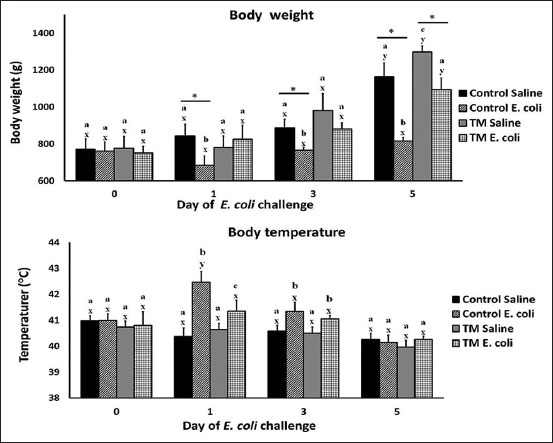
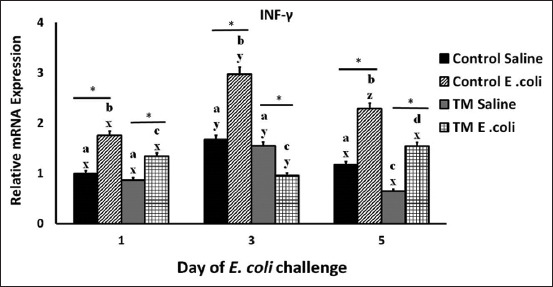
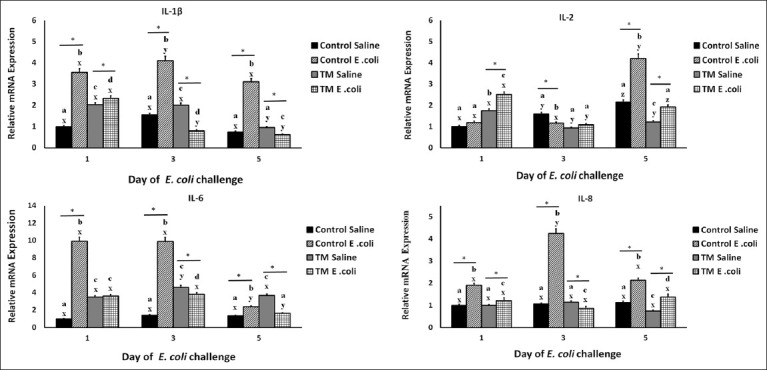
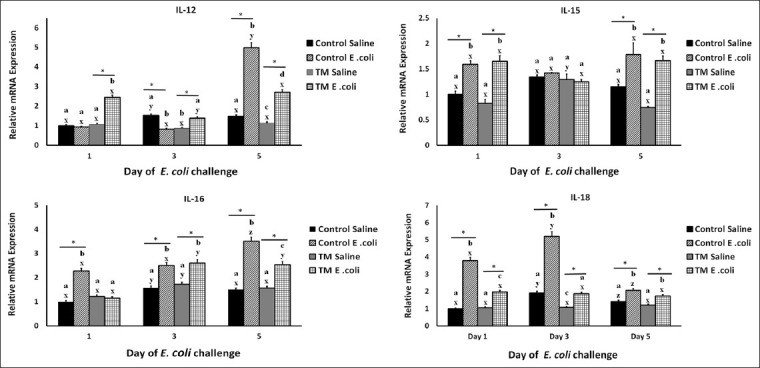
A total of 740 fertile eggs were procured from a certified Ross broiler breeder. The eggs were divided into two incubation groups: the control and TM groups. The eggs in the control group were kept at 37.8°C air temperature and 56% relative humidity (RH) during incubation; eggs of the TM group were incubated under standard conditions, except for embryonic days 10-18, during which they were incubated at 39°C and 65% RH for 18 h daily. On the 7 day of incubation, eggs with dead embryos were excluded. After hatching was complete, each group was further subdivided into saline-treated or -challenged groups. The (serotype 078 with the dose of 1.5 × 10 colony-forming unit/mL) challenge was performed when the birds were 20 days old. Body weight and T measurements were taken on post-hatch days 20, 21, 23, and 25. Splenic mRNA expression of cytokines (IL-1β, IL-2, IL-6, IL-8, IL-12, IL-15, IL-16, IL-18, and IFN-γ) was analyzed by real-time quantitative polymerase chain reaction.
Following the challenge, the TM-treated group's body performance parameters (BW and T) were significantly increased compared with the control group. Body weight was higher in the TM group than in the control group (p < 0.05); T was lower in the TM group than in the control group (p < 0.05). The mRNA levels of IL and IFN-γ were more stable and moderately induced in the TM group compared with the control group. Thermal manipulation altered the basal mRNA levels of ILs and IFN-γ and changed their expression dynamics after the challenge.
Thermal manipulation during embryogenesis could boost the immune system response to .
热调控(TM)即在肉鸡胚胎发育关键时期使其暴露于轻度热应激下,可改善热应激期间的组织稳定性、氧化应激反应和免疫反应。热调控在增强免疫反应方面可能比其他方法更具成本效益。本研究旨在评估胚胎发育期间热调控以及同时进行的[病原体名称]攻毒对家禽体重(BW)、体温(T)和脾脏中细胞因子(白细胞介素[IL]-1β、IL-2、IL-6、IL-8、IL-12、IL-15、IL-16、IL-18和干扰素[IFN]-γ)mRNA表达的影响。
从一家认证的罗斯肉鸡育种场采购了740枚受精蛋。将这些蛋分为两个孵化组:对照组和热调控组。对照组的蛋在孵化期间保持在37.8°C的气温和56%相对湿度(RH)下;热调控组的蛋在标准条件下孵化,但在胚胎发育第10 - 18天期间,每天在39°C和65%RH下孵化18小时。在孵化第7天,排除有死胚的蛋。孵化完成后,每组进一步细分为盐水处理组或攻毒组。当家禽20日龄时进行[病原体名称](血清型078,剂量为1.5×10菌落形成单位/毫升)攻毒。在孵化后第20、21、23和25天测量体重和体温。通过实时定量聚合酶链反应分析脾脏中细胞因子(IL-1β、IL-2、IL-6、IL-8、IL-12、IL-15、IL-16、IL-18和IFN-γ)的mRNA表达。
攻毒后,热调控处理组的身体性能参数(体重和体温)与对照组相比显著提高。热调控组的体重高于对照组(p < 0.05);热调控组的体温低于对照组(p < 0.05)。与对照组相比,热调控组中白细胞介素和干扰素-γ的mRNA水平更稳定且有适度诱导。热调控改变了白细胞介素和干扰素-γ的基础mRNA水平,并改变了攻毒后它们的表达动态。
胚胎发育期间的热调控可增强免疫系统对[病原体名称]攻毒的反应。