Cha Woo-Jin, Kim Kiho
Department of Psychology, Chung-Ang University, 84, Heukseok-ro, Dongjak-gu, Seoul 06974, Republic of Korea.
Department of Psychology of Counseling, Sejong Cyber University, Cheonho-daero 680, Gwangjingu, Seoul 04992, Republic of Korea.
Int J Clin Health Psychol. 2023 Oct-Dec;23(4):100399. doi: 10.1016/j.ijchp.2023.100399. Epub 2023 Jul 25.
BACKGROUND/OBJECTIVE: Individuals with broad autism phenotype (BAP) showed a diminished ability to recognize emotion. This study aims to examine whether their decline in emotion recognition ability could be more clearly identified as task complexity increased and whether their decline could be influenced by their eye-gaze patterns.
41 individuals with BAP and 40 healthy controls performed two types of emotion recognition tasks. After confirming conditions wherein the BAP group did not perform well compared to the control group, we compared gaze proportion on faces and context between groups when performing the conditions.
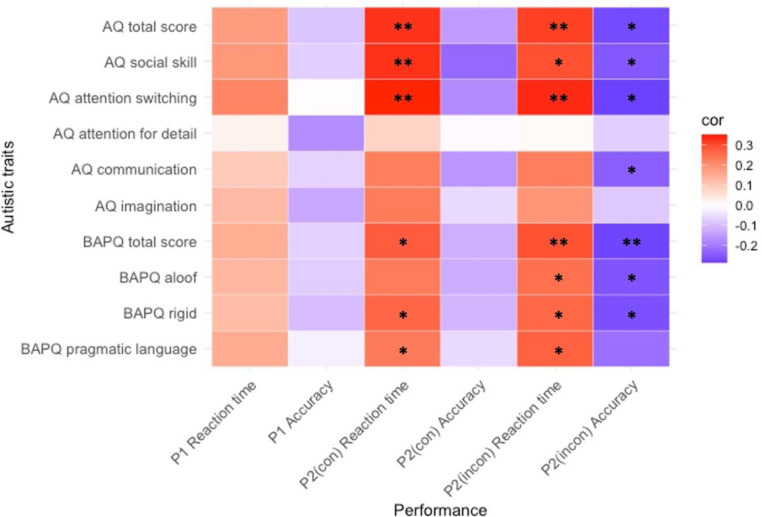
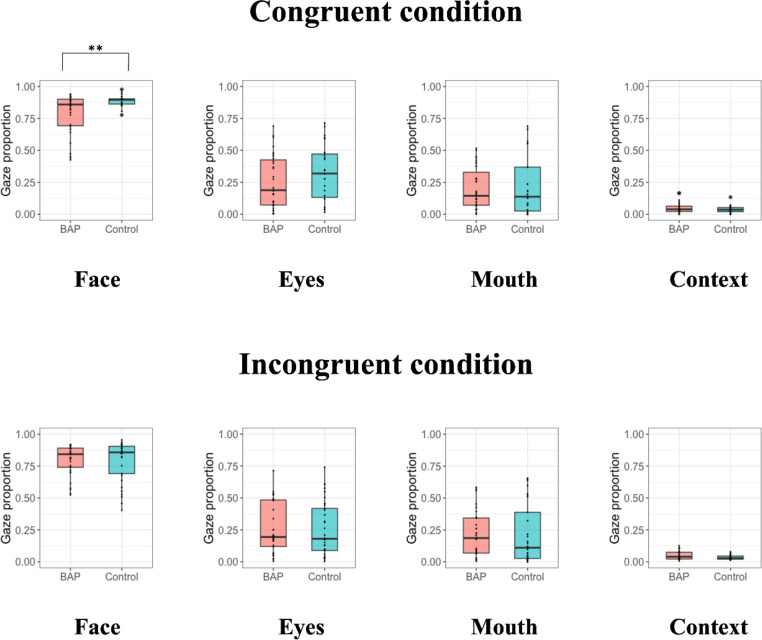
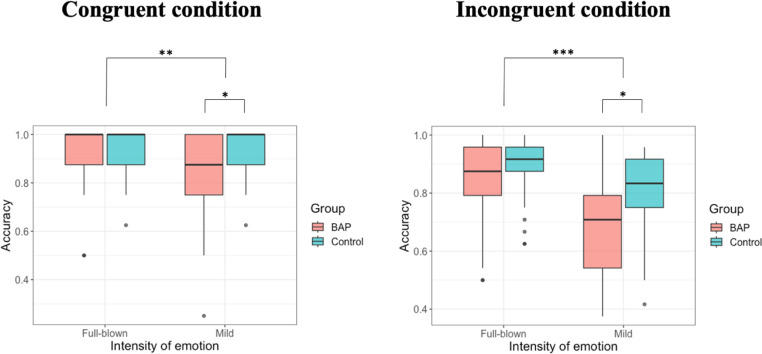
The more difficult the task, the clearer the significant relationships between the level of autistic traits and emotion recognition ability. The BAP group showed lower accuracy compared to the control group when a face with mild emotional intensity was presented with context. In terms of gaze proportion, the BAP group looked less at faces when recognizing emotions compared to the control group.
These findings indicate that diminished emotion recognition ability in individuals with BAP may be influenced by face gaze.
背景/目的:具有广泛自闭症表型(BAP)的个体在识别情绪方面能力减弱。本研究旨在探讨随着任务复杂性增加,他们在情绪识别能力上的下降是否能更清晰地被识别出来,以及他们的下降是否会受到其目光注视模式的影响。
41名具有BAP的个体和40名健康对照者进行了两种类型的情绪识别任务。在确认BAP组与对照组相比表现不佳的条件后,我们比较了两组在执行这些条件时在面部和情境上的注视比例。
任务越困难,自闭症特征水平与情绪识别能力之间的显著关系就越明显。当呈现带有情境的轻度情绪强度的面部时,BAP组与对照组相比准确性较低。在注视比例方面,与对照组相比,BAP组在识别情绪时对面部的注视较少。
这些发现表明,具有BAP的个体情绪识别能力的减弱可能受到面部注视的影响。