Sung MinDong, Jang Won Seok, Kim Hae Reong, Park Ji Ae, Lim Sun Min, Kim Hye Ryun, Cho Byoung Chul, Park Yu Rang, Hong Min Hee
Division of Pulmonology and Critical Care, Department of Internal Medicine, Severance Hospital, Yonsei University College of Medicine, Seoul, Republic of Korea.
Department of Biomedical Systems Informatics, Yonsei University College of Medicine, Seoul, Republic of Korea.
Transl Lung Cancer Res. 2023 Jul 31;12(7):1506-1516. doi: 10.21037/tlcr-23-7. Epub 2023 Jul 14.
Not all non-small cell lung cancer (NSCLC) patients will benefit from immune checkpoint therapy and use of these medications carry serious autoimmune adverse effects. Therefore, biomarkers are needed to better identify patients who will benefit from its use. Here, the correlation of overall survival (OS) with baseline and early treatment period serum biomarker responses was evaluated in patients with NSCLC undergoing immunotherapy.
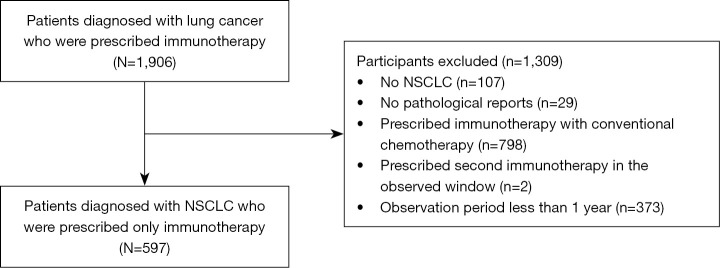
Patients diagnosed with NSCLC undergoing immunotherapy (n=597) at a tertiary academic medical center in South Korea were identified between January 2010 and November 2021. The neutrophil-lymphocyte ratio (NLR), C-reactive protein (CRP), and lactate dehydrogenase (LDH) levels in the survival and non-survival groups were examined at baseline and early treatment periods. Additionally, aberrant laboratory parameters at each period were used to stratify survival curves and examine their correlation with one-year OS.
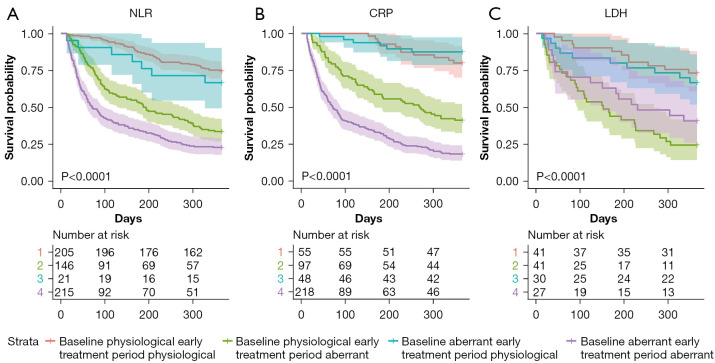
In the non-survival group, the NLR, CRP, and LDH levels at the early treatment period were higher than those at the baseline (P<0.001). The survival curves stratified based on aberrant laboratory findings in each period varied (log-rank test P<0.001). Multivariate Cox regression analysis revealed that having prescribed more than 3rd line of chemotherapy [hazard ratio (HR) =3.19, 95% confidence interval (CI): 1.04-9.82; P=0.043] and early treatment period CRP (HR =3.88; 95% CI: 1.55-9.72; P=0.004) and LDH (HR =4.04; 95% CI: 2.01-8.12; P<0.001) levels were significant predictors of one-year OS.
Early treatment period CRP and LDH levels were significant predictors of OS in patients with NSCLC undergoing immunotherapy.
并非所有非小细胞肺癌(NSCLC)患者都能从免疫检查点治疗中获益,且使用这些药物会带来严重的自身免疫不良反应。因此,需要生物标志物来更好地识别能从其使用中获益的患者。在此,对接受免疫治疗的NSCLC患者的总生存期(OS)与基线期及治疗早期血清生物标志物反应的相关性进行了评估。
2010年1月至2021年11月期间,在韩国一家三级学术医疗中心识别出597例接受免疫治疗的NSCLC患者。在生存组和非生存组中,于基线期和治疗早期检测中性粒细胞与淋巴细胞比值(NLR)、C反应蛋白(CRP)和乳酸脱氢酶(LDH)水平。此外,利用各时期异常的实验室参数对生存曲线进行分层,并检查其与1年总生存期的相关性。
在非生存组中,治疗早期的NLR、CRP和LDH水平高于基线期(P<0.001)。根据各时期异常实验室检查结果分层的生存曲线有所不同(对数秩检验P<0.001)。多因素Cox回归分析显示,接受三线以上化疗[风险比(HR)=3.19,95%置信区间(CI):1.04 - 9.82;P = 0.043]以及治疗早期的CRP(HR = 3.88;95% CI:1.55 - 9.72;P = 0.004)和LDH(HR = 4.04;95% CI:2.01 - 8.12;P<0.001)水平是1年总生存期的显著预测因素。
治疗早期的CRP和LDH水平是接受免疫治疗的NSCLC患者总生存期的显著预测因素。