Clark Kaylyn, Fu Wei, Liu Chia-Lun, Ho Pei-Chuan, Wang Hui, Lee Wan-Ping, Chou Shin-Yi, Wang Li-San, Tzeng Jung-Ying
Department of Pathology and Laboratory Medicine, Penn Neurodegeneration Genomics Center, Perelman School of Medicine, University of Pennsylvania, Philadelphia, PA, United States.
Department of Pathology and Laboratory Medicine, Perelman School of Medicine, University of Pennsylvania, Philadelphia, PA, United States.
Front Aging Neurosci. 2023 Jul 27;15:1168638. doi: 10.3389/fnagi.2023.1168638. eCollection 2023.
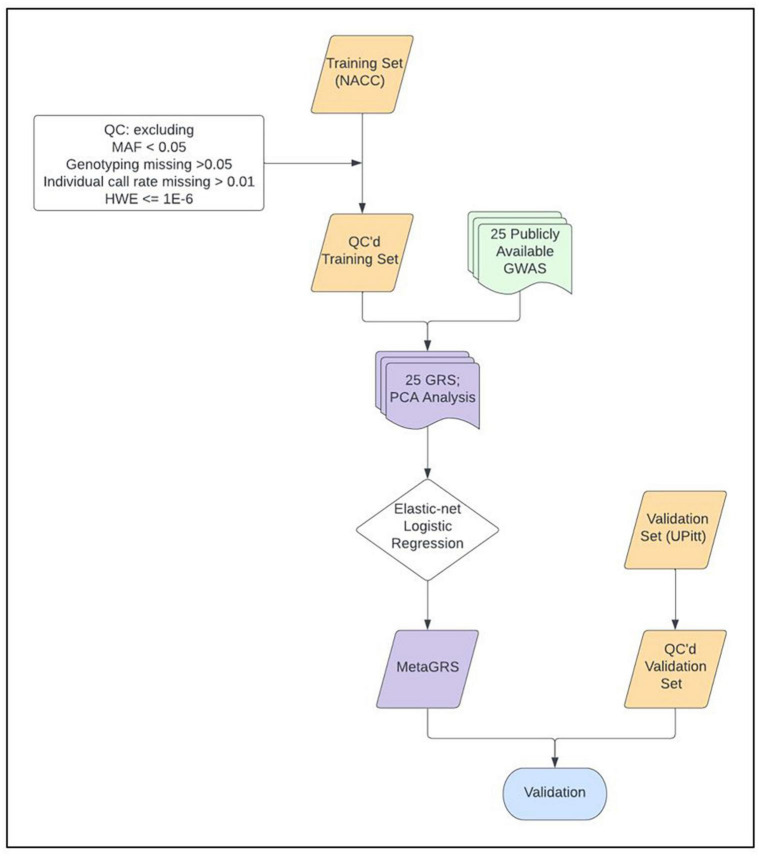
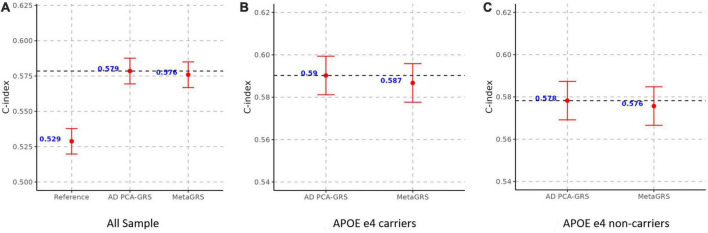
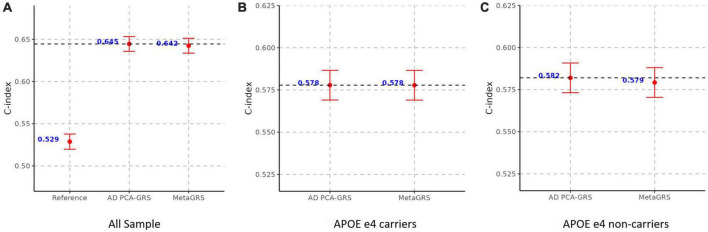
To better capture the polygenic architecture of Alzheimer's disease (AD), we developed a joint genetic score, MetaGRS. We incorporated genetic variants for AD and 24 other traits from two independent cohorts, NACC ( = 3,174, training set) and UPitt ( = 2,053, validation set). One standard deviation increase in the MetaGRS is associated with about 57% increase in the AD risk [hazard ratio (HR) = 1.577, = 7.17 E-56], showing little difference from the HR for AD GRS alone (HR = 1.579, = 1.20E-56), suggesting similar utility of both models. We also conducted APOE-stratified analyses to assess the role of the e4 allele on risk prediction. Similar to that of the combined model, our stratified results did not show a considerable improvement of the MetaGRS. Our study showed that the prediction power of the MetaGRS significantly outperformed that of the reference model without any genetic information, but was effectively equivalent to the prediction power of the AD GRS.
为了更好地捕捉阿尔茨海默病(AD)的多基因结构,我们开发了一种联合遗传评分——MetaGRS。我们纳入了来自两个独立队列NACC(n = 3174,训练集)和UPitt(n = 2053,验证集)的AD及其他24个性状的遗传变异。MetaGRS增加一个标准差与AD风险增加约57%相关[风险比(HR)= 1.577,P = 7.17×10⁻⁵⁶],与单独的AD遗传风险评分(HR = 1.579,P = 1.20×10⁻⁵⁶)相比差异不大,表明两种模型的效用相似。我们还进行了载脂蛋白E(APOE)分层分析,以评估ε4等位基因在风险预测中的作用。与联合模型类似,我们的分层结果并未显示MetaGRS有显著改善。我们的研究表明,MetaGRS的预测能力显著优于无任何遗传信息的参考模型,但与AD遗传风险评分的预测能力有效等同。