Schelle Luca, Abrantes Joana, Baldauf Hanna-Mari, Esteves Pedro José
Faculty of Medicine, Max von Pettenkofer Institute and Gene Center, Virology, National Reference Center for Retroviruses, LMU München, Munich, Germany.
CIBIO-InBIO, Research Center in Biodiversity and Genetic Resources, University of Porto, Vairão, Portugal.
Front Microbiol. 2023 Jul 26;14:1213685. doi: 10.3389/fmicb.2023.1213685. eCollection 2023.
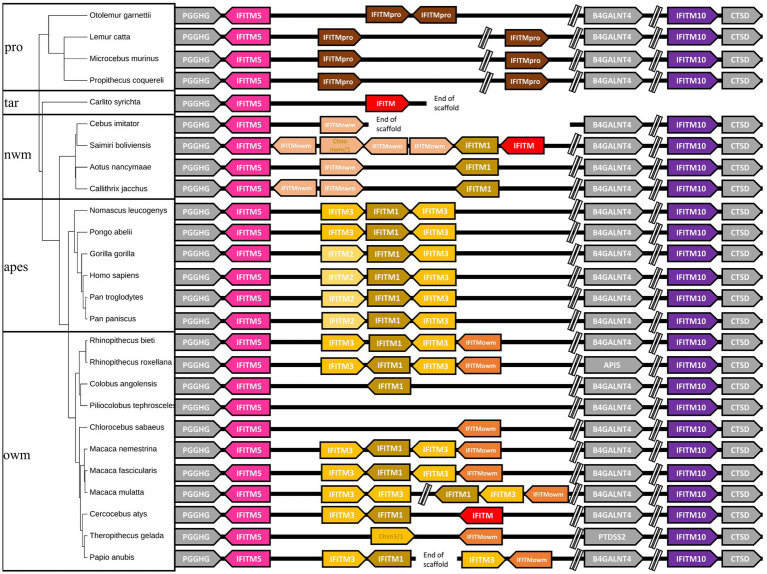
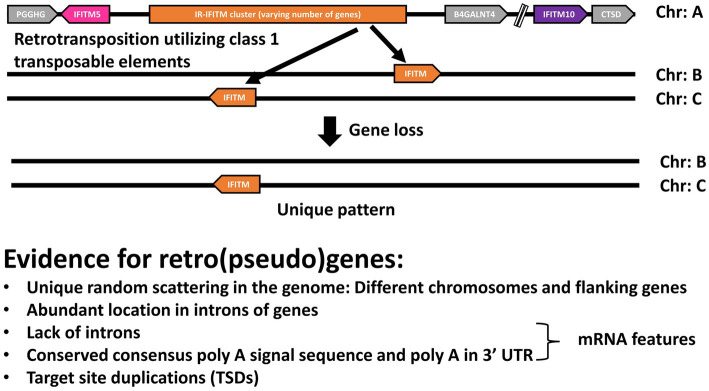
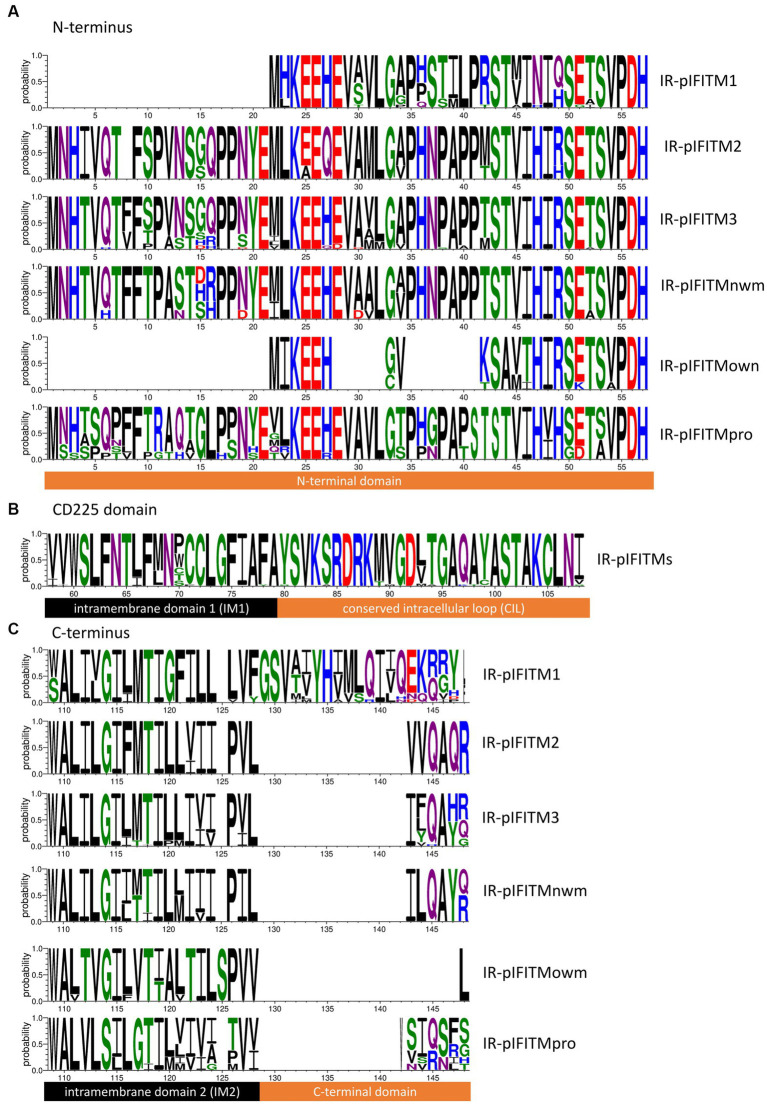
Interferon-inducible transmembrane proteins (IFITMs) are a family of transmembrane proteins. The subgroup of immunity-related (IR-)IFITMs is involved in adaptive and innate immune responses, being especially active against viruses. Here, we suggest that IFITMs should be classified as (1) a canonical IFITM gene cluster, which is located on the same chromosome, and (2) IFITM retrogenes, with a random and unique location at different positions within the genome. Phylogenetic analyses of the canonical cluster revealed the existence of three novel groups of primate IFITMs (pIFITM) in the IR-IFITM clade: the prosimian pIFITMs(pro), the new world monkey pIFITMs(nwm) and the old world monkey pIFITMs(owm). Therefore, we propose a new nomenclature: IR-pIFITM1, IR-pIFITM2, IR-pIFITM3, IR-pIFITMnwm, IR-pIFITMowm, and IR-pIFITMpro. We observed divergent evolution for pIFITM5 and pIFITM10, and evidence for concerted evolution and a mechanism of birth-and-death evolution model for the IR-pIFITMs. In contrast, the IFITMs scattered throughout the genomes possessed features of retrogenes retrotransposed by class 1 transposable elements. The origin of the IFITM retrogenes correspond to more recent events. We hypothesize that the transcript of a canonical IFITM3 has been constantly retrotransposed using class 1 transposable elements resulting in the IFITM retro(pseudo)genes. The unique pattern of each species has most likely been caused by constant pseudogenization and loss of the retro(pseudo)genes. This suggests a third mechanism of evolution for the IR-IFITMs in primates, similar to the birth-and-death model of evolution, but via a transposable element mechanism, which resulted in retro(pseudo)genes.
干扰素诱导跨膜蛋白(IFITMs)是一类跨膜蛋白家族。免疫相关(IR-)IFITMs亚组参与适应性和先天性免疫反应,对病毒具有特别强的活性。在此,我们建议将IFITMs分为两类:(1)位于同一条染色体上的典型IFITM基因簇;(2)IFITM反转录基因,其在基因组内的不同位置具有随机且独特的定位。对典型基因簇的系统发育分析揭示,在IR-IFITM进化枝中存在三类新的灵长类IFITMs(pIFITM):原猴亚目的pIFITMs(pro)、新大陆猴的pIFITMs(nwm)和旧大陆猴的pIFITMs(owm)。因此,我们提出一种新的命名法:IR-pIFITM1、IR-pIFITM2、IR-pIFITM3、IR-pIFITMnwm、IR-pIFITMowm和IR-pIFITMpro。我们观察到pIFITM5和pIFITM10的趋异进化,以及IR-pIFITMs协同进化的证据和生死进化模型机制。相比之下,散布于基因组中的IFITMs具有由1类转座元件反转录转座产生的反转录基因特征。IFITM反转录基因的起源对应于更近的事件。我们推测,典型IFITM3的转录本通过1类转座元件不断反转录转座,从而产生IFITM反转录(假)基因。每个物种的独特模式很可能是由反转录(假)基因的持续假基因化和丢失造成的。这表明灵长类动物中IR-IFITMs存在第三种进化机制,类似于生死进化模型,但通过转座元件机制,导致了反转录(假)基因的产生。