Department of Neurology, Beijing Tiantan Hospital, Capital Medical University, Beijing, China.
China National Clinical Research Center for Neurological Diseases, Beijing Tiantan Hospital, Capital Medical University, Beijing, China.
JAMA Netw Open. 2023 Aug 1;6(8):e2328828. doi: 10.1001/jamanetworkopen.2023.28828.
Ginkgo diterpene lactone meglumine (GDLM) has attracted much attention because of its potential neuroprotective properties in ischemic stroke. The efficacy of GDLM in patients with acute ischemic stroke (AIS) needs to be verified by well-designed randomized clinical trials.
To assess the efficacy and safety of GDLM in patients with AIS.
DESIGN, SETTING, AND PARTICIPANTS: This multicenter, randomized, double-blind, placebo-controlled, parallel-group trial involved 3448 patients who had AIS, were aged 18 to 80 years, had a clinically diagnosed AIS symptom within 48 hours of onset, had a modified Rankin Scale (mRS) score of 0 or 1 prior to onset, and had a National Institutes of Health Stroke Scale score ranging from 4 to 24. The trial took place at 100 centers in China from February 1, 2016, to May 1, 2018. The mRS is a global stroke disability scale with scores ranging from 0 (no symptoms or completely recovered) to 6 (death). The National Institutes of Health Stroke Scale is a tool used by clinicians to quantify impairment caused by stroke (range, 0-42, with higher scores indicating greater severity). Data were analyzed from January 2019 to December 2022.
Patients were randomized to receive GDLM or placebo once daily via intravenous infusion in a 1:1 ratio. The treatment was dispensed within 48 hours after symptoms and continued for 14 days. Interventions of thrombolysis and thrombectomy were not permitted during the treatment.
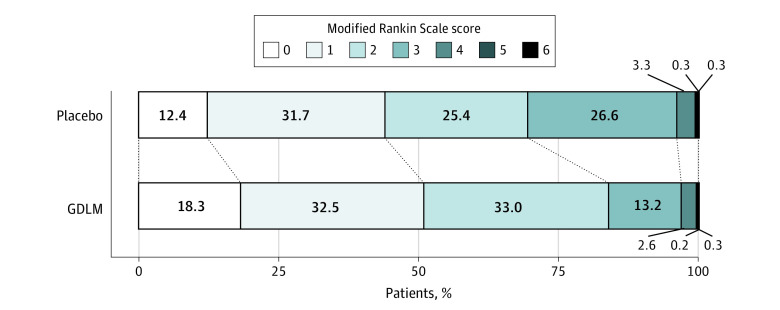
The primary outcome was the proportion of patients with an mRS of 0 or 1 on day 90 after randomization. Safety outcomes included adverse events and serious adverse events.
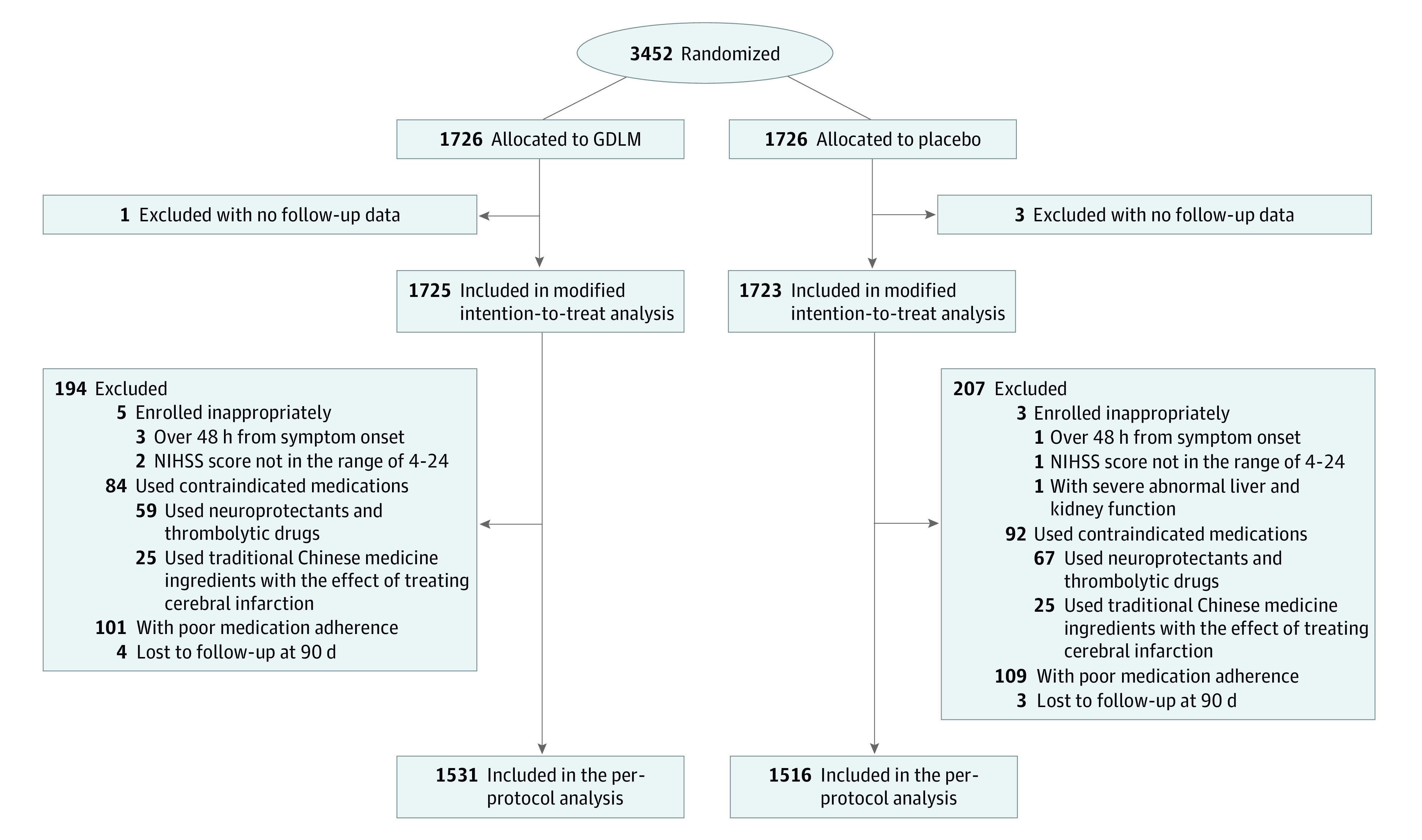
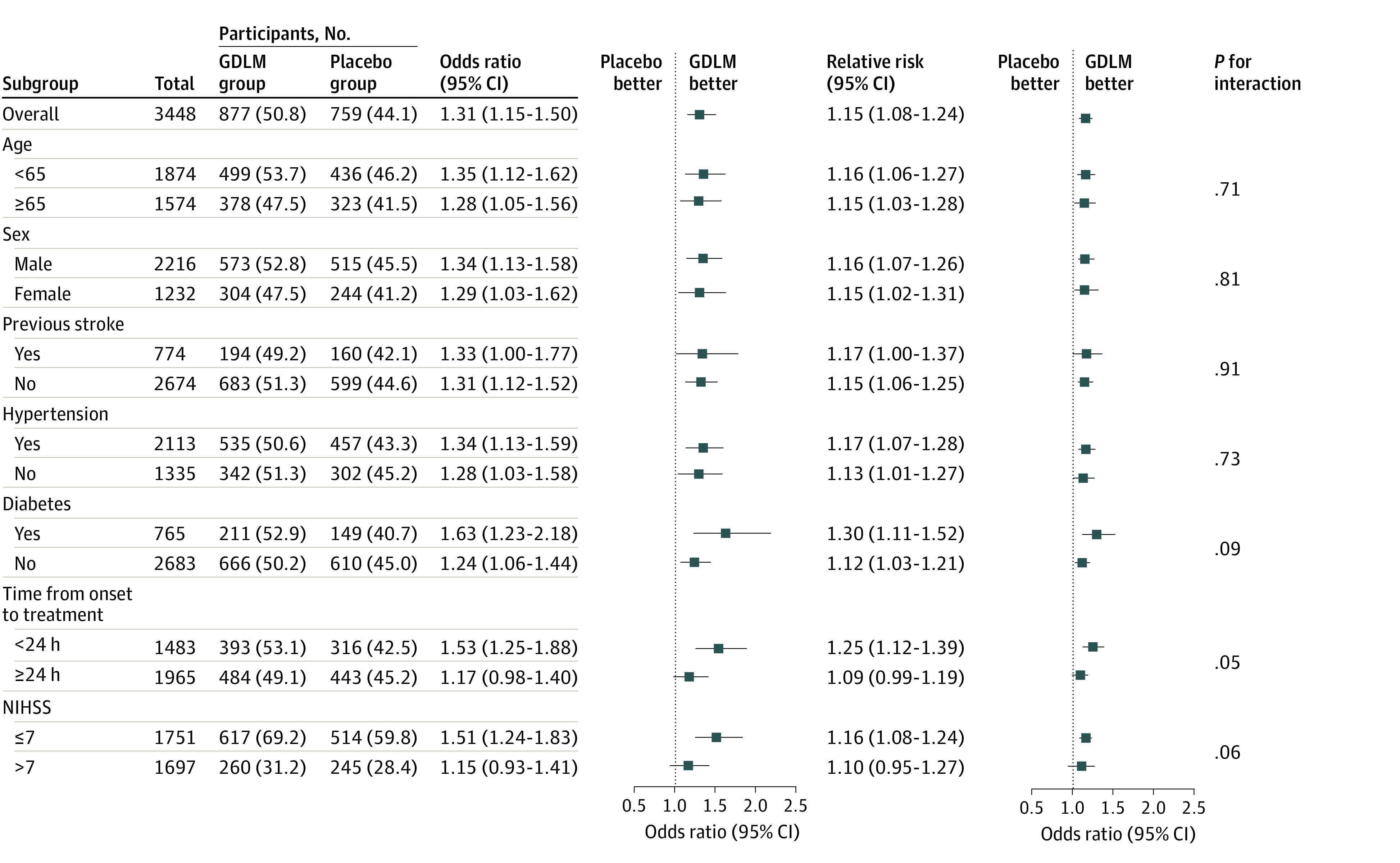
A total of 3448 patients were randomized, with 1725 patients assigned to the GDLM group and 1723 patients assigned to the placebo group. The median (IQR) age of the patients was 63 (55-71) years, and 1232 (35.7%) were women. The primary outcome on day 90 occurred in 877 patients (50.8%) in the GDLM group, and 759 patients (44.1%) in the placebo group (risk difference, 6.79%; 95% CI, 3.46%-10.10%; odds ratio, 1.31; 95% CI, 1.15-1.50; relative risk, 1.15; 95% CI, 1.08-1.24; P < .001). Adverse events occurred relatively equally between the 2 groups (303 [17.6%] vs 298 [17.3%]; risk difference, 0.27%; 95% CI, -2.26% to 2.80%; odds ratio, 1.02; 95% CI, 0.85-1.21; relative risk, 1.02; 95% CI, 0.88-1.17; P = .83).
Among patients with AIS in this randomized clinical trial, GDLM improved the proportion of patients achieving favorable clinical outcomes at 90 days compared with placebo.
ClinicalTrials.gov Identifier: NCT02526225.
重要性:银杏二萜内酯葡胺(GDLM)因其在缺血性中风中的潜在神经保护特性而备受关注。GDLM 在急性缺血性中风(AIS)患者中的疗效需要通过精心设计的随机临床试验来验证。
目的:评估 GDLM 在 AIS 患者中的疗效和安全性。
设计、设置和参与者:这是一项多中心、随机、双盲、安慰剂对照、平行组试验,涉及 3448 名 AIS 患者,年龄 18 至 80 岁,发病后 48 小时内有临床诊断的 AIS 症状,发病前改良 Rankin 量表(mRS)评分为 0 或 1,美国国立卫生研究院中风量表(NIHSS)评分为 4 至 24。该试验于 2016 年 2 月 1 日至 2018 年 5 月 1 日在中国 100 个中心进行。mRS 是一种全球中风残疾量表,评分范围为 0(无症状或完全恢复)至 6(死亡)。NIHSS 是临床医生用来量化中风引起的损伤的工具(范围为 0-42,得分越高表示损伤越严重)。数据于 2019 年 1 月至 2022 年 12 月进行分析。
干预措施:患者随机接受 GDLM 或安慰剂每日一次静脉输注,比例为 1:1。症状出现后 48 小时内给药,持续 14 天。治疗期间不允许溶栓和血栓切除术。
主要结果和测量:主要结果是随机分组后第 90 天 mRS 评分为 0 或 1 的患者比例。安全性结局包括不良事件和严重不良事件。
结果:共有 3448 名患者被随机分组,1725 名患者被分配到 GDLM 组,1723 名患者被分配到安慰剂组。患者的中位数(IQR)年龄为 63(55-71)岁,1232 名(35.7%)为女性。第 90 天的主要结局发生在 GDLM 组 877 名(50.8%)患者和安慰剂组 759 名(44.1%)患者中(风险差,6.79%;95%CI,3.46%-10.10%;优势比,1.31;95%CI,1.15-1.50;相对风险,1.15;95%CI,1.08-1.24;P < .001)。两组不良反应发生率相当(303 [17.6%] vs 298 [17.3%];风险差,0.27%;95%CI,-2.26%至 2.80%;优势比,1.02;95%CI,0.85-1.21;相对风险,1.02;95%CI,0.88-1.17;P = .83)。
结论和相关性:在这项随机临床试验中,与安慰剂相比,GDLM 可提高 AIS 患者 90 天的临床结局良好的比例。
试验注册:ClinicalTrials.gov 标识符:NCT02526225。