Singh Tanbir, Matsumi Yutaka, Nakayama Tomoki, Hayashida Sachiko, Patra Prabir K, Yasutomi Natsuko, Kajino Mizuo, Yamaji Kazuyo, Khatri Pradeep, Takigawa Masayuki, Araki Hikaru, Kurogi Yuki, Kuji Makoto, Muramatsu Kanako, Imasu Ryoichi, Ananda Anamika, Arbain Ardhi A, Ravindra Khaiwal, Bhardwaj Sanjeev, Kumar Sahil, Mor Sahil, Dhaka Surendra K, Dimri A P, Sharma Aka, Singh Narendra, Bhatti Manpreet S, Yadav Rekha, Vatta Kamal, Mor Suman
Research Institute for Humanity and Nature, Kyoto, 6038047, Japan.
Institute for Space-Earth Environmental Research, Nagoya University, Nagoya, 4648601, Japan.
Sci Rep. 2023 Aug 14;13(1):13201. doi: 10.1038/s41598-023-39471-1.
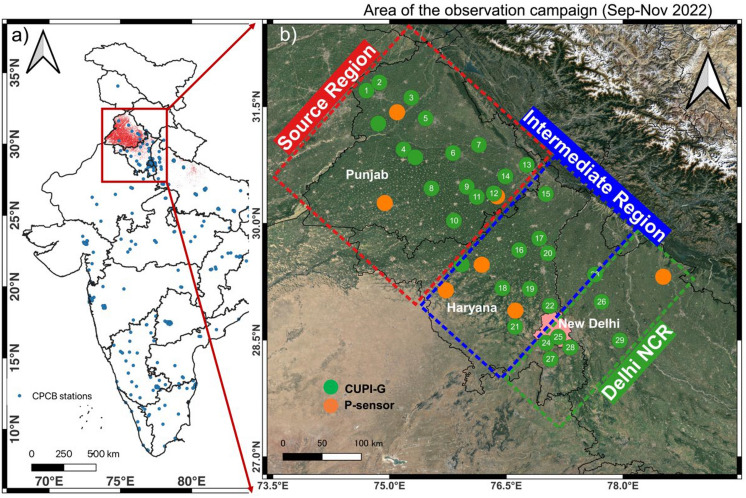
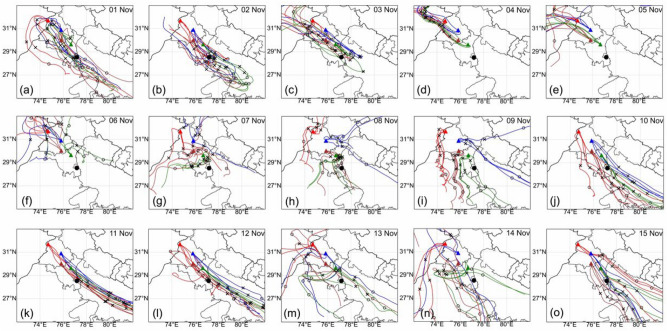
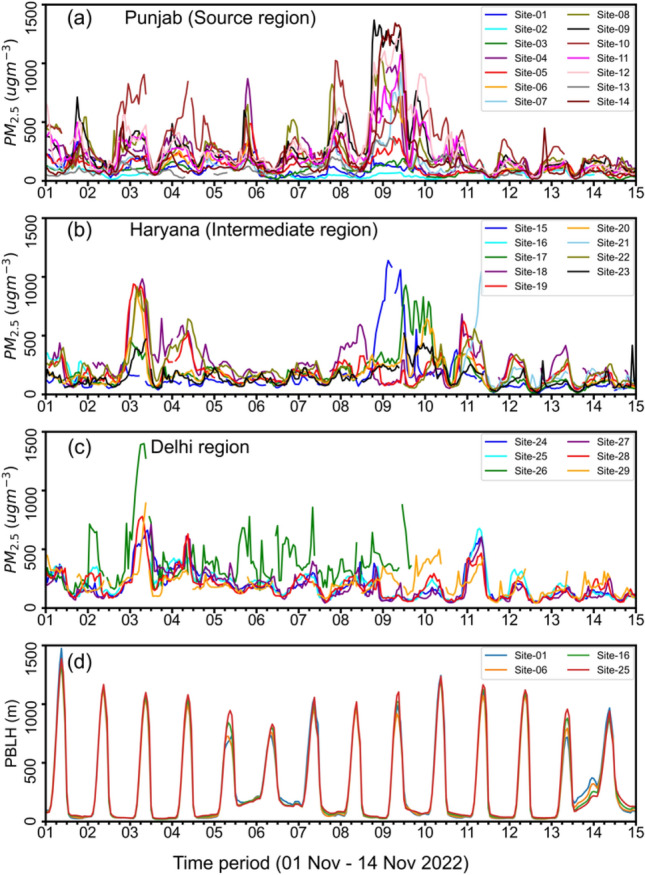
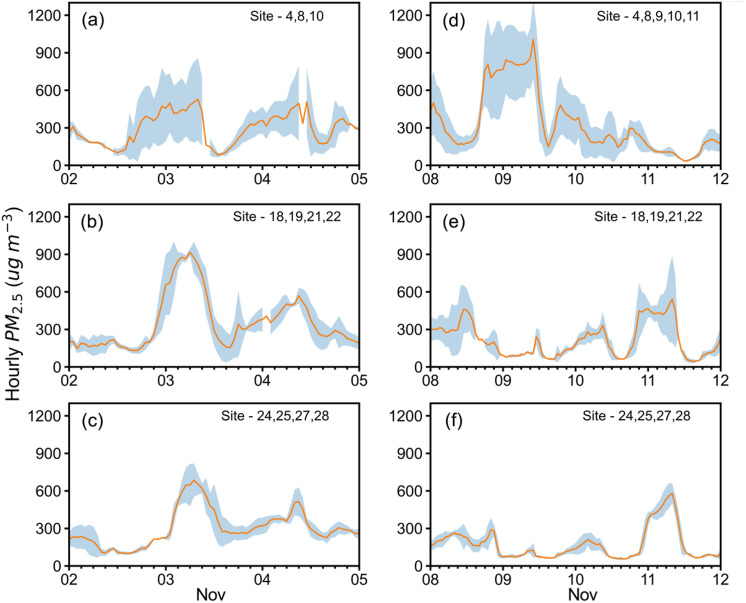
Exposure to particulate matter less than 2.5 µm in diameter (PM) is a cause of concern in cities and major emission regions of northern India. An intensive field campaign involving the states of Punjab, Haryana and Delhi national capital region (NCR) was conducted in 2022 using 29 Compact and Useful PM Instrument with Gas sensors (CUPI-Gs). Continuous observations show that the PM in the region increased gradually from < 60 µg m in 6-10 October to up to 500 µg m on 5-9 November, which subsequently decreased to about 100 µg m in 20-30 November. Two distinct plumes of PM over 500 µg m are tracked from crop residue burning in Punjab to Delhi NCR on 2-3 November and 10-11 November with delays of 1 and 3 days, respectively. Experimental campaign demonstrates the advantages of source region observations to link agricultural waste burning and air pollution at local to regional scales.
暴露于直径小于2.5微米的颗粒物(PM)是印度北部城市和主要排放地区令人担忧的一个问题。2022年,在旁遮普邦、哈里亚纳邦和德里国家首都辖区(NCR)开展了一项密集的实地考察活动,使用了29台配备气体传感器的紧凑型实用PM仪器(CUPI-Gs)。连续观测表明,该地区的PM在10月6日至10日从<60微克/立方米逐渐增加到11月5日至9日的高达500微克/立方米,随后在11月20日至30日降至约100微克/立方米。11月2日至3日和11月10日至11日,从旁遮普邦的作物秸秆焚烧源追踪到德里NCR的两个超过500微克/立方米的明显羽状物,延迟分别为1天和3天。实验活动证明了源区观测在将农业废弃物焚烧与地方到区域尺度的空气污染联系起来方面的优势。